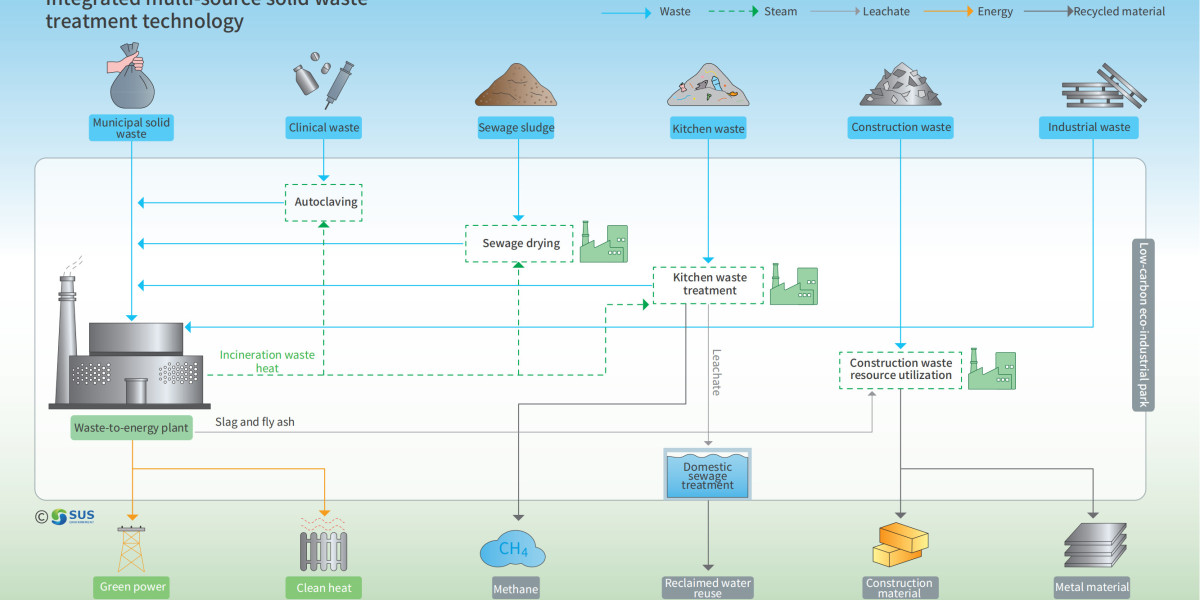

China’s waste-to-energy (WtE) strategy has become one of the most defining features of its modern environmental policy, driven by rapid urbanization, rising consumption, and the sheer scale of municipal solid waste generated by its 1.4 billion people. In 2020 alone, China produced more than 235 million tonnes of urban waste—over 600,000 tonnes every single day . Faced with overflowing landfills, methane emissions, and shrinking land resources, the country has turned aggressively toward WtE as both a disposal method and a clean-energy solution.To get more news about china waste to energy, you can visit en.shsus.com official website.
At its core, waste-to-energy refers to converting non‑recyclable waste into electricity or heat through combustion, gasification, pyrolysis, or anaerobic digestion. China overwhelmingly relies on large-scale incineration with energy recovery, aligning this approach with its long-term carbon neutrality pledge for 2060 . The appeal is obvious: WtE can reduce waste volume by up to 90%, cut methane emissions, and generate renewable electricity. But the deeper question—one I often find myself wrestling with—is whether this model represents genuine sustainability or simply a technologically sophisticated way to delay more fundamental reforms.
From an energy perspective, the numbers are staggering. China now operates more than 1,135 incineration plants, processing 1.1 million tons of waste daily and producing 27,000 MW of clean energy—more than half of the world’s total WtE capacity . These facilities have become a backbone of urban waste management, especially in megacities where land scarcity makes traditional landfills nearly impossible. The country’s WtE market, valued at $7.01 billion in 2024, is projected to grow to $16.48 billion by 2034, driven by rising electricity demand and strict environmental mandates datainsightsmarket.com.
Yet the environmental trade-offs are more complex than the headline numbers suggest. While WtE offers clear advantages over landfilling, it remains carbon‑intensive, especially due to the high proportion of plastic waste in China’s municipal streams. Research highlights that despite energy benefits, incineration still produces significant emissions unless paired with advanced sorting and high‑efficiency combustion technologies . This is where I believe China faces its biggest challenge: scaling WtE without locking itself into a future where burning waste becomes more convenient than reducing it.
One of the most fascinating dimensions of China’s WtE expansion is its growing international footprint. Chinese companies, having mastered large-scale construction and reduced equipment costs domestically, are now exporting their expertise abroad. In Central Asia, for example, Chinese firms are building WtE plants in Kazakhstan, Kyrgyzstan, and Uzbekistan, offering cost‑effective solutions to countries struggling with inadequate waste infrastructure . This outward push is partly driven by domestic overcapacity—China built WtE plants so quickly that supply began to outpace demand—but it also reflects Beijing’s broader strategy of exporting green technologies as part of its global development agenda.
Personally, I see this duality—domestic necessity and international ambition—as a defining feature of China’s environmental evolution. On one hand, WtE plants help cities breathe easier by reducing landfill reliance and generating clean energy. On the other, they risk becoming a crutch that slows progress toward recycling, waste reduction, and circular economy principles. The THRIVE Framework, often used to evaluate China’s WtE strategy, emphasizes materiality and systems thinking: solutions must address root causes, not just symptoms . In my view, China’s WtE system is powerful, but it must be paired with aggressive waste sorting, plastic reduction, and public education to avoid becoming a long-term environmental liability.
Still, it’s impossible to ignore the technological innovation emerging from this sector. At the 2025 Waste-to-Energy Technology Conference in Xi’an, Chinese researchers showcased AI‑powered combustion optimization, real‑time carbon monitoring, and advanced emissions control systems—tools that could significantly reduce the environmental footprint of incineration if widely adopted . These developments suggest that China is not merely scaling WtE but actively trying to refine it into a cleaner, smarter, and more transparent system.
Ultimately, China’s waste-to-energy journey is a story of scale, urgency, and ambition. It reflects a country grappling with the consequences of rapid modernization while trying to chart a sustainable path forward. Whether WtE becomes a bridge to a circular future or a long-term dependency will depend on how China balances incineration with deeper reforms in consumption, recycling, and environmental governance. For now, WtE remains both a symbol of China’s environmental progress and a reminder of the complex choices that lie ahead.