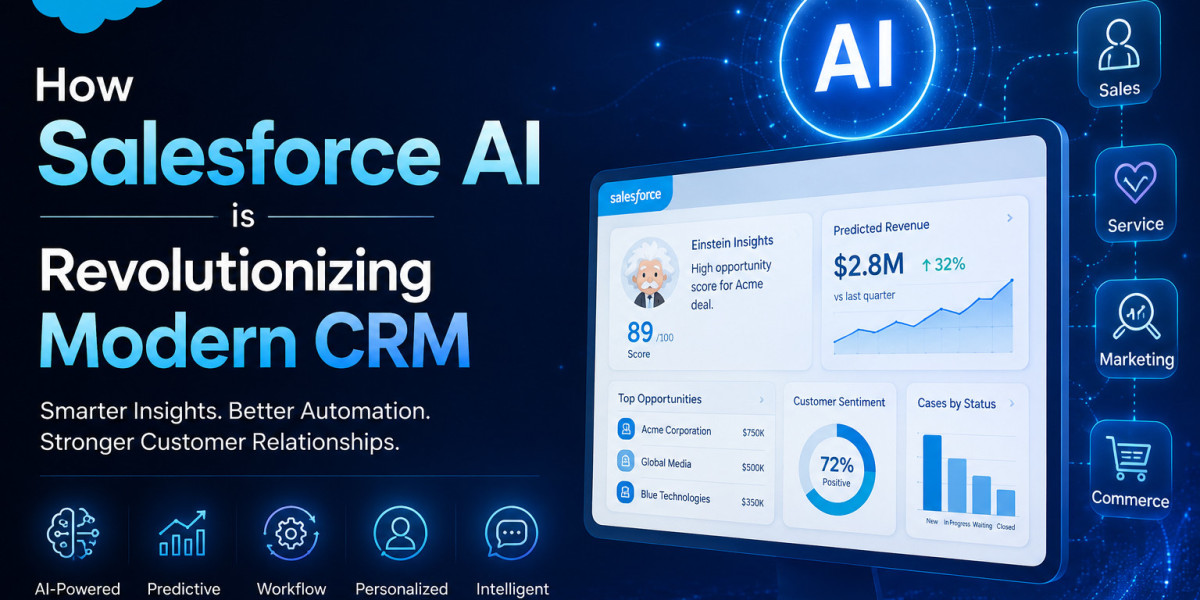

Customer expectations are changing rapidly in today’s digital world. Businesses are no longer competing only on products or pricing — they are competing on customer experience. To stay ahead, organizations need smarter systems that can analyze data, automate processes, and deliver highly personalized interactions. This is where Salesforce AI is transforming the future of Customer Relationship Management (CRM).
Salesforce AI combines artificial intelligence with CRM technology to help businesses improve decision-making, automate workflows, and create more meaningful customer experiences. From predictive analytics to AI-powered automation, Salesforce is redefining how companies manage customer relationships across sales, marketing, and customer service.
What is Salesforce AI?
Salesforce AI refers to the artificial intelligence capabilities integrated within the Salesforce ecosystem. It uses machine learning, predictive analytics, automation, and generative AI technologies to help businesses work smarter and faster.
Salesforce AI enables organizations to:
- Analyze customer behavior in real time
- Predict sales opportunities
- Automate repetitive tasks
- Improve customer support
- Deliver personalized marketing campaigns
- Generate actionable business insights
By combining AI with CRM data, businesses can make better decisions while improving operational efficiency.
Why AI is Becoming Essential in CRM
Traditional CRM systems mainly focus on storing customer information and tracking interactions. However, modern businesses require CRM platforms that can actively assist teams in identifying opportunities, reducing manual work, and enhancing customer engagement.
Artificial intelligence helps businesses:
- Understand customer preferences
- Predict future customer actions
- Automate workflows
- Improve sales forecasting
- Deliver faster customer support
- Personalize communication at scale
AI-driven CRM platforms are helping organizations move from reactive customer management to proactive engagement strategies.
Key Ways Salesforce AI is Revolutionizing CRM
1. Smarter Sales Forecasting
Sales forecasting is critical for business planning, but traditional forecasting methods often rely on manual analysis and assumptions.
Salesforce AI helps sales teams by:
- Predicting deal outcomes
- Identifying high-value opportunities
- Analyzing sales patterns
- Providing revenue forecasts in real time
This allows businesses to make more accurate decisions and improve sales performance.
2. Personalized Customer Experiences
Modern customers expect personalized experiences across every interaction. Salesforce AI analyzes customer behavior, purchase history, and engagement patterns to help businesses deliver tailored recommendations and communication.
Businesses can use AI to:
- Recommend relevant products
- Personalize email campaigns
- Deliver targeted offers
- Improve customer engagement strategies
Personalization helps businesses increase customer satisfaction and loyalty.
3. AI-Powered Customer Service
Customer support teams often manage large volumes of inquiries across multiple channels. Salesforce AI improves service operations by automating repetitive tasks and helping agents respond faster.
AI-powered customer service features include:
- Intelligent chatbots
- Automated case routing
- Suggested responses for agents
- Sentiment analysis
- Self-service support options
These capabilities help businesses reduce response times and improve customer experiences.
4. Intelligent Workflow Automation
Manual processes consume time and increase the risk of human error. Salesforce AI automates repetitive tasks, allowing teams to focus on strategic activities.
Automation examples include:
- Lead assignment
- Follow-up reminders
- Data entry automation
- Approval workflows
- Customer notifications
Automation improves productivity while reducing operational inefficiencies.
5. Predictive Analytics for Better Decision-Making
Salesforce AI helps businesses analyze large volumes of data to uncover trends and predict future outcomes.
Predictive analytics can help organizations:
- Identify churn risks
- Predict customer buying behavior
- Optimize marketing strategies
- Improve inventory planning
- Forecast customer demand
Data-driven insights help businesses make faster and smarter decisions.
Salesforce Einstein: The AI Engine Behind Salesforce
One of the most powerful AI solutions within Salesforce is Salesforce Einstein. It brings artificial intelligence directly into the Salesforce platform, helping users access AI-driven insights without requiring advanced technical expertise.
Salesforce Einstein offers features such as:
- Predictive lead scoring
- AI-generated recommendations
- Automated data capture
- Intelligent opportunity insights
- AI-powered analytics
- Generative AI content creation
Einstein helps businesses improve productivity and customer engagement across departments.
Benefits of Salesforce AI for Businesses
Increased Productivity
AI reduces manual work by automating repetitive processes, allowing employees to focus on higher-value tasks.
Improved Customer Retention
By understanding customer needs and behavior patterns, businesses can provide better support and personalized experiences that improve loyalty.
Faster Decision-Making
AI-powered insights help businesses identify opportunities and risks quickly, improving operational agility.
Better Sales Performance
Sales teams gain access to predictive insights that help prioritize leads and close deals more effectively.
Enhanced Marketing Efficiency
AI enables businesses to create highly targeted campaigns that improve engagement and conversion rates.
Industries Using Salesforce AI
Salesforce AI is being adopted across multiple industries, including:
- Healthcare
- Financial services
- Retail and e-commerce
- Manufacturing
- Technology
- Telecommunications
Organizations use AI-driven CRM tools to improve operational efficiency and customer experiences in industry-specific ways.
Challenges Businesses Should Consider
While Salesforce AI offers significant advantages, businesses should also prepare for implementation challenges.
Common challenges include:
- Data quality issues
- Employee training requirements
- Integration complexities
- AI adoption resistance
- Security and compliance concerns
A clear implementation strategy helps organizations maximize the benefits of Salesforce AI.
The Future of AI in CRM
Artificial intelligence will continue to shape the future of CRM technology. Businesses are increasingly investing in AI-powered automation, predictive analytics, and generative AI tools to improve customer experiences and operational performance.
Future trends in Salesforce AI may include:
- Advanced conversational AI
- Hyper-personalized customer journeys
- Autonomous workflow management
- Real-time predictive recommendations
- AI-driven business intelligence
Organizations that adopt AI-powered CRM solutions early will have a stronger competitive advantage in the evolving digital landscape.
Conclusion
Salesforce AI is revolutionizing modern CRM by helping businesses automate operations, improve decision-making, and deliver highly personalized customer experiences. From predictive analytics and intelligent automation to AI-powered customer support, Salesforce is transforming how organizations manage customer relationships.
As customer expectations continue to evolve, businesses need smarter CRM solutions that can adapt quickly and provide actionable insights. Salesforce AI empowers organizations to increase productivity, strengthen customer engagement, and drive long-term business growth.
Companies that embrace AI-driven CRM strategies today will be better prepared to compete in the future of digital business.