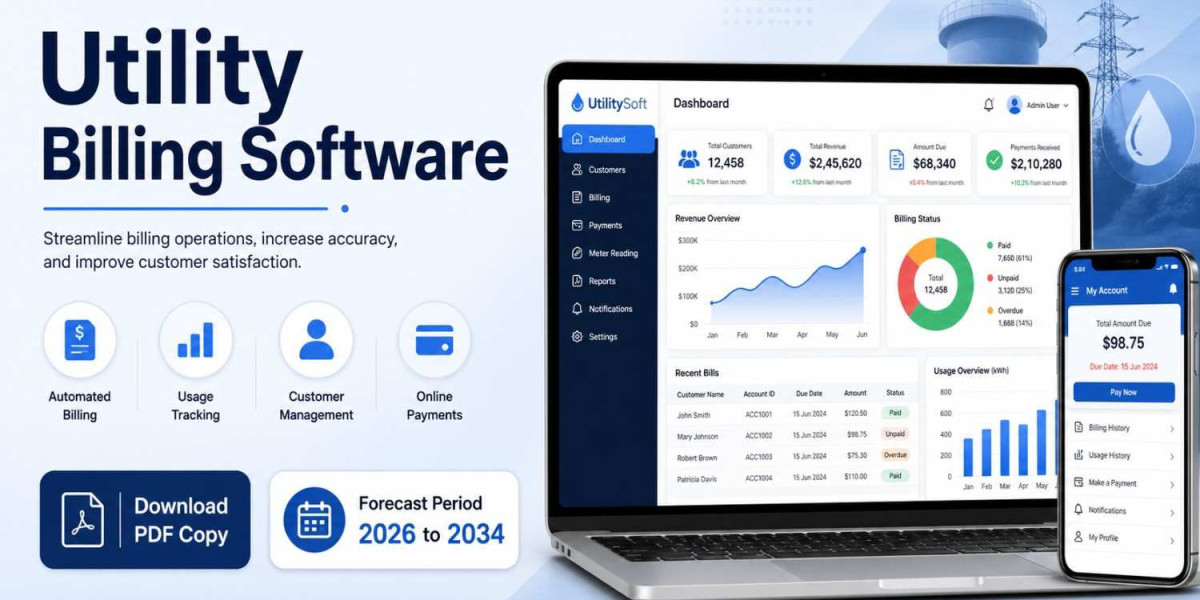

The global utility billing software market is undergoing a significant transformation as providers move away from traditional manual processes toward automated, cloud-based solutions. As of 2024, the industry is witnessing an unprecedented surge in demand driven by the need for operational efficiency and the rising complexity of modern energy grids.
The global utility billing software market size is projected to reach US$ 12.64 billion by 2034 from US$ 6.14 billion in 2025. The market is anticipated to register a CAGR of 8.36% during the forecast period 2026-2034.
Market Overview and Evolution
Utility billing software serves as the backbone of modern service providers. These platforms manage the end to end process of calculating consumption, generating invoices, and processing payments. The evolution of this market is closely tied to the global shift toward smart cities and the digitization of public infrastructure.
In the coming decade, the shift from legacy on-premise systems to Software as a Service (SaaS) models will be the primary catalyst for growth. Utility companies are increasingly seeking scalable solutions that can handle massive datasets generated by smart meters. By 2034, the integration of Internet of Things (IoT) devices with billing software will be standard, allowing for real time data synchronization and highly accurate billing cycles that reduce disputes and improve customer satisfaction.
Market Report Scope
The scope of the utility billing software market is expansive, covering various deployment models, end user segments, and geographic regions.
By Deployment Type: The market is bifurcated into cloud-based and on-premise solutions. While on-premise systems still exist among large, established entities, the cloud segment is expected to dominate the market share by 2034 due to lower upfront costs and ease of remote management.
By Application: The software caters to several verticals, including electricity, water and wastewater, and gas. The electricity segment currently holds a significant share, but the water utility segment is expected to see rapid growth as municipalities invest in digital infrastructure to combat water scarcity.
By End User: The market serves both public and private utility providers. Small to medium-sized enterprises (SMEs) are emerging as a high growth segment as they adopt cost effective cloud billing platforms to compete with larger players.
By Region: North America and Europe remain the leading markets due to early adoption of smart grid technologies. However, the Asia Pacific region is anticipated to record the highest compound annual growth rate through 2034, fueled by massive urbanization and government initiatives in countries like India and China.
Key Market Drivers and Trends
Several factors are steering the utility billing software market toward its 2034 valuation.
First, the rise of renewable energy sources is complicating the billing landscape. With more consumers becoming "prosumers" (those who both consume and produce energy via solar panels), billing software must now handle "net metering." This requires two way communication and complex calculations that only advanced software can manage.
Second, there is a growing emphasis on customer experience. Modern consumers expect mobile app integration, multiple payment gateways, and real time usage notifications. Utility providers are investing in software that offers self service portals to reduce the burden on call centers and improve the overall user journey.
Third, regulatory compliance is becoming more stringent. Governments are mandating transparent billing practices and better data security. Modern billing platforms are designed with built in compliance modules that automatically update to reflect local and national regulations, mitigating the risk of legal penalties for utility providers.
Download Sample PDF Report@ https://www.theinsightpartners.com/sample/TIPRE00011385
Competitive Landscape and Top Players
The market is characterized by intense competition among established tech giants and specialized niche providers. These companies are focusing on mergers, acquisitions, and continuous product innovation to maintain their market positions.
Key players driving the market toward 2034 include:
- Oracle Corporation: Known for its comprehensive "Oracle Utilities" suite, the company provides robust, scalable solutions for large scale utility providers worldwide.
- SAP SE: A leader in enterprise resource planning, SAP offers integrated billing solutions that connect meter data to financial accounting.
- Itron Inc.: A specialist in energy and water management, Itron focuses heavily on the integration of smart meters with billing intelligence.
- Enghouse Networks: This player provides agile billing solutions tailored for multi service utilities, focusing on digital transformation.
- Hansen Technologies: A global provider of billing and customer care software that specializes in the energy and water sectors.
- VertexOne: Known for its cloud based customer information systems (CIS) and billing platforms specifically designed for the mid market.
Future Outlook
Looking toward 2034, the utility billing software market will move toward a fully autonomous ecosystem. We can expect the implementation of blockchain technology to facilitate secure, peer to peer energy trading and automated billing through smart contracts. Data analytics will evolve from simple reporting to predictive modeling, allowing utility providers to forecast demand and adjust pricing strategies dynamically.
The focus will shift from simple "meter to cash" processes to holistic "resource management." As sustainability becomes a global priority, billing software will play a crucial role in incentivizing conservation through tiered pricing and carbon footprint tracking on individual invoices. The next decade will define a new era where utility billing is no longer a back office function but a strategic tool for environmental and economic management.
Frequently Asked Questions
1. What is the primary benefit of cloud based utility billing software over on-premise versions?
Cloud based solutions offer greater flexibility, lower initial capital expenditure, and automatic updates. They allow utility providers to access data from any location and scale their operations quickly without the need for extensive physical hardware.
2. How does smart meter integration affect the billing software market?
Smart meters provide a continuous flow of real time data. This requires billing software to have high processing power and advanced analytics capabilities to turn raw data into accurate, time of use invoices, which is a major driver for software upgrades.
3. Will AI play a role in utility billing by 2034?
Yes, AI will be central to the industry by 2034. It will be used for automated debt collection, detecting billing anomalies, predicting customer churn, and providing personalized energy saving recommendations to consumers through the billing portal.
The Insight Partners provides comprehensive syndicated and tailored market research services in the healthcare, technology, and industrial domains. Renowned for delivering strategic intelligence and practical insights, the firm empowers businesses to remain competitive in ever-evolving global markets.
• Email: sales@theinsightpartners.com
• Website: theinsightpartners.com
• Phone: +1-646-491-9876
Also Available in: Korean|German|Japanese|French|Chinese|Italian|Spanish