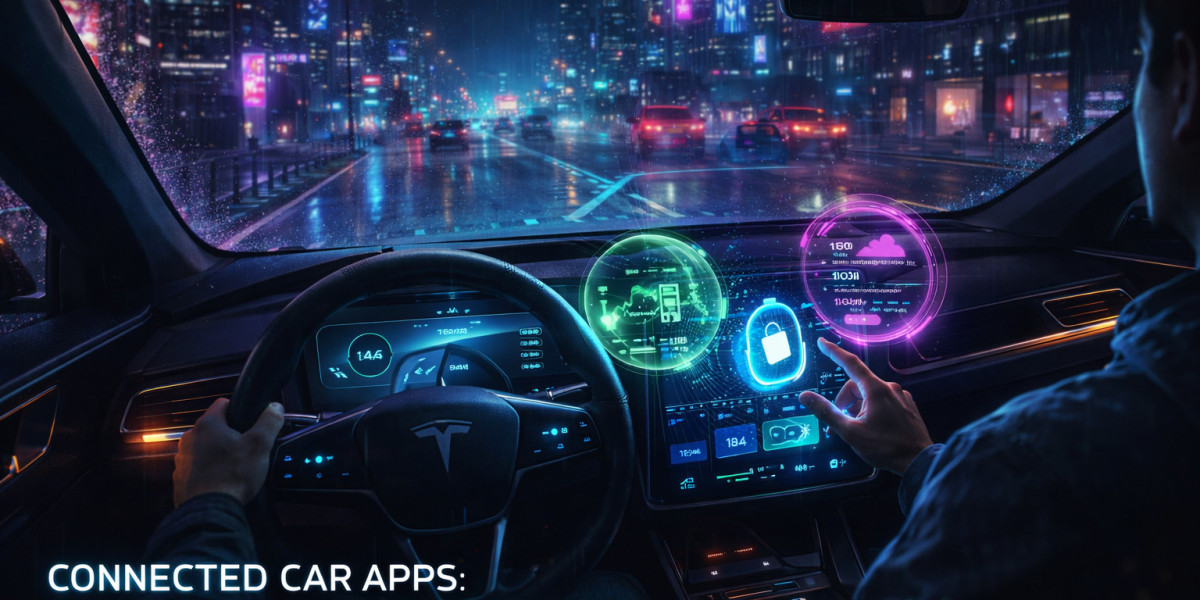

The automotive industry has reached a tipping point where software is no longer a peripheral feature; it is the core of the driving experience. In early 2026, the discussion around Connected Car Apps: What Drivers Actually Want 2026 has shifted from novelty gadgets to essential utility. For automakers and developers, understanding this shift is the difference between a high-retention digital ecosystem and a "ghost app" that users delete after the first week of ownership.
Drivers in 2026 are increasingly sophisticated. They are moving away from the "more is better" philosophy of the early 2020s, opting instead for deep integration, biometric security, and predictive maintenance. This article explores the current state of vehicle connectivity and identifies the specific digital requirements that define the modern driver's expectations.
The 2026 Connectivity Landscape: Beyond the Basics
As of early 2026, the "connected car" is no longer just a vehicle with a Wi-Fi hotspot. According to the S&P Global Mobility 2025 Report, over 90% of new vehicles sold globally now feature some form of embedded connectivity. However, quantity has not always equaled quality.
The primary friction point for users today remains the disconnect between the smartphone and the head unit. While Apple CarPlay and Android Auto remain dominant, many OEMs (Original Equipment Manufacturers) are attempting to reclaim the dashboard with proprietary OS environments. This "OS War" has created a fragmented experience where drivers often find themselves managing three different interfaces just to play a podcast or navigate to a charging station.
The Definition of Value in 2026
For a connected car app to be considered valuable in 2026, it must solve a problem faster than a physical button or a smartphone could. If a driver has to dig through three sub-menus to adjust the lumbar support, the app has failed. Success in this space requires a "Zero-UI" mindset—where the app anticipates needs based on context, such as pre-conditioning the cabin based on a calendar invite or suggesting a route change due to real-time grid-load data for EVs.
Essential Features: What Drivers Prioritize Now
Based on consumer sentiment data from the 2025 J.D. Power Automotive Performance, Execution and Layout (APEAL) Study, three specific pillars have emerged as non-negotiable for the 2026 driver.
1. Unified Energy Management (EV-First)
With EV adoption rates continuing to climb, the most sought-after app feature is accurate, real-time energy management. Drivers no longer want just a "percentage" of battery; they want predictive range modeling that accounts for current elevation, ambient temperature, and even the degradation of the battery over time.
2. Biometric Entry and "Phone-as-a-Key" (PaaK)
The physical key fob is becoming a legacy item. In 2026, drivers expect ultra-wideband (UWB) technology to allow for hands-free entry. The app must function as a secure vault that enables:
Remote Valet Mode: Limiting speed and trunk access via the app.
Digital Key Sharing: Sending a temporary "key" to a friend’s phone via encrypted messaging.
Biometric Start: Using FaceID or fingerprint sensors on the phone to authorize the vehicle start sequence.
3. Proactive Maintenance Alerts
Drivers are looking for apps that act as a "health monitor" for the vehicle. Instead of a vague "Check Engine" light, a high-quality Android App Development Company in the USA would focus on creating interfaces that explain the specific fault code, the estimated cost of repair, and the ability to book a service appointment directly through the interface.
The Privacy Paradox: Data for Convenience
One of the most significant shifts in Connected Car Apps: What Drivers Actually Want 2026 is the increased scrutiny of data privacy. Following several high-profile data leaks in 2024 involving driver behavior profiles, users are demanding "Privacy by Design."
Transparency: Drivers want a "Data Nutrition Label" that clearly states what is being tracked (GPS, speed, in-cabin voice) and who it is being sold to.
Granular Control: The ability to opt-out of insurance-telemetry tracking without losing access to safety features like emergency roadside assistance.
Local Processing: A preference for voice commands and biometric data to be processed "on the edge" (within the car's hardware) rather than in the cloud.
Real-World Implementation: Success vs. Friction
Consider the contrast between two hypothetical (but common) implementation strategies in the 2026 market.
Scenario A: The Proprietary "Walled Garden"
A legacy automaker decides to block smartphone mirroring to force users into a subscription-based navigation app.
Outcome: High initial churn. Drivers report frustration at having to pay $15/month for a map that is less accurate than the free version on their phone.
Result: The automaker sees a 20% drop in "Brand Loyalty" metrics in year-over-year surveys.
Scenario B: The Integrated Ecosystem
A brand partners with a top-tier Android App Development Company in the USA to build an app that syncs with the user's existing Google or Apple ecosystem while providing exclusive vehicle-deep data (like tire pressure and fluid levels).
Outcome: Seamless transition. The driver's "Work" and "Home" locations are already there, and the car's native app handles the heavy lifting of battery pre-conditioning.
Result: High engagement and increased take-rate for premium connected services.
AI Tools and Resources
In the development and optimization of connected car ecosystems, several AI-driven tools are currently shaping how these apps function in 2026.
NVIDIA DRIVE Concierge — AI framework for in-car digital assistants.
Best for: Creating natural language interfaces that control vehicle hardware.
Why it matters: Allows drivers to use conversational speech (e.g., "I'm feeling a bit cold") instead of specific commands.
Who should skip it: Budget-tier vehicle manufacturers with limited compute hardware.
2026 status: Widely adopted by premium European and North American OEMs.
Mapbox ADAS — AI-powered map data for Advanced Driver Assistance Systems.
Best for: Providing lane-level accuracy for semi-autonomous driving features.
Why it matters: Essential for "Connected Car Apps" that offer hands-free highway driving.
Who should skip it: Simple city-commuter apps that don't interface with steering or speed.
2026 status: Current industry standard for high-definition mapping.
Sonatus Vehicle Platform — Software-defined vehicle infrastructure.
Best for: Managing over-the-air (OTA) updates and data collection.
Why it matters: Ensures the app stays updated without requiring a trip to the dealership.
Who should skip it: Manufacturers still using legacy "fixed-function" hardware architectures.
2026 status: Rapidly expanding into the mid-market SUV segment.
Risks and Limitations: When Connectivity Fails
Despite the technological leaps, there are inherent risks in the "Software-Defined Vehicle" (SDV) era.
When Connectivity Fails: The "Dead Zone" Scenario
Imagine a driver in a remote mountainous region with no cellular service. They have relied entirely on their phone-as-a-key app and have left their physical key at home.
- Warning signs: The app shows "Offline" status; Bluetooth handshake takes longer than 10 seconds.
- Why it happens: Over-reliance on cloud-based authentication rather than local-token validation. If the app requires a "ping" to a server to verify a digital key, the driver is effectively locked out of their own car in a dead zone.
- Alternative approach: Developers must implement "Offline-First" protocols where the security token is stored in the phone’s Secure Element and the car’s local storage, allowing for Bluetooth/NFC entry without a cell signal.
Execution Failure: The Subscription Fatigue Many brands are attempting to gatekeep hardware features (like heated seats or increased horsepower) behind app-based monthly payments.
The Risk: This creates significant "Brand Resentment." In 2026, we are seeing a "Right to Repair" and "Right to Ownership" movement where consumers are legally challenging the pay-walling of hardware they have already purchased.
Key Takeaways for 2026
Utility Over Novelty: Drivers want apps that simplify the ownership experience, not apps that offer social media integration on the dashboard.
Seamlessness is Mandatory: If the vehicle app does not communicate perfectly with the user's smartphone ecosystem, it will be ignored.
Privacy is a Product Feature: Transparent data handling is no longer a legal checkbox; it is a competitive advantage that builds brand trust.
Energy Intelligence: For the 2026 EV market, accurate, predictive charging and range data is the #1 requested feature.
The future of Connected Car Apps: What Drivers Actually Want 2026 is defined by invisible technology. The best apps are the ones the driver doesn't have to "use"—they simply work in the background to ensure the car is charged, the cabin is comfortable, and the journey is safe.