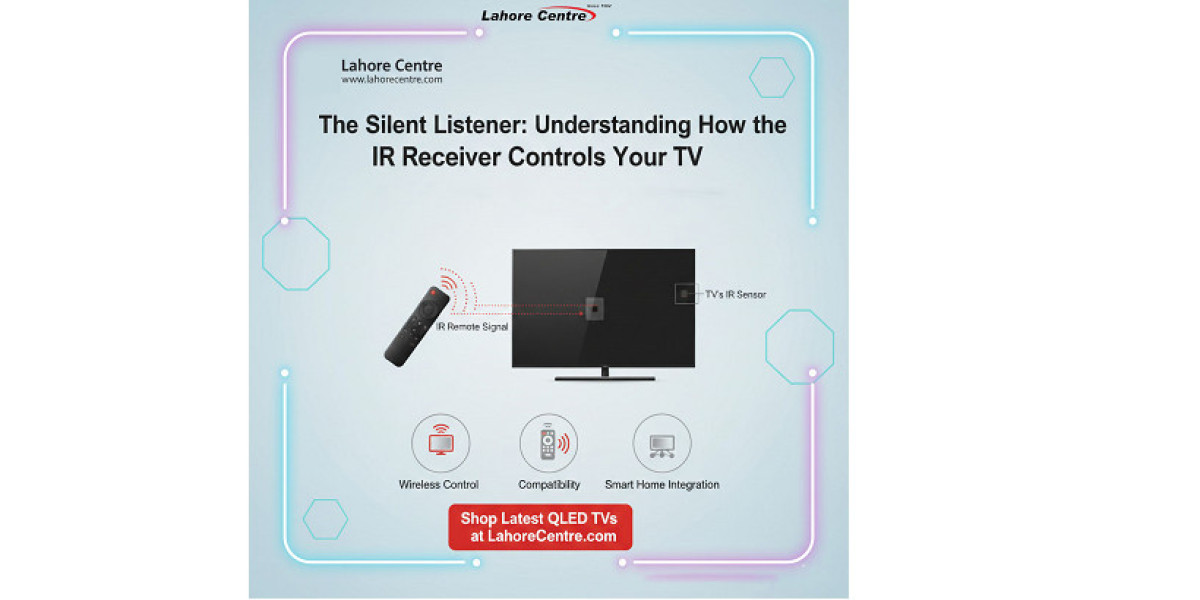

How the IR Receiver Controls Your TV?
In the world of high-tech home entertainment, we often marvel at 8K resolutions, AI-driven processors, and ultra-thin displays. However, there is a tiny, unassuming component that has remained the backbone of the television experience for decades: the IR (Infrared) Receiver. This "silent listener" is the gateway between your physical commands and the digital brain of your LED TV. While we are seeing a massive shift toward Bluetooth and voice-activated remotes in 2026, the IR receiver remains an essential feature for universal compatibility and fallback reliability. Whether you are adjusting the volume on a budget-friendly model or navigating the menus of a flagship screen, the science of infrared light is what makes that wireless magic happen. Understanding this component is key to getting the most out of your hardware, especially when considering the current Led price and the technology packed into modern sets.
The Science of Invisible Light: How IR Communication Works
The IR receiver is essentially a specialized photodiode tuned to a specific wavelength of lighttypically around 940 nanometers. This light is completely invisible to the human eye, sitting just beyond the red end of the visible spectrum. When you press a button on your remote, an LED in the remotes tip flashes in a specific coded pattern, much like Morse code. The Smart LED TV has its receiver waiting and "listening" for these flashes. To prevent interference from other light sources like sunlight or light bulbs, these signals are usually modulated at a frequency of 38 kHz. The receiver filters out everything else and only passes that specific 38 kHz pattern to the TVs microprocessor, which then translates the "Morse code" into a command like "Power Off" or "Channel Up."
Placement and Aesthetics in Modern Displays
In the past, IR receivers were often housed in bulky, visible red windows on the front of the television. In 2026, the design language has shifted toward a "bezel-less" look. On a modern Samsung LED TV, the IR receiver is often hidden behind a tiny, translucent part of the frame or integrated into the physical power button module located underneath the screen. This allows for a clean, uninterrupted aesthetic without sacrificing functionality. Because IR technology requires a direct "line of sight," manufacturers must be incredibly clever about where they place this sensor to ensure it can still pick up signals reflected off walls or ceilings, even if the remote isn't pointed directly at the "eye" of the TV.
IR vs. Bluetooth: Why Both Still Matter in 2026
You might wonder why we still use infrared when Bluetooth technology is so prevalent. When you use a Samsung Smart LED, you might notice the remote works even from another roomthat is the Bluetooth at work. However, the IR receiver is kept as a vital secondary system. IR is incredibly energy-efficient, allowing a remote to last for years on a single set of batteries. Furthermore, IR requires no "pairing" process; it works the instant you point and click. This makes it the universal standard for third-party remotes and home automation hubs. Having both systems ensures that even if your Bluetooth connection drops or needs re-pairing, you are never locked out of your television's core functions.
Reliability and the Dawlance Engineering Edge
Brands like Dawlance have optimized their sensor technology to handle the specific environmental challenges of South Asian homes, where bright sunlight can often flood a room. A Dawlance LED TV features high-sensitivity IR modules that use advanced optical filters to ignore the IR noise generated by the sun. This prevents the "unresponsive remote" syndrome that many cheaper TVs suffer from during the daytime. By focusing on the quality of these small components, Dawlance ensures that the user experience remains frustration-free, proving that even the most basic parts of a TV deserve high-end engineering.
The LG Smart Interface and Sensor Integration
LG has taken a hybrid approach with its Magic Remote system. While the primary navigation uses a gyroscope and Bluetooth, the LG LED TV still utilizes its IR receiver for the initial "Power On" command and for controlling legacy devices like older DVD players or soundbars. This "Universal Control" feature is a highlight of the LG smart LED ecosystem, where the TVs IR receiver can actually learn and repeat codes from other remotes. It turns the TV into a central command hub for your entire living room, reducing the "remote clutter" that often plagues modern home theaters.
Troubleshooting the IR Receiver: The Smartphone Trick
If your TCL LED TV stops responding to the remote, the IR receiver is one of the first things to check. A common DIY trick is to use your smartphones camera. Point your remote at the camera lens and press a button; you will see a flickering light on your phone's screen that your eyes can't see. If the remote is flashing but the TCL Android LED isn't responding, the issue likely lies with the TV's internal sensor. Sometimes, dust buildup on the sensor window or a blocked line of sight from a soundbar can be the culprit. At Lahore Centre, our technicians often find that a simple cleaning of the sensor area can restore a TV to perfect working order.
TCLs Smart Sensor Evolution
TCL has been at the forefront of integrating AI with traditional sensors. In a high-end TCL Smart LED, the IR receiver is sometimes paired with an ambient light sensor. This allows the TV to not only listen for remote commands but also sense the light levels in the room to adjust the screen brightness automatically. This dual-purpose sensor module saves space inside the chassis and allows for a more responsive "Smart" experience. As software becomes more complex, the hardwareincluding the IR receivermust become more efficient, and TCLs 2026 lineup is a testament to this evolution in component design.
Haiers Focus on Durable Components
Durability is a key concern for consumers in Pakistan, and Haier addresses this by using reinforced IR modules. A Haier LED TV is built to withstand voltage fluctuations that can sometimes "fry" sensitive sensors. Their IR receivers are protected by surge-resistant circuitry, ensuring that the "silent listener" doesn't go deaf after a power spike. This commitment to longevity is why Haier remains a top choice for families. When you shop at Lahore Centre, you can see these robust designs in person and understand why internal part quality is just as important as the screen size.
The Future of the IR Receiver in 2026 and Beyond
Looking ahead, we are seeing the rise of "IR Blasters" and IoT (Internet of Things) integration. Many smart TVs can now send IR signals out to other devices, allowing you to control your air conditioner or satellite box through the TV's menu. The IR receiver is evolving from a simple input device into a part of a wider communication network. Even as we move toward purely digital, voice-controlled homes, the simplicity and reliability of infrared mean that the IR receiver will likely be a part of our televisions for another decade. It is a proven technology that works every time, without the need for an internet connection or complex pairing.
Conclusion: Respecting the Smallest Components
In the quest for the best possible viewing experience, it is easy to overlook the IR receiver. Yet, it is the component that enables the very first interaction you have with your TV every day. From the sophisticated filtering in a Samsung to the durable modules in a Haier, the IR receiver is a perfect example of how mature technology can still play a vital role in a modern, smart world. When you choose your next TV, remember that the "silent listener" is working hard behind the scenes to ensure your commands are heard loud and clear. Visit us at Lahore Centre to explore the latest models and see how these tiny sensors are making our smart homes more intuitive than ever before.
Frequently Asked Questions (FAQs)
Q1: Why does my remote only work when I point it directly at a certain spot?
This is because IR is a "line of sight" technology. The signal moves in a straight line and can be blocked by obstacles. If you have to point it at a specific spot, that is where the IR receiver is located.
Q2: Can bright sunlight stop my TV remote from working?
Yes. Sunlight contains a vast amount of infrared radiation.If direct sunlight hits the TVs IR receiver, it can "drown out" the signal from your remote, making the TV seem unresponsive.
Q3: Is an IR receiver different from a Bluetooth remote?
Yes.An IR receiver uses light pulses and requires a clear path. A Bluetooth remote uses radio waves, which can pass through walls and don't require you to point the remote at the TV.
Q4: My TV has a Bluetooth remote; does it still have an IR receiver?
Almost certainly.Most Smart TVs keep an IR receiver for "Universal Remotes" and as a backup in case the Bluetooth remote loses its pairing.
Q5: Can I replace a broken IR receiver?
Yes. On most TVs, the IR receiver is a small, replaceable board. However, it requires opening the TV, so it is usually best to have it serviced by a professional at a location like Lahore Centre.