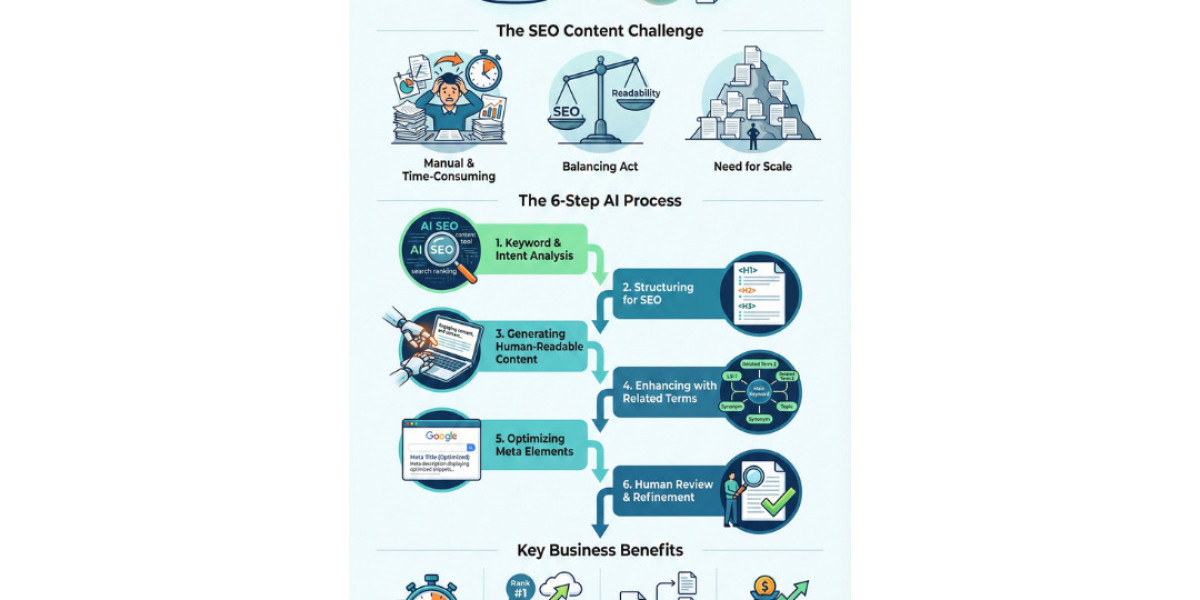

An AI SEO content generator produces content that is specifically designed to perform well in search engines while remaining readable and informative for users. By analyzing search intent, keyword patterns, and content structure, it helps businesses generate optimized articles, blogs, and web pages efficiently without sacrificing clarity or quality. This approach supports both content scale and search visibility.
Why businesses need search-focused content
Effective search-focused content is critical for driving organic traffic and engaging target audiences. Many businesses face challenges when producing such content manually.
Common problems include:
Difficulty keeping content aligned with current search trends
Manual keyword research and placement is time consuming
Maintaining readability while meeting SEO requirements
Large volumes of content needed for blogs, landing pages, or product pages
Risk of inconsistent tone and structure across multiple authors
These challenges can result in lower rankings, fewer clicks, and wasted marketing effort. An ai seo content generator addresses these by automating content creation while integrating SEO best practices.
How an AI SEO content generator works
Unlike traditional content creation, an AI SEO content generator uses advanced algorithms to combine keyword strategy, search intent analysis, and natural language generation. The process can be broken down into the following steps:
Step 1: Keyword and search intent analysis
The generator starts by analyzing the primary keyword, related terms, and search intent. It identifies what users are looking for and the type of content that ranks well.
For example, for the keyword “AI SEO content generator,” the tool identifies that users are searching for explanations, benefits, use cases, and operational workflows.
This ensures the content aligns with what the audience actually wants to read.
Step 2: Structuring content for SEO
The AI develops an outline based on best practices for SEO. This includes headings, subheadings, and content sections optimized for keyword placement.
Common elements include:
H1 for main topics
H2 and H3 for subtopics and FAQs
Keyword density and placement analysis
Internal linking suggestions for website context
This structure improves search engine comprehension and user experience simultaneously.
Step 3: Generating human-readable content
The AI writes full paragraphs under each heading while balancing keyword integration and natural readability.
For instance, it avoids overloading a paragraph with the target keyword while still keeping it present in the right context. Sentences are varied in structure to make the content flow naturally.
Step 4: Enhancing with related terms and LSI keywords
To strengthen SEO, AI adds semantically related keywords and phrases. These terms improve search engine understanding of the content topic.
Example: For “AI SEO content generator,” related terms may include “automated SEO writing,” “keyword optimization tool,” and “search-friendly content creation.” Including these terms improves ranking potential without keyword stuffing.
Step 5: Optimization for meta and on-page elements
Many AI tools also suggest meta titles, meta descriptions, and alt text for images. These elements help search engines understand the content and improve click-through rates.
A blog post or landing page can be fully optimized in one go, saving hours of manual adjustments.
Step 6: Review and human refinement
Even with AI, human review is essential to ensure accuracy, tone, and context relevance. This includes checking:
Fact correctness
Brand alignment
Readability for target audiences
The review process is faster than creating content manually from scratch, while ensuring quality remains high.
How AI keeps content unique and relevant
The AI ensures each article is original and tailored by:
Dynamic sentence generation: Avoids repeating text from other sources
Context aware phrasing: Adjusts wording to match the topic and intent
Data-driven updates: Integrates new trends and keywords for relevance
Controlled variation: Produces different content formats, headings, and paragraph structures for uniqueness
Even when multiple articles are generated on similar topics, each remains distinct and search-friendly.
Business benefits of AI SEO content generators
Companies adopting AI for SEO content creation report measurable advantages:
Time savings: Reduces content drafting time by 60 to 80 percent
Improved search rankings: Better keyword integration and structure increases organic visibility
Content scalability: Hundreds of blog posts, landing pages, or product pages can be produced quickly
Consistency: Maintains tone, style, and formatting across large volumes of content
Cost efficiency: Reduces reliance on large content teams or outsourcing for high-volume projects
For example, an e-commerce company generating 200 product pages per month found AI assistance reduced writing hours by 75 percent while improving search discoverability.
Practical situations to use AI SEO content generators
Businesses often see the most benefit in scenarios such as:
Launching a content marketing campaign with multiple blogs or landing pages
Updating existing content to match current search trends
Expanding keyword-focused content for new products or services
Scaling content across multiple regions or languages
Maintaining consistent on-page SEO across hundreds of product or service pages
In these cases, AI ensures content creation keeps pace with business growth while remaining search-friendly.
Considerations for optimal outcomes
While AI can handle most SEO content tasks, certain factors improve effectiveness:
Human review: Ensures factual accuracy, tone, and contextual relevance
Quality inputs: Correct keywords, topic data, and search intent information improve output quality
Regular updates: Incorporating new search trends keeps content relevant
Category-specific templates: Tailoring structure to content type ensures better SEO performance
Using these considerations, businesses can achieve faster, higher-quality results with AI-generated SEO content.
Conclusion
An ai seo content generator creates search-focused content by analyzing keywords, understanding search intent, structuring text for SEO, and producing readable, original articles. Businesses benefit from faster content production, improved search performance, and scalable output. With human review, AI ensures both accuracy and search visibility, making it a reliable tool for modern digital marketing strategies.
FAQs
Q.1 How does an ai seo content generator work
Ans: It combines keyword analysis, search intent, content structuring, and natural language generation to produce unique, search-friendly articles.
Q.2 Can AI content rank well on search engines
Ans: Yes, when properly optimized with keywords, headings, meta elements, and reviewed for accuracy, it can improve organic visibility.
Q.3 Is human input required after AI writing
Ans: Yes, human review ensures factual accuracy, readability, and brand alignment before publication.
Q.4 How fast can AI generate SEO content
Ans: AI tools can produce multiple articles, landing pages, or blog posts in hours, significantly reducing manual writing time.