
Introduction
The meeting room was quiet, almost uncomfortably so. Three siblings sat around a polished table, folders unopened, eyes avoiding each other. Their father had built a thriving enterprise from nothing. He had assumed that success would naturally carry forward. What he had not planned for was what would happen after he was gone.
This moment, filled with uncertainty and unspoken tension, is where succession planning truly begins.
Across the UAE, similar stories unfold every year. Families with strong businesses, valuable assets, and good intentions find themselves unprepared for transition. This is why the conversation around RAK ICC Foundation vs Company has moved from a technical discussion to a deeply personal one.
At Dubai Business and Tax Advisors, succession planning is not treated as a legal formality. It is approached as a narrative that must continue smoothly, even when the original author is no longer present.
Why Families Are Rethinking Succession in the UAE
The UAE has become a global hub for entrepreneurs, investors, and family offices. With this growth comes complexity. Families are no longer confined to one jurisdiction. Children are educated abroad. Assets span countries. Family structures evolve.
In this environment, informal promises are no longer enough. Clear frameworks are essential. This is where Family wealth planning UAE plays a defining role.
Succession planning is no longer about dividing assets. It is about preserving values, ensuring continuity, and protecting relationships. The choice of structure determines whether wealth becomes a bridge or a barrier between generations.
The Traditional Path: Understanding the RAK ICC Company
For decades, the RAK ICC Company has been the default choice for asset holding and business ownership. It is familiar, widely accepted, and operationally efficient. Entrepreneurs understand companies. They know how directors function, how shares are issued, and how profits flow.
In a company structure, ownership is clear. Shareholders hold equity. Directors manage operations. Decisions are made through resolutions. For active businesses, this clarity is valuable.
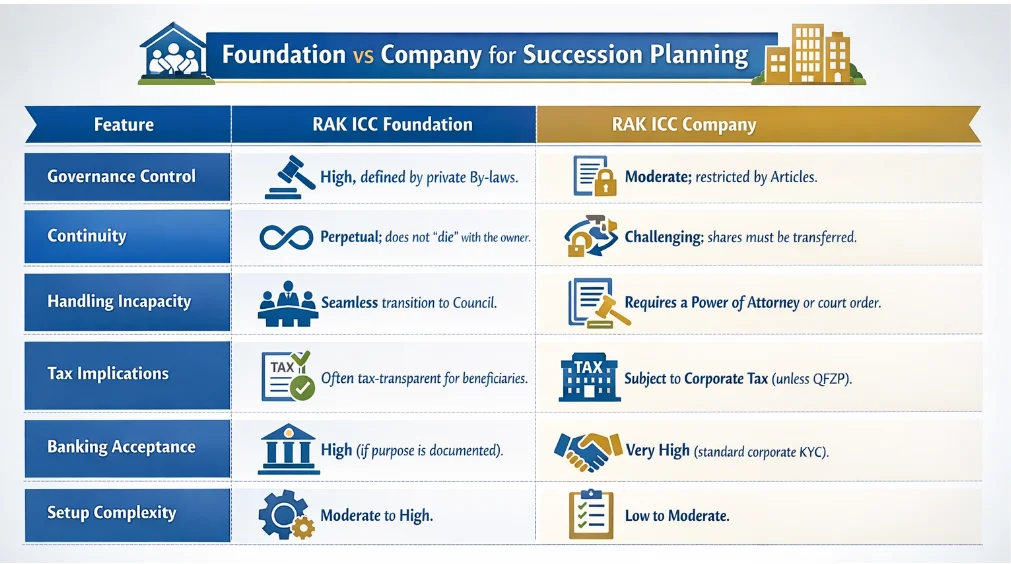
However, companies are built for commerce, not continuity. When a shareholder passes away, shares must transfer. That process can trigger inheritance procedures, regulatory reviews, and family disagreements. During this period, control may be unclear, and operations can suffer.
Many families assume these issues will resolve themselves. Experience shows they rarely do.
A Different Philosophy: The RAK ICC Foundation
A RAK ICC Foundation introduces a fundamentally different way of thinking. Instead of asking who owns the assets, it asks how the assets should serve the family over time.
As an Offshore foundation UAE structure, a foundation is a standalone legal entity with no shareholders. Assets belong to the foundation itself. Governance is handled by a Council, guided by rules defined by the founder.
This distinction allows founders to separate control from benefit. Beneficiaries receive value, but governance follows predefined principles. This makes foundations uniquely powerful for long-term Legacy planning UAE.
Rather than reacting to life events, a foundation anticipates them.
A Story of Two Outcomes
Consider two families with similar wealth and values.
The first family relied solely on a company. Shares were divided equally among heirs. No governance framework was established. Over time, differences in ambition, financial need, and risk tolerance created friction. Decisions stalled. Trust eroded.
The second family implemented a foundation. The foundation owned the operating company. Clear rules defined who could manage, who could benefit, and under what conditions. Distributions were structured. Decision-making authority was assigned based on capability, not emotion.
Years later, the difference was visible. One family struggled with conflict. The other focused on growth.
This is the lived reality behind RAK ICC Foundation vs Company.
Governance as the Backbone of Continuity
Most succession challenges are not legal failures. They are governance failures.
A RAK ICC Foundation allows families to design governance systems that evolve. These systems can include:
Clear decision-making hierarchies
Defined roles for family members
Conditions for distributions
Safeguards for vulnerable beneficiaries
Oversight mechanisms to prevent abuse
By contrast, a RAK ICC Company relies on shareholder agreements that often become outdated or ignored. While these agreements can help, they rarely address emotional dynamics or long-term family evolution.
Modern RAK ICC succession structures prioritize governance as much as ownership.
Asset Protection in an Unpredictable World
Wealth is exposed to many risks. Market volatility, personal liabilities, family disputes, and external claims can all threaten long-term stability.
A key advantage of a RAK ICC Foundation lies in its contribution to asset protection UAE strategies. Because assets are legally owned by the foundation, they are separated from individual estates. This separation can provide resilience when personal circumstances change.
Companies, on the other hand, tie assets directly to shareholders. This can expose wealth during divorce proceedings, creditor actions, or inheritance disputes.
For families thinking beyond the current generation, this distinction matters deeply.
Succession Planning as a Living Narrative
Succession planning is often treated as a checklist. Draft a will. Appoint heirs. Sign documents. In reality, it is an ongoing story.
At Dubai Business and Tax Advisors, families are encouraged to think of succession as a narrative that must remain coherent across chapters. A RAK ICC Foundation allows that narrative to be written thoughtfully, revised when necessary, and preserved over time.
Founders can define not only who benefits, but why. They can encourage education, entrepreneurship, or stewardship. They can delay distributions until maturity. They can protect heirs from both external pressure and internal conflict.
This level of intentionality is difficult to achieve through a company alone.

Common Pitfalls That Undermine Succession Plans
Even sophisticated families make avoidable mistakes:
Assuming a company structure automatically handles succession
Delaying planning due to discomfort with the topic
Ignoring future generations entirely
Treating governance as a one-time exercise
Failing to align legal structures with family values
These missteps often lead to outcomes founders explicitly wished to avoid. Conflict, fragmentation, and loss of control are rarely accidental. They are usually the result of incomplete planning.
Choosing the Right Structure for the Right Story
There is no universal answer. The choice between RAK ICC Foundation vs Company depends on the family’s complexity, asset base, and long-term vision.
A RAK ICC Company may be appropriate when:
Ownership is simple
Assets are limited
Succession risks are low
A RAK ICC Foundation becomes essential when:
Multiple heirs are involved
Assets span jurisdictions
Long-term governance matters
Family harmony is a priority
In advanced Family wealth planning UAE, many families adopt a layered approach. The foundation sits at the top, owning the company. The company operates. The foundation governs.
Looking Ahead
As the UAE continues to attract global families and capital, succession planning will only grow more complex. Structures that worked in the past may no longer suffice.
The growing focus on RAK ICC succession structures reflects a broader shift. Families are no longer satisfied with ownership alone. They want clarity, continuity, and control that extends beyond their lifetime.
Final Reflection
Succession planning is not about preparing for the end. It is about preparing for continuity.
Whether through a RAK ICC Company or a RAK ICC Foundation, the ultimate goal is the same. To ensure that what was built with effort, sacrifice, and vision continues to serve future generations.
The difference lies in how deliberately that future is shaped.
At Dubai Business and Tax Advisors, the most successful succession plans are those that respect both structure and story. They recognize that wealth without direction can divide, but wealth guided by intention can unite.
And in the evolving landscape of Legacy planning UAE, that understanding makes all the difference.