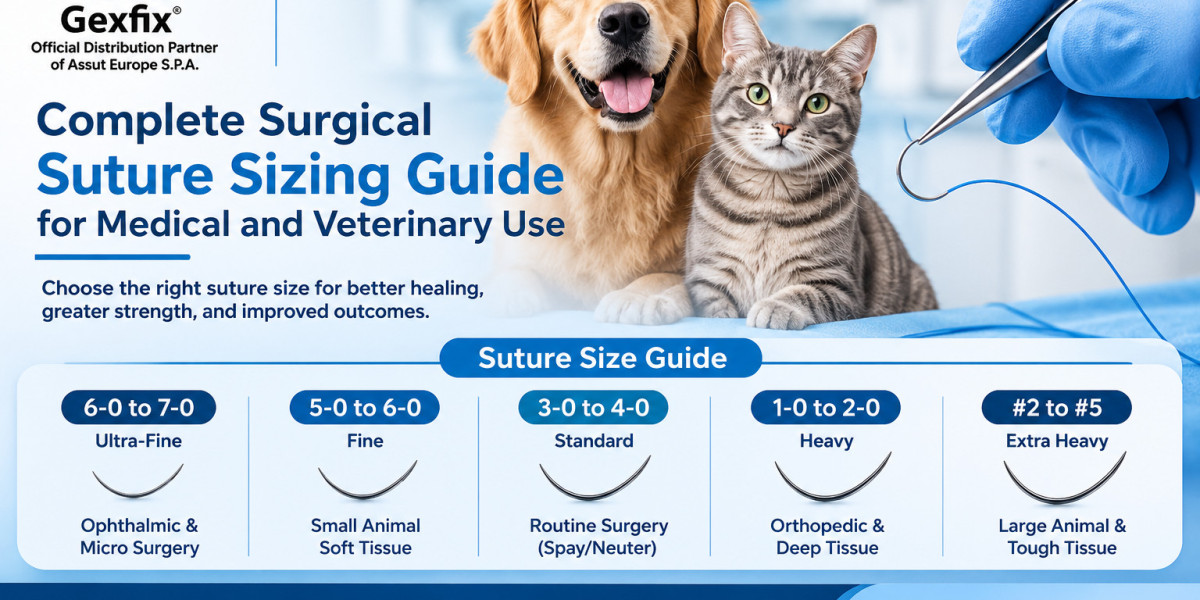

Every suture package carries a number that describes how thick the thread is, and that number shapes how the closure behaves in tissue. Understanding suture sizing helps surgeons, veterinary technicians and students choose a thread that is strong enough to hold the tissue without causing needless damage. The labels can look confusing at first because they count downward through zeros. Once the pattern is clear the scale is simple to read and easy to apply. This guide explains how sizes are labeled, how they relate to tissue type and patient size, how needles and materials affect the decision and where other closure methods fit. It is general educational information and does not replace the judgment of a trained clinician or the manufacturer's instructions for use.
What Suture Size Means
Suture size describes the diameter of the thread. A thicker thread is stronger but also bulkier. A thinner thread is gentler on tissue but breaks under less force. Every sizing decision balances these two facts.
Two labeling systems appear on most packages. The United States Pharmacopeia scale is called USP and it is the most familiar. The metric system gives the diameter in tenths of a millimeter. Many labels show both so a clinician can compare products from different makers and regions.
Reading the USP Scale
The USP scale starts with whole numbers for heavy threads and then moves into zeros for finer ones. A size 2 thread is thicker than a size 1 thread. Size 0 is thinner than size 1. After that the labels add zeros. A thread marked 2/0 is thinner than size 0. A thread marked 3/0 is thinner than 2/0 and a thread marked 4/0 is thinner still.
The simple rule is that more zeros mean a finer thread. Some packages print the same size as 3-0 or 000 but all of these notations mean the same thing. This guide uses the slash form to keep things consistent.
USP and Metric Equivalents
The list below shows common sizes with their metric equivalents. The metric number is the diameter in tenths of a millimeter so metric 2 means a diameter of about 0.2 mm.
USP 2 matches metric 5
USP 1 matches metric 4
USP 0 matches metric 3.5
USP 2/0 matches metric 3
USP 3/0 matches metric 2
USP 4/0 matches metric 1.5
USP 5/0 matches metric 1
USP 6/0 matches metric 0.7
USP 7/0 matches metric 0.5
USP 8/0 and finer are used mainly in microsurgery and eye surgery
The exact diameter range allowed for each size differs slightly between material classes such as natural absorbable, synthetic absorbable and non absorbable. For that reason two threads of the same USP size from different materials can feel slightly different in the hand. The label still tells the clinician which size class the product belongs to.
Why Size Matters in Practice
The right size affects several things at once. Strength is the obvious one. A thread has to hold the tissue edges together under the forces the tissue will meet during healing. Coughing, walking, bending and swelling all place load on a closure.
Tissue trauma is the second factor. A larger thread leaves a larger channel as it passes through the tissue and adds more foreign material to the wound. In fragile tissue a heavy thread can cut through or crush the area it is supposed to protect.
Knot size is a third. A thicker thread makes a bigger knot. A bulky knot can irritate the skin or sit prominently under thin tissue. A fine thread makes a small neat knot but needs careful handling because fine monofilament can slip if too few throws are used.
Tissue reaction is the fourth. More material in the wound can provoke more inflammation. A common teaching principle is to use the finest thread that will reliably hold the tissue for as long as healing requires.
Matching Size to Tissue
Tissue type is the main guide. Tougher and more heavily loaded tissue needs a thicker thread while delicate tissue needs a finer one. The ranges below are general reference points used in teaching and common practice. Individual surgeons may choose differently based on the patient and the procedure.
Veterinary Reference Ranges
Skin in cats and small dogs often uses 4/0 or 3/0
Skin in medium and large dogs often uses 3/0 or 2/0
Subcutaneous tissue ranges from 4/0 in small patients to 2/0 in large dogs
The abdominal wall closure in cats and small dogs often uses 3/0 or 2/0 and in large dogs may use 2/0 or 0
Bladder and intestinal closures commonly use 4/0 or 3/0 depending on patient size
Ligatures vary widely based on the size of the vessel or pedicle
Eyelids and other delicate structures often use 5/0 to 6/0 or finer
Large animals such as horses and cattle usually need heavier sizes because their tissues bear greater loads. Exotic species may need very fine sizes because of small and fragile tissue.
Medical Reference Ranges for People
Facial skin is commonly closed with fine sizes such as 5/0 or 6/0
Scalp, trunk and limb skin commonly use 3/0 or 4/0
Hand and finger skin often uses 4/0 or 5/0
Deeper dermal layers often use 3/0 or 4/0 absorbable thread
Fascia and other load bearing layers use heavier sizes such as 0, 1 or 2/0
These ranges are included only to show how size follows tissue demand. Anyone treating a wound should follow the training standards and local protocols that apply to their role.
Matching Size to the Patient
Patient size changes the choice even when the tissue type stays the same. A thread that works well for skin on a large dog may be much too heavy for a kitten. Smaller animals have thinner skin and smaller structures so a finer thread and a smaller needle keep the closure in proportion.
Activity level also matters. A very active patient places more stress on a closure than a calm one. A surgeon may choose a slightly stronger size or add support such as an extra layer when high activity is expected.
Body condition plays a role as well. Thin patients have less cushioning under the skin so knots may be more noticeable. Heavier patients may have thicker fat layers that need careful closure to avoid dead space.
How Material Affects Size Choice
Thread material and size work together. A material with lower strength may need a larger size for the same job.
Absorbable and Non Absorbable Threads
Absorbable sutures lose strength over time and are broken down by the body. They suit internal layers where nothing should be left behind. Non absorbable sutures keep their strength much longer and are often used for skin or for tissue that heals slowly.
Absorption times vary by product. A mid term monofilament may hold useful strength for about ninety to one hundred twenty days while a long term monofilament may last about one hundred eighty to two hundred ten days. Matching the strength curve to the healing time of the tissue matters as much as picking the right diameter.
Monofilament, Braided and Barbed Designs
Monofilament thread is a single smooth strand. It slides through tissue easily and carries less bacteria along its surface. Braided thread has several fibers woven together. It handles well and ties securely but its texture can add friction. Barbed thread has small projections along the strand that grip tissue so no knots are needed. Barbed sutures are used in specific closures and are chosen according to the manufacturer's guidance.
Each design can be chosen across a range of sizes. The structure influences handling but the size still follows the tissue demand.
The Needle Is Part of the Decision
Most surgical sutures come with the needle attached. The needle makes the first path through tissue and the thread follows. A good thread paired with a poor needle can still damage tissue.
Needle Point Types
Taper point needles have a round body that narrows to a sharp tip. They separate tissue fibers rather than cutting them and suit delicate soft tissue. Cutting needles have sharp edges that slice through tissue and suit tougher layers such as skin. Reverse cutting needles place the cutting edge on the outer side of the curve so the thread is less likely to tear through the wound edge.
Curve and Length
Needle curves are described as fractions of a circle. A three eighths curve is common for skin and shallow work. A half circle curve suits deeper or tighter spaces. Longer needles take wider bites while shorter needles suit small areas. Finer threads are normally paired with smaller needles so the hole made by the needle is not larger than the thread needs.
How to Read a Suture Package
Packaging contains the information needed to confirm the right product. A typical label shows the material and the USP size and the needle code. It also shows the needle length and curve and the strand length. The sterility statement and expiration date and lot number appear as well.
Always check the label before opening the pack. Confirm that the product is intended for the species or patient group involved. Products marked for veterinary use only should never be used on people. The reverse also applies since human labeled products follow different regulatory requirements. Check the expiration date and do not use any pack that is damaged or wet. Once a pack is opened the contents should be used for that patient or discarded.
Knots and Handling at Different Sizes
Knot security changes with size. Finer threads have less surface area so knots can loosen more easily. Monofilament materials are especially likely to slip because their surface is smooth. Surgeons often add an extra throw with monofilament. Heavier threads can make bulky knots that irritate tissue so the knot should be trimmed neatly and placed away from the wound line where possible.
Tension control matters at every size. A knot tied too tight can squeeze tissue and reduce blood flow while a knot that is too loose leaves a gap. Fine threads can snap if pulled sharply. Smooth steady motions work best.
Where Other Closure Methods Fit
A suture is not always the right tool. Several alternatives can replace sutures or work alongside them depending on the wound.
A skin stapler places small stainless steel staples across the skin edges. It closes long straight incisions quickly and spaces the closure evenly. It is used for the skin layer only so deeper layers still need suture sized for the tissue beneath. Staples are generally removed after the skin has healed.
Tissue adhesive holds the edges of short and shallow wounds that are under little tension. It sets within seconds and wears away as the skin heals. It does not support deeper layers or wounds that move a lot. Some teams also apply a thin layer of surgical glue over a finished closure as a surface barrier. This supports a well closed wound but does not replace structural closure.
Many procedures combine methods. A surgeon may close deep layers with absorbable thread chosen for tissue strength and then finish the skin with staples or adhesive. The choice depends on wound length and tension and location and the patient's behavior after surgery.
Instruments and Preparation
Even the right size can fail when handled poorly. Needle holders should grip the needle firmly without crushing the thread. Fine forceps should hold delicate tissue without tearing it. Clean sharp scissors allow neat trimming of knots. Well maintained veterinary surgical instruments support accurate suture placement and protect finer threads from damage during handling.
Instrument size should suit the thread and needle. A heavy needle holder can crush a fine thread or bend a small needle. A light holder may not grip a large needle securely. Proper cleaning and sterilization protect the patient from infection and extend the life of the equipment.
Storage and Handling of Suture Material
Good storage keeps suture material reliable. Keep packages in their original sterile packaging until needed. Store them in a clean dry place away from heat and direct light. Follow the storage conditions printed on the box. Check expiration dates on a regular schedule and rotate stock so older packs are used first.
Avoid pulling thread sharply from the pack or bending it into tight kinks. Kinked monofilament can keep a memory of the shape and become harder to handle. Do not soak or wet thread unless the manufacturer instructions call for it.
Common Suture Sizing Mistakes
A few mistakes appear again and again.
Choosing a thread that is too heavy for delicate tissue and causing avoidable trauma
Choosing a thread that is too fine for a wound under tension so it breaks
Pairing a fine thread with a needle that is too large for the patient
Tying knots too tight so tissue is squeezed and loses blood supply
Using too few throws with monofilament so the knot loosens
Ignoring how long the tissue needs support and choosing a material that absorbs too soon
Relying on adhesive to hold a wound that is under real tension
Avoiding these mistakes comes down to matching thread, needle and technique to the specific tissue instead of using a single size for every case.
What Patients and Pet Owners Should Know
Patients and owners do not choose suture sizes but they can protect the result. Follow aftercare instructions closely. Keep the wound clean and dry unless told otherwise. Limit strenuous activity while healing takes place. Use a protective collar for animals if one is provided so licking and chewing do not damage the closure.
Check the wound each day. Redness that spreads, swelling that grows, discharge, a bad smell, open edges or loose stitches deserve a call to the clinic. Buried absorbable sutures usually do not need removal while skin stitches and staples are removed at a scheduled visit. Asking the clinician which type was used makes recovery easier to plan.
Quick Reference Summary
More zeros means a finer thread
Finer threads suit delicate tissue and small patients while heavier threads suit load bearing tissue and large patients
The finest thread that safely holds the tissue is generally the best choice
Needle type and size should match the tissue and the thread
Material and absorption time should match the healing time of the tissue
Always read the package label and confirm the product is intended for the patient group
Summary
Suture sizing follows a clear and consistent scale once the logic of the zeros is understood. The USP and metric labels describe the same diameter in different ways and the best size depends on tissue type and patient size and the load the closure will face. Material and needle choice matter as much as thickness. Staples and adhesive have their own roles but sutures remain the most adaptable way to match a closure to the tissue. When size, needle, material and technique work together the closure has the best chance of healing smoothly.
Gexfix International Corp. supplies absorbable and non absorbable veterinary sutures in a range of USP sizes and needle configurations in partnership with Assut Europe S.P.A.
FAQs
Q: What does 3/0 mean on a suture package?
A: The label 3/0 is a USP size describing thread thickness. Each added zero means a finer thread, so 3/0 is thinner than 2/0 and thicker than 4/0. It matches metric size 2, or about 0.2 mm.
Q: Is a thicker suture always stronger and better?
A: A thicker suture holds more force but also leaves a larger channel and adds more foreign material. In delicate tissue it can cause damage. Clinicians usually choose the finest size that securely holds the tissue.
Q: How do USP and metric suture sizes compare?
A: USP and metric labels describe the same diameter in different ways. Metric size is the diameter in tenths of a millimeter. For example USP 4/0 matches metric 1.5 and USP 2/0 matches metric 3.
Q: Does the needle type matter as much as the size?
A: Yes. Taper needles spread fibers and suit delicate soft tissue while cutting needles pass through tough skin. A needle that is too large or the wrong shape can damage tissue even when the thread size is correct.
Q: Can veterinary sutures be used on people?
A: No. Products marked for veterinary use only are intended for animals and are regulated differently from human products. Always read the label and use products only for the patient group they are intended for.
A few notes for the client review. I linked the primary keyword to the main shop page since there is no dedicated suture sizing page, so swap in a better URL if one exists. The size ranges are general teaching references, and the client may want their veterinary reviewer to confirm them. The human section is brief and kept generic, as with the scalp post, so they should confirm they are comfortable publishing it on a veterinary site.