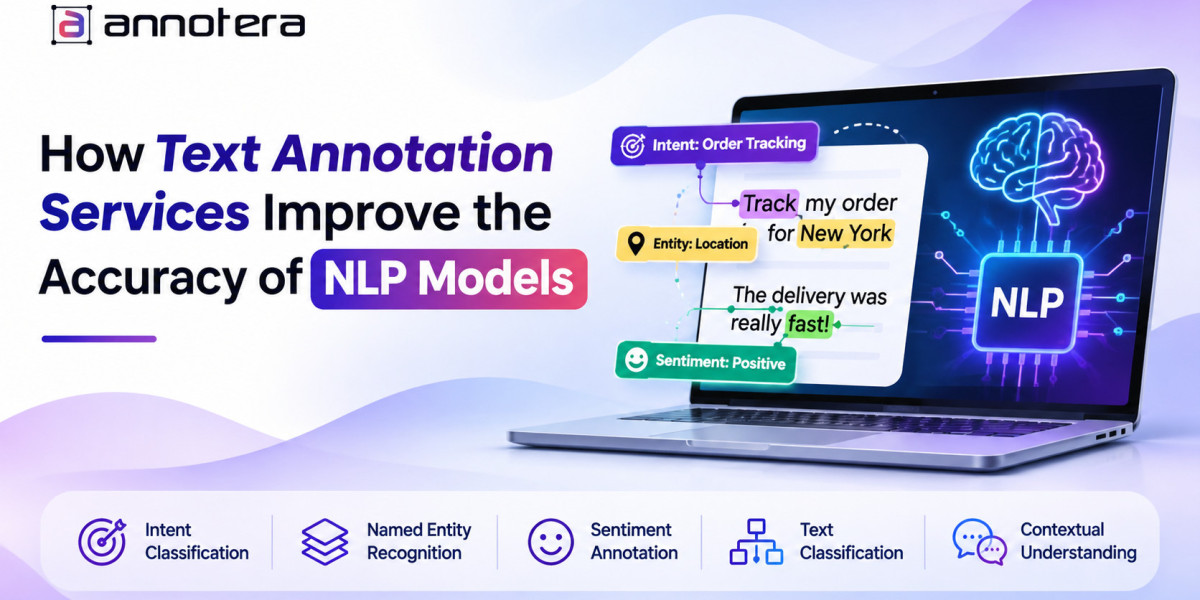

Natural Language Processing (NLP) has become a critical component of modern artificial intelligence (AI), powering applications such as chatbots, virtual assistants, sentiment analysis tools, search engines, recommendation systems, and automated customer support platforms. However, the performance of these applications depends heavily on the quality of the data used to train their underlying models. Even advanced NLP algorithms can produce inaccurate results when trained on inconsistent, incomplete, or poorly labeled datasets.
This is where text annotation services play an important role. By converting unstructured textual information into structured, machine-readable datasets, text annotation helps NLP models understand language, recognize context, identify user intentions, and generate more relevant responses.
For businesses developing intelligent language-based applications, investing in reliable annotation processes is essential for improving model accuracy, consistency, and real-world performance.
Understanding the Role of Text Annotation in NLP
Text annotation is the process of assigning meaningful labels, tags, or categories to textual data so that machine learning models can recognize specific patterns and relationships within language.
Unlike humans, NLP models do not naturally understand the meaning behind words, sentences, or conversations. They learn linguistic patterns from annotated examples during training. These examples help models distinguish between different entities, identify relationships, interpret sentiment, and understand user queries.
Common text annotation techniques include:
Named Entity Recognition (NER): Identifying entities such as names, locations, organizations, dates, and product references.
Intent Classification: Categorizing user queries based on their underlying purpose, such as making a purchase, requesting information, or resolving an issue.
Sentiment Annotation: Identifying emotions and opinions expressed in textual content.
Part-of-Speech Tagging: Classifying words as nouns, verbs, adjectives, adverbs, and other grammatical components.
Text Classification: Assigning predefined categories to documents, messages, or customer feedback.
Semantic Annotation: Labeling relationships and contextual meanings between words, phrases, and sentences.
These annotation techniques provide NLP models with structured training examples, helping them learn how language functions across different contexts.
6 Ways Text Annotation Services Improve NLP Model Accuracy
1. Improving Contextual Understanding
Human language is complex. A single word can have multiple meanings depending on the surrounding sentence, conversation, or situation.
For example, the word "bank" may refer to a financial institution or the side of a river. Without contextual information, an NLP model may incorrectly interpret the intended meaning.
Professional text annotation helps resolve such ambiguities by labeling words and phrases according to their actual context. Annotators examine surrounding sentences, linguistic relationships, and conversational intent before assigning appropriate labels.
This enables NLP models to develop stronger contextual understanding and deliver more accurate interpretations across different communication scenarios.
2. Enhancing Intent Classification
Understanding what a user wants is essential for conversational AI, customer support automation, and virtual assistants. Intent classification enables NLP models to identify the purpose behind a user's message.
For example, queries such as "Where is my order?", "Track my delivery," and "Has my package shipped?" may use different expressions but communicate a similar intent.
Through structured text annotation, these queries can be consistently labeled under categories such as order tracking or delivery status.
Accurate intent classification helps conversational AI systems respond appropriately, reduce misunderstandings, and improve user experiences. A reliable annotation framework also ensures that similar queries receive consistent labels across training datasets.
3. Reducing Data Inconsistency and Annotation Errors
Inconsistent training labels can negatively affect NLP model performance. When similar sentences receive different labels without a valid contextual reason, models may struggle to identify reliable linguistic patterns.
Professional annotation workflows address this challenge through predefined annotation guidelines, quality assurance procedures, and multiple review stages.
A dependable text annotation company establishes clear labeling standards and uses trained annotators to maintain consistency across large datasets.
Quality checks, inter-annotator agreement measurements, and adjudication processes further help identify disagreements and correct labeling errors before datasets are used for model training.
4. Improving Named Entity Recognition
Named Entity Recognition is an important NLP capability that allows models to identify and categorize specific information within unstructured text.
For instance, in the sentence "Annotera provides data annotation services to AI companies," an NER model should recognize "Annotera" as an organization and "AI companies" as an industry-related entity.
Accurate entity annotation helps NLP models extract meaningful information from business documents, financial records, customer conversations, healthcare-related text, and other sources.
By providing precisely labeled entity datasets, text annotation services improve information extraction, document processing, search relevance, and automated data classification.
5. Supporting Multilingual and Domain-Specific NLP Models
Language patterns vary across regions, industries, and cultural contexts. A model trained primarily on general English datasets may struggle to understand industry-specific terminology, regional expressions, abbreviations, or multilingual conversations.
Specialized annotation helps address these limitations by incorporating domain-specific vocabulary, language variations, and contextual differences into training datasets.
For example, financial NLP applications require an understanding of banking terminology, while healthcare applications need accurate recognition of medical terms and clinical expressions.
Professional text annotation outsourcing services can provide access to trained linguistic resources and structured workflows for developing multilingual and industry-specific datasets.
6. Strengthening Model Generalization
An NLP model should perform accurately not only on familiar training examples but also on previously unseen sentences and real-world queries.
Training datasets that contain repetitive, narrow, or poorly labeled examples can limit a model's ability to generalize.
Text annotation helps improve dataset diversity by incorporating different sentence structures, vocabulary variations, conversational styles, and contextual scenarios.
Including ambiguous expressions, informal language, spelling variations, and less common user queries allows NLP models to learn more comprehensive linguistic patterns.
This supports better performance when models encounter unfamiliar inputs after deployment.
Why Human Expertise Matters in Text Annotation
Automated annotation tools can accelerate data labeling, but they may struggle with sarcasm, ambiguous expressions, cultural references, and complex contextual relationships.
Human annotators bring linguistic understanding and contextual judgment to these situations. They can distinguish between subtle differences in meaning, identify misleading interpretations, and resolve labeling disagreements.
Combining human expertise with automated annotation tools creates a more effective workflow. Automation improves processing efficiency, while human review helps maintain accuracy and consistency.
At Annotera, we recognize that high-quality training data is fundamental to building reliable AI systems. Our text annotation capabilities focus on structured labeling, contextual accuracy, and quality-driven annotation workflows that support diverse NLP applications.
Choosing the Right Text Annotation Partner
Selecting an experienced annotation partner is an important consideration for businesses developing NLP models. Organizations should evaluate potential providers based on:
Domain Expertise: Experience handling industry-specific terminology and complex language structures.
Annotation Quality: Established quality assurance, validation, and review procedures.
Scalability: The ability to manage growing datasets without compromising labeling consistency.
Data Security: Appropriate measures to protect sensitive textual information.
Customization: Flexible annotation guidelines aligned with specific NLP model requirements.
Working with a capable text annotation company helps organizations build dependable training datasets while reducing the operational challenges associated with large-scale data labeling.
Conclusion
The accuracy of NLP models depends on more than advanced algorithms and computational capabilities. It begins with high-quality, consistently annotated training data.
From contextual understanding and intent classification to named entity recognition and multilingual processing, text annotation services help NLP models interpret language more accurately and respond more effectively to real-world inputs.
As businesses increasingly adopt conversational AI, intelligent search, and automated language processing, the demand for reliable training datasets will continue to grow.
Annotera helps organizations strengthen their AI development initiatives through quality-focused text annotation solutions. Whether you are developing conversational AI, enterprise NLP applications, or intelligent automation systems, our annotation expertise can help transform unstructured text into valuable training data.
Ready to improve your NLP model performance? Partner with Annotera for scalable, accurate, and reliable text annotation solutions tailored to your AI training requirements.