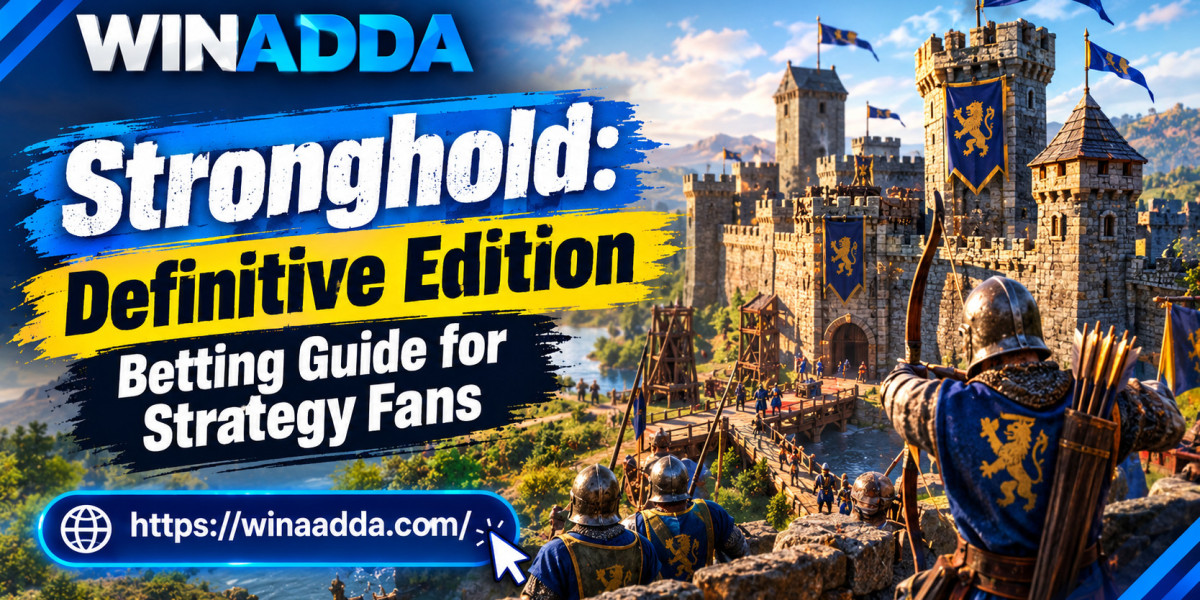

Stronghold: Definitive Edition is a real-time strategy game that combines castle building, economic management, military planning, and medieval warfare. Developed by Firefly Studios, it revisits the classic Stronghold experience with improved visuals, updated features, and multiplayer support. Players must build settlements, manage resources, protect their population, and prepare armies to defend or conquer castles.
Unlike action-focused games, Stronghold: Definitive Edition rewards patience, planning, and efficient resource use. A player must consider the long-term effects of every important decision. Building too many military units too early can weaken the economy, while spending too much time developing a settlement can leave it open to attack.
For strategy fans exploring competitive gaming through Winadda, this game offers an interesting way to study decision-making and multiplayer performance. Success depends on balancing economic growth with military strength, using terrain effectively, and adapting to an opponent's plans. These factors make strategic analysis more complex than simply comparing previous wins.
This guide explains the game's core mechanics, important multiplayer considerations, and the factors that may help fans evaluate competitive performance. It also covers the limitations of match predictions and the importance of responsible decision-making.
It is important to distinguish between multiplayer gaming and betting availability. Stronghold: Definitive Edition supports multiplayer matches, but that does not automatically mean that official esports tournaments or betting markets are available. Readers should verify any specific event or market before relying on it.
Winadda, Winadda Login, and Winadda app are included as relevant search terms for readers exploring online gaming services. Their inclusion does not confirm that this particular game is supported by a platform.
Understanding Stronghold: Definitive Edition Gameplay
Stronghold: Definitive Edition is built around two closely connected systems: economic development and military strategy. Players must establish a functioning settlement before they can support a powerful army. They also need to protect their people and buildings while preparing for possible attacks.
The game includes military campaigns, economic missions, siege scenarios, and multiplayer battles. It also features additional campaign content and historical castle challenges. The definitive edition improves the original game's presentation while retaining its central focus on castle management and medieval warfare.
Economic development begins with collecting essential resources. Wood supports construction, stone helps create stronger structures, and food keeps the population supplied. Other materials and production chains become important as the settlement grows.
The military side requires a different set of decisions. Players must recruit suitable troops, prepare defensive positions, and decide when to attack. An army may be powerful on paper but ineffective if it reaches the battlefield without proper support or a clear objective.
These systems influence each other throughout a match. A strong economy can support a larger army, but excessive military spending may slow development. A well-designed castle can delay an opponent, but defensive buildings still need to be supported by an appropriate strategy.
For competitive analysis, fans should consider the whole game rather than focusing on one impressive attack or one successful defensive action. Long-term planning often determines whether an early advantage becomes a lasting lead.
Resource Management and Economic Planning
Resource management is one of the most important skills in Stronghold: Definitive Edition. Players need a reliable supply of materials to construct buildings, produce goods, recruit troops, and maintain their settlements.
Wood is especially useful during the early stages because many essential buildings require it. Players who establish an efficient supply of construction materials can develop their settlement more quickly. However, expanding production without considering available space and other needs can create new problems.
Stone becomes important when constructing durable defensive structures. A player who plans to build extensive walls and towers must ensure that stone production can meet demand. Poor resource planning may delay fortifications and leave the castle vulnerable.
Food production is equally important. A settlement needs enough food to support its population, and players must balance production with other economic priorities. Too little food can damage the settlement's stability, while excessive investment in food production may leave fewer resources available for other tasks.
Gold provides another important part of the economic system. It can support military recruitment and other strategic decisions. Players must consider how their income, expenses, and available reserves will change as the game progresses.
When assessing a player's economic performance, look at efficiency rather than the size of the settlement alone. A large economy is not necessarily effective if it consumes resources without supporting a clear plan. A smaller, well-managed economy may provide everything needed for a successful attack or a strong defence.
Castle Design and Defensive Strategy
Castle construction is central to Stronghold: Definitive Edition. Walls, towers, gates, and defensive positions help protect important buildings and control access to the settlement. Their placement can influence how an opponent approaches an attack.
A well-designed castle should reflect the terrain and the player's overall strategy. Natural barriers may provide useful protection, while open approaches can make a settlement easier to attack. Players should consider the routes an enemy army might take before deciding where to build defensive structures.
Walls are important, but they do not solve every problem. A strong defensive layout still requires troops capable of responding to threats. If defenders cannot reach vulnerable areas quickly enough, even substantial fortifications may fail to prevent an attack.
Defensive depth is another useful concept. A castle that relies on one outer barrier may become vulnerable once that barrier is breached. Additional positions can create opportunities to slow the attacker and protect important areas deeper inside the settlement.
However, defensive investment has a cost. Building too many walls and towers may consume resources that could have supported economic growth or military recruitment. Players must decide how much protection is appropriate for the situation.
For competitive analysis, castle design should be judged according to its purpose. A defensive player may prioritise resilience, while an aggressive player may invest more heavily in the economy and troops needed for an early attack. Neither approach is automatically superior.
Military Units and Siege Warfare
Military strength depends on more than the number of troops available. Players need to understand unit roles, movement, combat limitations, and the demands of the objective.
Different units perform different tasks. Some are suited to close combat, while others can attack from a distance or support a siege. Selecting an appropriate combination helps an army respond to different threats.
Siege warfare introduces additional planning requirements. Attackers must consider how to approach walls, weaken defensive positions, and protect their forces while attempting to enter a castle. A poorly planned assault can waste valuable troops without making meaningful progress.
Defenders need to understand how to use their fortifications and units together. Placing troops where they can respond effectively may be more useful than concentrating every available unit in one location. Good defensive decisions can force attackers to spend more time and resources than expected.
The timing of an attack is also important. Launching an assault before an army is ready may give the defender an easy advantage. Waiting too long can allow the opponent to strengthen the castle and improve their economy.
Players must therefore balance preparation with urgency. The best moment to attack depends on available resources, army strength, the opponent's defences, and the current objective.
For fans examining multiplayer performance, the ability to prepare and execute a siege is an important indicator of strategic skill. However, results must still be considered in the context of the map and match settings.
Understanding Multiplayer Modes and Match Settings
Stronghold: Definitive Edition supports online multiplayer for up to eight players. Its multiplayer settings allow hosts to customise important conditions, including starting resources, initial troops, technology level, alliances, and game speed. These options can significantly change how a match develops.
This flexibility matters when evaluating competitive performance. A match that begins with abundant resources may reward different strategies from one in which players must develop their economies from a limited starting position.
Starting troops can also affect the pace of a game. When players begin with larger armies, early engagements may happen quickly. With fewer starting troops, economic development and recruitment may have a greater influence on the result.
Technology settings determine which buildings, troops, and resources are available. A match with access to advanced units may demand different preparation from one with more limited options.
Game speed can influence how much time players have to make decisions. Faster matches place greater pressure on quick planning and efficient execution. Slower settings may provide more room for economic development and detailed military preparation.
The King of the Hill multiplayer mode introduces another strategic challenge. Players compete to occupy the central keep exclusively for long enough to reduce the scoring counter to zero. This shifts attention towards control of a specific location rather than simply destroying an opponent's castle.
Before assessing any multiplayer matchup, fans should confirm the rules and settings. Two matches involving the same players can produce very different results if their starting conditions or objectives are different.
Evaluating Player Form and Strategic Consistency
Player form can help fans understand how consistently someone makes effective decisions. In a strategy game, however, performance cannot be measured by reaction speed alone. Resource management, military preparation, timing, and adaptability all contribute to success.
A player who regularly develops a stable economy may be better prepared for longer matches. Another player may prefer early pressure and attempt to gain an advantage before the opponent's defences become strong. Each style has strengths and weaknesses.
The important question is whether the strategy works under the specific match conditions. Early aggression may be effective when the opponent is poorly prepared, but it can fail against a player who establishes strong defences quickly.
Likewise, a defensive strategy may succeed when the player has enough resources to maintain the castle. It may become less effective if the opponent controls important areas or develops a much stronger economy.
Consistency across different maps and settings can provide useful evidence of adaptability. Players who can adjust their plans when conditions change may have an advantage over competitors who depend on one fixed approach.
Fans should also consider the quality of previous opponents. A strong record against experienced players may provide more relevant information than several victories against weaker competition. Still, no record guarantees a future result.
When researching a potential matchup through Winadda-related gaming content, verified match histories and comparable conditions should take priority over general reputation.
Analysing Maps, Terrain, and Strategic Opportunities
Map design can influence the development of a Stronghold: Definitive Edition match. Terrain affects how players build, defend, gather resources, and approach opponents. A strategy that works on one map may be less effective on another.
Players should consider the location of useful resources and the amount of space available for expansion. A settlement with convenient access to essential materials may develop efficiently, while another may need to invest more effort in production and transport.
The terrain can also influence defensive choices. Narrow approaches may make it easier to control enemy movement, while open areas can create opportunities for attackers to approach from several directions. Players who understand these features can plan their castle layouts more effectively.
Map awareness is particularly important when preparing for a siege. An attacker must consider the most practical route towards the enemy castle, while a defender needs to identify vulnerable positions and prepare suitable responses.
In multiplayer matches, the positions of other players can also influence strategic decisions. A player who focuses entirely on one opponent may leave themselves exposed to another. This is especially relevant in games involving several participants or changing alliances.
For analytical purposes, map familiarity should be considered alongside player skill. A competitor who understands a map well may make better decisions, but familiarity alone does not guarantee victory. The opponent's strategy and the match settings remain important.
Common Mistakes in Stronghold Match Analysis
One common mistake is judging players only by their army size. A large army may look impressive, but its effectiveness depends on troop composition, timing, and the ability to use it properly. A smaller force may succeed through better positioning or a well-planned attack.
Another mistake is ignoring the economy. Military strength often depends on the resources available to support it. A player who recruits too many troops too early may struggle to maintain development or prepare for a longer battle.
Fans may also assume that the strongest castle will always win. Fortifications can provide important protection, but they do not replace economic planning or effective military decisions. A poorly managed settlement can struggle even when its walls are difficult to breach.
A further mistake is comparing results from different multiplayer settings without accounting for the differences. Starting resources, technology levels, troop availability, and game speed can all change the strategic demands of a match.
It is also important to avoid overreacting to a single victory or defeat. A match may be decided by an unusual strategic choice or a particular map condition. A broader record provides a more balanced picture of a player's strengths.
Finally, fans should distinguish between historical competitive results and current activity. Stronghold: Definitive Edition has a multiplayer mode, but the existence of that mode does not establish that an active professional tournament or betting market is available.
Winadda Login and Winadda App for Strategy Fans
Readers researching online gaming services may come across Winadda, Winadda Login, and Winadda app while exploring gaming-related content. These terms relate to the platform experience rather than the strategic mechanics of Stronghold: Definitive Edition.
Winadda Login refers to accessing an account associated with the platform. Users should protect their account details, use secure credentials, and review the applicable account policies before sharing personal information.
The Winadda app may be relevant to readers who prefer using online services through a mobile device. However, supported games, available features, payment options, and competitive markets should be verified independently. It would be inaccurate to assume that Stronghold: Definitive Edition is supported without reliable confirmation.
For strategy fans, learning the game is the most useful starting point. Reviewing multiplayer matches, studying economic decisions, understanding siege tactics, and comparing castle designs can help build a deeper knowledge of competitive play.
Readers should also distinguish between a game that supports multiplayer and a game that has a verified betting market. These are separate matters. Anyone considering a betting service should confirm its terms, check applicable local laws, and understand the relevant age restrictions before participating.
Responsible Gaming and Financial Awareness
Strategy games can provide hours of entertainment without involving financial risk. Players can enjoy Stronghold: Definitive Edition by completing campaigns, designing castles, improving their economic planning, and competing with friends.
If betting is legally available to an eligible adult, it should be approached with caution. Strategic analysis can help explain gameplay, but it cannot guarantee the outcome of a match or provide a reliable source of income.
Setting a strict spending limit is important whenever financial risk is involved. Only money that can be lost without affecting essential expenses should be considered. Borrowing money or using funds reserved for bills, savings, or family needs can create serious financial problems.
It is also important to avoid chasing losses. Increasing stakes after an unsuccessful prediction can lead to rushed decisions and greater risk. Taking a break is often a better response.
Fans should recognise when there is insufficient information to assess a match. If the competitors, rules, or current event details cannot be verified, avoiding a prediction is a sensible choice.
Responsible gaming means keeping entertainment within safe limits and seeking appropriate support if betting begins to affect finances, relationships, or everyday responsibilities. Anyone below the legal gambling age should not participate in betting activities.
Conclusion
Stronghold: Definitive Edition offers a rich strategy experience built around castle construction, economic management, military planning, and siege warfare. Its multiplayer modes add further complexity by allowing players to compete under different settings and objectives.
A useful Winadda Stronghold: Definitive Edition betting guide should focus on economic efficiency, castle design, troop selection, map awareness, multiplayer rules, and player consistency. These factors help explain why one strategy may succeed while another fails. However, no combination of statistics or tactical knowledge can guarantee a match prediction.
Winadda, Winadda Login, and Winadda app are relevant search terms for readers exploring online gaming services, but platform features and betting availability should always be verified independently.
Ultimately, the best approach is to understand the game's mechanics, rely on trustworthy information, and recognise the limits of available evidence. By combining careful strategic analysis with responsible decision-making, fans can develop a stronger appreciation of Stronghold: Definitive Edition and the planning that makes real-time strategy games engaging.