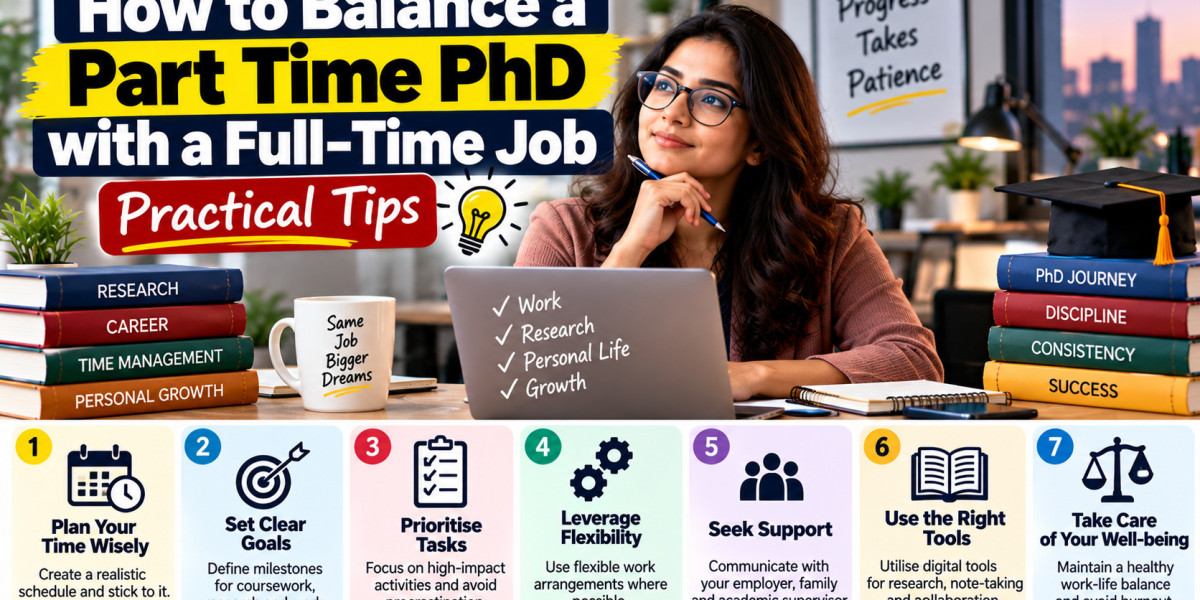

Starting a doctorate while holding a job sounds exciting in the first month and exhausting by the sixth. Deadlines at work do not move because your literature review is due. Family events do not pause for your data collection. And yet thousands of people complete a PhD while working every year, and most of them do it with ordinary habits rather than superhuman effort.
This guide gives practical advice on how to balance PhD and job commitments over the long haul. It covers planning your time, choosing a topic that helps instead of competes with your job, working with your employer and supervisor, protecting your energy, and handling the rough patches that nearly every part time scholar faces. If you are considering a part time PhD for working professionals, or you have just started one, these habits will save you months of struggle.
Understand What You Are Signing Up For
A part time PhD usually runs for four to six years. During that time you will attend coursework, meet your supervisor, present progress reports, collect and analyse data, write a thesis and defend it. Most of this happens outside your working hours.
Be honest with yourself before you begin. A realistic estimate for most scholars is ten to fifteen focused hours a week, with heavier bursts during data collection and thesis writing. If you cannot see where those hours will come from, solve that problem first, before you apply.
Step 1: Build a Realistic Weekly Schedule
Good intentions fail without a schedule. Treat research like a standing appointment.
- Map your week. List work hours, commute, family duties, sleep and fixed commitments. Then find the real gaps.
- Choose your best slots. Some people think best at 5 am, others late at night. Pick the time when your mind is sharpest for demanding tasks such as writing and analysis, and use tired hours for lighter work like formatting references.
- Block fixed sessions. Two or three sessions of two to three hours work better than many scattered half-hours, because deep thinking needs a warm-up.
- Use weekends wisely. One longer block of four to five hours on a weekend morning can move a chapter forward.
- Plan in small units. Instead of “work on thesis,” write “draft two pages of methods” or “code ten interviews.”
- Review weekly. Spend ten minutes every Sunday looking at what you finished and planning the next week.
Consistency matters more than intensity. Ten steady hours a week beat a burst of thirty hours followed by three weeks of nothing.
Step 2: Choose a Topic That Works With Your Job
One of the smartest ways to balance PhD and job is to let them feed each other.
- Pick a topic connected to your work. Your daily tasks can supply data, cases, participants and context, which saves enormous time.
- Keep the scope narrow. A focused question can be finished while working. A broad one will drag on for years.
- Check data access early. Make sure you can collect the data you need, with permission, within a realistic timeline.
- Avoid topics that need daily lab or fieldwork unless your employer can host them or your schedule truly allows it.
- Protect confidentiality. If you use internal company data, get written permission and follow ethical rules.
A topic that overlaps with your job turns some of your working hours into research hours, in a way that is ethical and agreed with your employer.
Step 3: Work With Your Employer, Not Around Them
Your employer is your biggest ally or your biggest obstacle. Treat the relationship with care.
- Be open about your plans. You need an NOC anyway, so use that conversation to explain your timeline and what you will need.
- Show the benefit. Explain how your research could improve processes, knowledge or the organisation’s reputation.
- Agree on leave in advance. Ask about leave for coursework, examinations, seminars, fieldwork and thesis writing. Get the agreement in writing if possible.
- Never let work suffer. Keep your performance steady. A drop in work quality is the fastest way to lose support.
- Ask about assistance. Some employers offer fee reimbursement, study leave or flexible hours.
- Keep records. Maintain copies of your NOC, leave approvals and correspondence.
If your employer changes, or your role changes, inform your university promptly, and obtain a fresh NOC if needed.
Step 4: Make Your Supervisor Part of Your System
A good supervisor relationship can make or break a part time PhD.
- Set expectations in the first month. Discuss meeting frequency, response times and how to handle delays.
- Send short, regular updates. A two-line email every few weeks keeps your work visible and prevents long silences.
- Prepare for every meeting. Bring a list of questions, a short summary of progress and a draft if you have one.
- Use deadlines. Agree on small deadlines with your supervisor, because external accountability helps when energy is low.
- Be honest about problems. If work has become overwhelming, say so early. Supervisors can adjust plans, but only if they know.
- Ask for feedback in writing. It helps you plan changes and avoid misunderstandings.
Many part time scholars drift because they avoid contact when progress is slow. The opposite habit, staying in touch even when you have little to show, is far healthier.
Step 5: Protect Your Energy and Health
Time is only half the problem. Energy is the other half.
- Sleep properly. Cutting sleep to study works for a few weeks, then collapses. Aim for consistent rest.
- Move your body. A short walk or exercise session clears your mind and improves focus.
- Eat regularly. Skipped meals and heavy caffeine lead to crashes.
- Take real breaks. Plan at least one day a week without research.
- Schedule rest after big milestones. After submitting a chapter or finishing data collection, give yourself a lighter week.
- Watch for burnout. Signs include constant exhaustion, dread of your work, irritability and loss of interest. If these appear, talk to your supervisor, a friend or a counsellor, and adjust your plan.
If you feel persistently low, anxious or unable to cope, consider speaking with a mental health professional. Seeking support early is a sign of good judgment, not weakness.
Step 6: Bring Your Family Into the Plan
A PhD affects everyone at home, so involve them from the start.
- Explain the commitment. Share how many years it will take, how many hours you need and what the degree means for your future.
- Agree on routines. Decide which evenings and weekend hours are research time.
- Share household tasks. Discuss what can be delegated or simplified.
- Plan family time too. Protect time for children, partners and parents so resentment does not build.
- Celebrate milestones together. Passing coursework, completing a chapter or publishing a paper deserves recognition.
Support at home often decides whether a part time scholar finishes.
Step 7: Use Tools and Systems to Save Time
Good systems reduce friction and protect your limited hours.
- Reference managers: Tools such as Zotero or Mendeley save countless hours on citations.
- Note systems: Keep one organised place for reading notes, ideas and quotes, with sources recorded.
- Task lists: Use a simple tool or notebook to track weekly goals.
- Backups: Save your thesis and data in at least two places, including cloud storage. Losing months of work to a crashed laptop is a preventable disaster.
- Templates: Use thesis templates from your university to avoid formatting headaches later.
- Writing habits: Write a little every research session, even if it is rough. Editing is easier than starting from nothing.
- Reading strategy: Read abstracts and conclusions first, then go deep only on the most relevant papers.
Step 8: Plan for Peaks and Troughs
The workload of a part time PhD is uneven. Plan for the heavy periods.
- Coursework year: Expect more classes and assignments, so protect your calendar early.
- Data collection: This is often the most time-sensitive phase. Save leave and arrange access in advance.
- Thesis writing: Plan a long block of leave or reduced work, if possible, during the final months.
- Viva preparation: Keep a few weeks free to revise and rehearse.
- Busy seasons at work: Identify your office peak periods and avoid planning major research milestones then.
A simple year-by-year plan, reviewed regularly with your supervisor, helps you see these peaks coming.
What To Do When You Fall Behind
Almost every part time scholar falls behind at some point. The key is to respond calmly.
- Diagnose the cause. Is it workload, motivation, unclear direction or a personal problem?
- Talk to your supervisor. Share the situation and ask for a revised plan.
- Shrink the next task. Break the next step into something you can finish in an hour.
- Restart with a small win. Write one paragraph or run one analysis.
- Adjust the timeline if needed. If your registration allows, discuss extensions or leave early, not at the last minute.
- Do not disappear. Staying in contact is far better than silence.
Falling behind is not failure. Quitting quietly is what usually ends a part time PhD.
Common Mistakes to Avoid
- Overcommitting at the start. Promising twenty hours a week and delivering five leads to guilt.
- Choosing a topic unrelated to work. It doubles your workload.
- Hiding problems from your supervisor.
- Neglecting health and relationships.
- Leaving thesis writing to the end. Draft chapters as you go.
- Ignoring backups.
- Skipping the employer conversation. Surprises damage trust.
- Comparing yourself with full-time scholars. Your pace is different, and that is fine.
Frequently Asked Questions
How many hours a week do I need for a part time PhD?
Most scholars need about ten to fifteen focused hours a week on average, with more during data collection and writing.
Can I do a PhD while working full time?
Yes, that is what the part time route is designed for. You need an employer NOC and a realistic plan for your time.
How do I balance PhD and job without burning out?
Use a fixed weekly schedule, protect sleep and rest, choose a topic linked to your work, keep regular contact with your supervisor and plan for heavy periods in advance.
Will my employer allow study leave?
It depends on the organisation. Discuss leave early, get agreements in writing and ask whether the organisation offers education support.
What if my job gets busier?
Talk to your supervisor, adjust the weekly plan and, if needed, discuss a short break or extension within the university’s rules.
Is it better to finish quickly or slowly?
Steady progress is better than bursts. Aim for a pace you can sustain within the maximum allowed period.
Final Thoughts
To balance PhD and job successfully, you need less heroism and more structure. Fixed research hours, a topic tied to your work, an understanding employer, regular contact with your supervisor and attention to your health will carry you further than any single burst of effort. A part time PhD for working professionals is a long walk, not a sprint, and the people who finish are usually those who keep walking at a steady pace.
Take ten minutes today to map your next week, mark three research sessions on your calendar and send your supervisor a short update. Small, regular actions are what build a doctorate.
https://gajahmada.my.id/read-blog/427_part-time-vs-full-time-phd-which-is-right-for-you.html
https://netlyra.com/read-blog/12_part-time-phd-at-iits-and-nits-eligibility-seats-and-admission.html
https://say.la/read-blog/184702_top-universities-for-part-time-phd-in-india-2026.html
https://castocus.com/blogs/81560/Part-Time-PhD-Research-Proposal-How-to-Write-One-That
https://mcmglobaleducation.blogolize.com/ugc-net-and-part-time-phd-is-the-exam-compulsory-82653983
https://www.mcmglobaleducation.com/blog/phd-in-psychology/
https://www.mcmacademy.in/ba-distance-education/
https://www.mcmacademy.in/msc-distance-education/
https://www.mcmacademy.in/mcom-distance-education/
https://www.mcmacademy.in/bcom-distance-education/
https://www.mcmacademy.in/blog/best-ece-colleges-in-india/
https://www.mcmacademy.in/blog/top-10-llm-specializations-in-demand/
https://www.mcmacademy.in/fast-track-courses/
https://www.mcmacademy.in/b-ed-in-one-year/
https://www.mcmacademy.in/graduation-degree-one-year-bangalore/