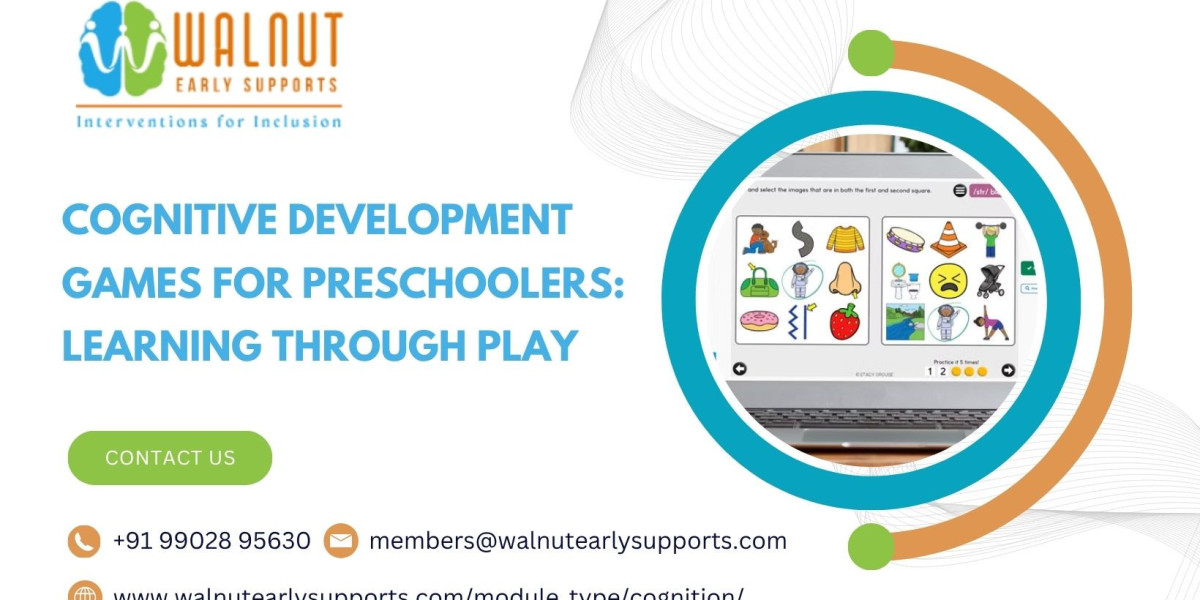

The preschool years are an important time for children to develop thinking, memory, attention, and problem-solving skills. During this stage, children learn about the world by exploring their surroundings, asking questions, and interacting with others. Play provides a natural and enjoyable way to support these skills while helping children become more confident learners.
Cognitive Development Games can make everyday learning more engaging by encouraging children to observe, remember, compare, and make decisions. Simple activities such as matching pictures, sorting objects, solving puzzles, and following instructions can help preschoolers practice essential thinking skills at their own pace.
Parents, teachers, and speech-language therapists can use these playful activities to create meaningful learning opportunities at home, in classrooms, and during therapy sessions.
What Is Cognitive Development in Preschoolers?
Cognitive development refers to how children learn, think, remember information, understand concepts, and solve problems. Between the ages of three and five, many children begin to recognize patterns, understand simple sequences, follow instructions, and make connections between objects and events.
These abilities support everyday activities such as learning new words, understanding stories, completing tasks, and interacting with others.
Children develop at different rates, so there is no single timeline that applies to everyone. Providing regular opportunities to explore, practice, and learn through play can help children strengthen their developing skills.
Why Are Cognitive Development Games Important?
Play encourages children to learn by doing rather than simply listening or watching. When children participate in games, they have opportunities to make choices, try different strategies, and learn from mistakes.
Here are some important skills that playful learning can support:
Attention and concentration: Activities encourage children to focus on a task and notice important details.
Memory: Matching cards and remembering instructions give children opportunities to practice recalling information.
Problem-solving: Puzzles and building activities encourage children to find solutions.
Logical thinking: Sorting and sequencing games help children identify patterns and relationships.
Language development: Describing objects, answering questions, and explaining choices encourage communication.
Early learning: Recognizing shapes, colors, numbers, and categories introduces concepts that support future classroom learning.
The benefits depend on the activity, the child's individual needs, and the guidance provided by the adult.
5 Cognitive Development Games for Preschoolers
Parents and educators do not need expensive toys to encourage learning. Many useful activities can be created with everyday objects and simple materials.
1. Picture Matching Games
Picture matching is a simple activity that encourages visual attention and memory. Prepare pairs of picture cards featuring familiar objects, animals, fruits, or household items.
Place the cards face up and ask the child to find matching pairs. As the child becomes comfortable, turn the cards face down and encourage them to remember where each picture is located.
You can also ask questions such as, "What is this animal called?" or "Where have you seen this fruit?" This adds a language-learning element to the activity.
2. Sorting Colors and Shapes
Collect objects such as blocks, buttons of suitable size, or colorful toys. Ask the child to group them according to color, shape, size, or type.
For example, a child might place all the red objects together and separate circles from squares. Later, introduce a new sorting rule to encourage flexible thinking.
These cognitive games help children notice similarities, differences, and patterns in their surroundings.
3. Simple Puzzles and Building Blocks
Puzzles and building blocks encourage children to think about how different pieces fit together. Give the child an age-appropriate puzzle or invite them to build a tower, bridge, or simple structure.
Encourage experimentation instead of immediately providing the answer. Questions such as "Which piece might fit here?" help children consider different possibilities and develop problem-solving strategies.
4. Sequencing and Storytelling Activities
Show children three or four picture cards that represent a familiar routine, such as washing hands, planting a seed, or getting ready for school.
Ask them to arrange the pictures in the correct order and explain what happens first, next, and last.
These activities help children understand sequences while practicing vocabulary, sentence formation, and storytelling. They can also be adapted to support communication goals during therapy sessions.
5. Listening and Following Instructions
Turn everyday instructions into a playful challenge. Ask children to complete simple tasks, such as "Pick up the blue block and place it beside the box."
As their skills develop, gradually introduce two-step instructions. Keep directions clear and adjust the difficulty to suit the child's abilities.
These activities encourage listening, attention, memory, and understanding of language without making learning feel like a test.
How to Choose the Right Cognitive Games
The most useful activities are those that match a child's current abilities and provide an appropriate level of challenge. A game that is too easy may not hold a child's interest, while one that is too difficult may cause frustration.
When selecting games for preschoolers, consider the following:
Age and developmental level: Choose activities that the child can participate in safely and meaningfully.
Learning goals: Focus on specific skills, such as memory, attention, sequencing, or problem-solving.
Interests: Use familiar themes, favorite animals, vehicles, or everyday experiences to encourage participation.
Opportunities for interaction: Choose activities that allow adults and children to talk, take turns, and share ideas.
Flexibility: Make activities easier or harder depending on the child's response.
Digital activities can also provide interactive practice. Cognitive Games Online may offer picture matching, visual recognition, sequencing, and other tasks that children can complete with adult guidance. Screen-based games should complement, rather than replace, movement, conversation, and hands-on play.
Supporting Cognitive and Language Development Through Play
Thinking skills and communication often develop together. When children solve puzzles, follow directions, describe pictures, or explain their choices, they practice both cognitive and language skills.
Parents and professionals can support this process by naming objects, introducing new vocabulary, asking open-ended questions, and allowing children enough time to respond.
For children who need additional communication support, online speech therapy materials and speech and language therapy resources can provide structured activities that complement individualized therapy goals. Speech-language therapists can help select suitable tasks based on each child's communication abilities and learning needs.
Therapy games for children can also encourage participation by combining repetition, visual support, and meaningful interaction. However, games alone do not replace individualized assessment or professional guidance when a child has developmental concerns.
Conclusion
Learning through play gives preschoolers opportunities to explore ideas, practice new skills, and build confidence. From picture matching and sorting to puzzles and storytelling, simple activities can encourage attention, memory, reasoning, and communication.
By choosing engaging, age-appropriate activities and adjusting them to each child's needs, parents, educators, and therapists can make everyday learning more meaningful. The goal is not to make every activity a lesson, but to create enjoyable experiences that encourage children to think, communicate, explore, and discover at their own pace.