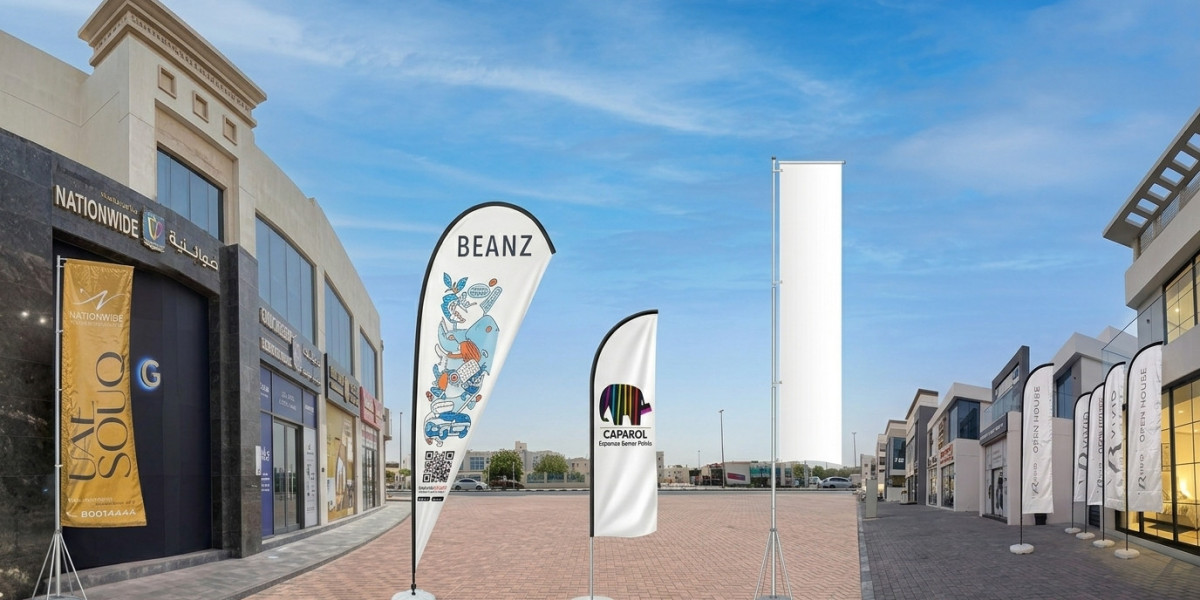

Flags have traditionally been associated with ceremonies, public spaces, and decoration. In modern business environments, however, they can serve a more practical purpose. A well-designed flag can identify a location, communicate a message, guide visitors, or make a temporary event area easier to recognise.
This makes custom flags more than decorative objects. They can become part of a wider visual communication system used by retailers, property businesses, event organisers, restaurants, exhibitions, and other organisations.
In busy commercial areas of Dubai, where businesses often compete for attention from pedestrians and passing traffic, the ability to communicate a simple message from a distance can be particularly useful.
What Makes a Flag a Branding Tool?
A flag becomes a branding tool when its design communicates something specific about a business, event, location, or campaign.
That communication might be as simple as a company logo and brand colours. It could also include a product message, event name, directional information, or promotional campaign.
The important point is that the design should have a clear purpose.
A flag covered with too much information may be difficult to understand when viewed from a distance. In most cases, a short message and strong visual identity are easier to recognise.
1. Helping Customers Find a Business
One of the most practical uses of custom flags is location identification.
A business located inside a commercial complex, behind a parking area, or along a busy road may not always be immediately visible from every direction. Flags positioned near an entrance can provide an additional visual marker.
For example, a showroom can use branded flags along its driveway to help visitors recognise the correct entrance.
This is especially useful when several businesses operate within the same commercial area.
2. Creating Visibility at Events
Events often use temporary structures that may look similar from a distance.
Flags can help identify individual exhibitors, sponsors, activity areas, registration points, or promotional zones. Because flags can be positioned vertically, they can remain visible above some lower-level displays.
At exhibitions in Dubai, a consistent flag design can also connect outdoor entrances with the main indoor display.
The design should match the event's overall visual identity rather than appearing unrelated to other signage.
3. Supporting Promotional Campaigns
Flags can communicate short-term promotional messages without requiring a permanent sign.
Retailers may use them to highlight a seasonal campaign, new product, opening, sale, or special event. Restaurants can use flags to identify a temporary promotion or outdoor activity.
Because promotional campaigns change, the flag design should be easy to understand without relying on excessive text.
A short headline, clear graphic, and recognisable brand identity can often communicate more effectively than a long promotional message.
4. Improving Outdoor Brand Recognition
Outdoor environments create a different challenge from indoor advertising.
A customer may only see a flag for a few seconds while walking, driving, or entering a commercial area. This means visibility and simplicity matter.
Colour contrast, logo size, message length, and flag placement all influence whether the design can be recognised quickly.
Businesses planning custom flags for business visibility can therefore benefit from treating the flag as an outdoor communication surface rather than simply adding a logo to fabric.
5. Guiding Visitors Around a Location
Not every business flag needs to promote something.
Flags can also provide directional information. At large events, sports grounds, outdoor markets, property developments, and temporary activations, they can help visitors identify different areas.
For example, a series of flags could indicate:
Registration
Main entrance
Parking
Product demonstrations
Food areas
Information desks
Activity zones
Using consistent colours and symbols can make the system easier to understand.
6. Supporting Real Estate Marketing
Property developments and real estate businesses often need visibility around large sites.
Flags can be positioned near entrances, sales offices, show properties, or roadside locations to identify a development. They can also support temporary marketing campaigns while construction or sales activity is underway.
The design should prioritise the property name and essential information rather than filling the available space with detailed sales copy.
A visitor who is interested can then receive additional information through the sales office, website, brochure, or representative.
7. Choosing the Right Flag Style
Different flag shapes create different visual effects.
Feather and teardrop styles are often associated with outdoor promotional displays, while other formats may be selected based on available space, wind conditions, mounting requirements, and the desired appearance.
The choice should therefore begin with the location and purpose.
Consider:
Available ground space
Expected wind exposure
Viewing distance
Required height
Installation method
Frequency of use
Transport and storage requirements
A flag that looks suitable in a product catalogue may not necessarily be the most practical choice for a specific location.
8. Designing Flags for Fast Recognition
A flag needs to work differently from a brochure or website.
Visitors are unlikely to stop and read a paragraph printed on a flag. The design should therefore be reduced to its most important elements.
A useful structure might include:
Logo or brand name → short message → simple visual cue
Large typography is generally easier to recognise from a distance. Strong contrast can also help separate the message from the background.
It is worth testing the artwork by viewing it from a distance before production. This can reveal whether the logo is too small or whether the message becomes difficult to read.
9. Considering Dubai's Outdoor Conditions
Outdoor branding in Dubai requires attention to the environment in which the flag will be displayed.
Sun exposure, heat, wind, dust, and frequent movement can affect outdoor display materials over time. Placement and installation should therefore be considered alongside the printed design.
Flags used temporarily for an event may have different requirements from flags intended for repeated outdoor use.
Businesses can also consult a local printing company in dubai such as Zahrat Al Madina Printing when comparing flag formats, printing requirements, and display options for a specific application.
10. Making Flags Part of a Larger Visual System
The strongest use of flags often comes when they work together with other branding elements.
A business might combine flags with storefront signage, banners, promotional tables, vehicle graphics, exhibition displays, or directional signs.
The goal is not to make every item identical. Instead, common colours, typography, logos, and messaging can create a recognisable visual system.
This approach can be especially useful during events where customers encounter a business at several different points.
Final Thoughts
Custom flags have moved beyond their traditional decorative role. They can help businesses identify locations, guide visitors, support promotions, strengthen event branding, and communicate simple messages in outdoor environments.
Their effectiveness depends less on how much information can fit onto the fabric and more on how quickly the intended message can be understood.
By choosing an appropriate flag style, keeping the design clear, considering the viewing environment, and connecting the flag with other branding elements, businesses can turn a simple outdoor display into a useful communication tool.








