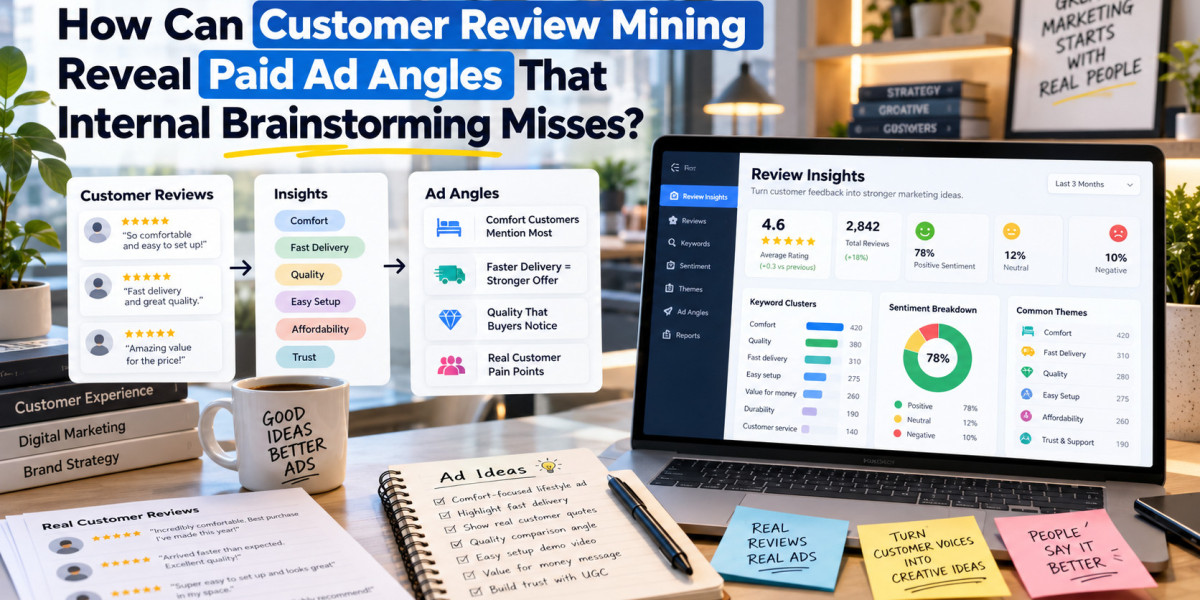

Marketing teams often search for new advertising ideas by holding brainstorming sessions, studying competitors, or asking creative teams to produce more concepts. These methods can be useful, but they sometimes create messages based on what the business wants to say rather than what customers genuinely care about.
Customer reviews provide a different source of insight. They contain real descriptions of problems, expectations, objections, disappointments, and successful outcomes. When these patterns are analysed carefully, they can reveal advertising angles that internal teams may never consider.
Customer review mining for ad creative is the process of collecting and organising language from customer feedback to develop more relevant hooks, benefits, proof points, and campaign messages. It does not mean copying reviews directly into advertisements. The objective is to understand how customers describe their experiences and convert those insights into responsible advertising ideas.
Why Internal Brainstorming Can Become Limited
People working closely with a product naturally understand its features, technical details, and intended value. However, this knowledge can make it difficult to see the buying experience from a customer’s perspective.
Internal teams may use professional terminology that customers do not understand. They may promote features that seem important inside the company but have little influence on purchasing decisions. They may also overlook small concerns that repeatedly prevent customers from converting.
A creative strategist can bring structure to the idea-development process, but strong concepts still require reliable customer evidence.
Reviews help challenge internal assumptions. They show which benefits customers mention without being prompted, which frustrations appear repeatedly, and which expectations are not being met.
What Customer Reviews Can Reveal
A single review may reflect one person’s experience. A large group of reviews can reveal patterns.
Positive reviews often explain why customers chose the product, what almost stopped them from purchasing, and which outcome they valued most. Negative reviews can identify unclear expectations, product limitations, delivery concerns, service problems, or missing information.
Reviews may reveal:
· The original problem that motivated the purchase
· The language customers use to describe that problem
· Features that create the most noticeable value
· Common concerns before buying
· Unexpected benefits discovered after purchase
· Situations in which the product performs best
· Reasons some customers feel disappointed
These insights can support better advertising because they come from actual experiences rather than assumptions about the audience.
Start With a Clear Research Question
Review mining becomes unmanageable when a team collects large amounts of feedback without knowing what it wants to learn.
Before gathering reviews, the business should define a research question. It may want to discover why customers switch from competitors, which objections delay purchases, what outcomes create satisfaction, or why some buyers request refunds.
A clear question helps the team focus on relevant evidence.
For example, a campaign struggling with click-through rates may need stronger hooks. A campaign receiving clicks but few conversions may need objection-related messaging. A product receiving many first-time purchases but weak retention may require research into expectations and post-purchase experience.
Effective audience research connects the research objective with the stage of the customer journey that needs improvement.
Collect Feedback From Multiple Sources
Businesses should not depend only on testimonials displayed on their own websites. These are often selected because they present the brand positively and may not represent the full customer experience.
Useful sources can include product reviews, marketplace feedback, app-store comments, customer surveys, support conversations, sales-call notes, social media comments, community discussions, cancellation responses, and reviews of competing solutions.
Competitor reviews are particularly valuable when a business is entering a market or has limited customer data. They can reveal common category-level expectations and frustrations.
However, teams should avoid taking isolated statements as universal truths. The objective is to identify repeated themes across enough feedback to make the insight meaningful.
Organise Reviews Into Useful Categories
Collecting feedback is only the first step. The information must be organised before it can guide creative decisions.
A simple review-mining framework may classify statements under categories such as:
Problems
What situation or frustration encouraged the customer to look for a solution?
Desired Outcomes
What did the customer hope to improve, achieve, save, avoid, or simplify?
Objections
What concerns made the customer hesitate before purchasing?
Triggers
What event caused the customer to take action at that particular time?
Valued Benefits
Which parts of the experience created the strongest satisfaction?
Complaints
Where did the product, service, delivery, or communication fail to meet expectations?
The team can also record the frequency of each theme. Repetition does not automatically make an idea valuable, but it helps distinguish common concerns from unusual individual experiences.
Turn Customer Language Into Advertising Angles
Once patterns are identified, the team can translate them into creative hypotheses.
Suppose customers repeatedly say that a service helped them understand where their advertising budget was being wasted. The advertising angle should not simply claim that the service provides “advanced campaign management.” A clearer angle may focus on identifying hidden budget leakage before increasing campaign spend.
If buyers repeatedly praise a product because it saves them time during a particular task, the advertisement can demonstrate that task and show the improvement. If negative reviews frequently mention confusing setup instructions, the campaign may need to explain onboarding more clearly rather than hiding the concern.
Review-derived advertising angles may focus on:
· A frequently mentioned pain point
· A specific before-and-after experience
· A common misconception
· An overlooked use case
· A reason customers switch
· A repeated objection
· An unexpected benefit
The language should be adapted into original advertising copy. Reviews should inform the message, not become material that is copied without permission or context.
Match the Angle With the Right Format
A useful insight can still underperform if it is presented in the wrong creative format.
A visual demonstration may suit a product benefit that is easy to show. A customer-story video may work better for an emotional transformation. A static advertisement can communicate a simple pain point and solution. A comparison creative may address dissatisfaction with an alternative.
Professional performance creative services should connect the customer insight with the platform, audience awareness level, and desired action.
The same theme can also be expressed through several formats. Testing different executions helps determine whether the insight is weak or whether the original presentation simply failed to communicate it effectively.
Test Review-Derived Angles as Hypotheses
Customer feedback provides direction, but it does not guarantee campaign success. Each angle should be treated as a testable hypothesis.
A team can test several review-derived themes while controlling other campaign variables where practical. Performance should be evaluated through more than clicks. Depending on the campaign objective, useful metrics may include conversion rate, qualified-lead rate, purchase value, customer acquisition cost, retention, and revenue.
The team should also examine whether the advertisement sets accurate expectations. An angle that generates many conversions but increases refunds or complaints may be attracting customers with the wrong promise.
Avoid Misleading Claims
Customer statements can be powerful, but not every statement should become an advertising claim.
A dramatic outcome experienced by one customer may not represent normal results. Sensitive information should not be used without permission. Reviews should not be edited in ways that change their meaning.
Businesses should also distinguish between customer language and verified product facts. Review mining helps identify what matters to the audience, but advertising claims still need to be accurate, supportable, and appropriate for the market.
Build a Repeatable Review-Mining Process
Customer review mining for ad creative should not be a one-time exercise. New reviews can reveal changes in customer expectations, competitor positioning, product quality, and market conditions.
Teams can schedule monthly or quarterly review sessions, maintain a shared insight library, label themes by customer segment, and record which ideas have already been tested.
This creates a stronger connection between customer experience and campaign development. It also prevents creative teams from repeatedly returning to the same generic concepts when they need new ideas.
Final Thoughts
Internal brainstorming remains useful, but it becomes more effective when supported by real customer evidence. Reviews reveal how customers describe their problems, what they value, what makes them hesitate, and where expectations are not being met.
The purpose of customer review mining for ad creative is not to collect attractive quotations. It is to find repeated patterns that can become relevant hooks, believable benefits, clearer objection handling, and more useful campaign tests.
The best advertising angles are often already present in customer conversations. Businesses simply need a structured process for finding, interpreting, and testing them.
Frequently Asked Questions
What is customer review mining?
Customer review mining is the process of analysing customer feedback to identify repeated problems, desired outcomes, objections, benefits, and language that can inform marketing decisions.
Can businesses use competitor reviews for research?
Yes. Competitor reviews can reveal category-level frustrations and expectations. However, businesses should use them for insight rather than copying claims, testimonials, or creative content.
How many reviews should a business analyse?
There is no universal number. The goal is to review enough feedback to identify repeated patterns rather than relying on a few unusually positive or negative experiences.
Should customer language be copied directly into ads?
Not necessarily. Customer language can guide messaging, but businesses should create original copy and obtain permission before using identifiable testimonials or direct quotations.
How often should review mining be conducted?
Monthly or quarterly analysis is useful for active brands. It should also be repeated after product changes, new campaigns, market shifts, or an increase in complaints and refunds.