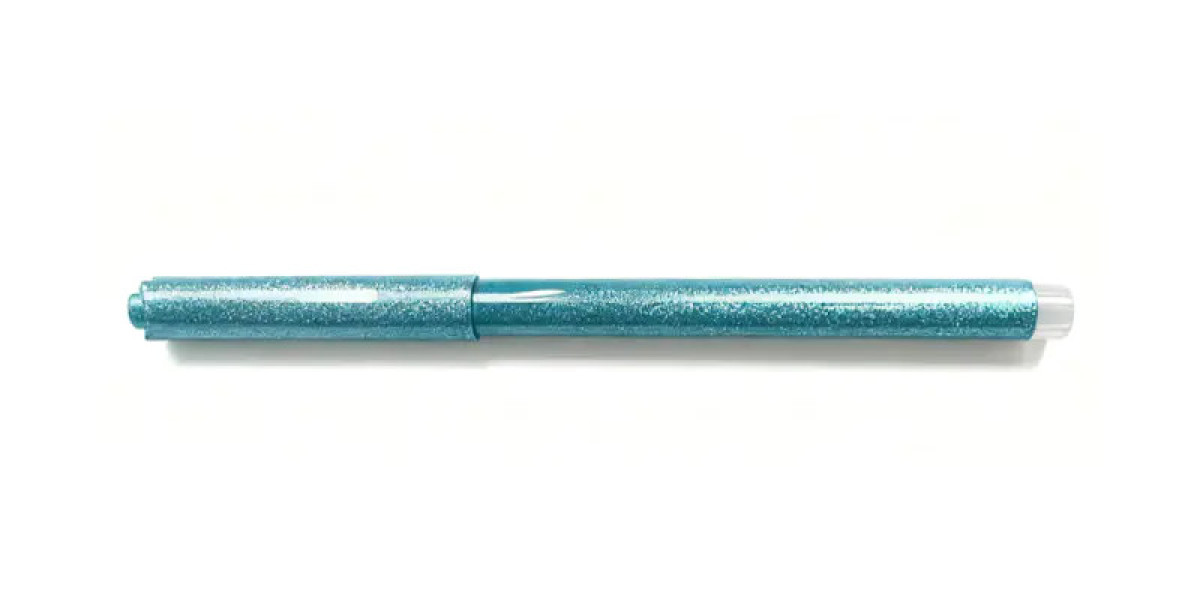

A glitter pen may look simple from the outside, but the writing performance depends heavily on what happens inside the barrel. A Normal Glitter Pen contains colored ink and small glitter particles that need to move through the internal ink-delivery system without creating excessive buildup around the nib.
Particle suspension is one of the main considerations. Because glitter particles are heavier than the surrounding liquid, they can gradually settle when a pen remains unused for a period of time. If the carrier liquid is too thin, the particles may separate quickly, causing the glitter effect to become less noticeable toward the end of a writing session. A suitable viscosity helps keep the particles distributed more evenly while still allowing the ink to travel through the nib.
Particle size also needs to correspond with the internal ink path. Glitter flakes that are too large can become trapped in narrow channels and restrict ink flow. This can lead to skipping, reduced glitter output, or complete blockage around the writing tip. Using particles with a controlled size range makes it easier for the glitter to move through the system without excessive interference.
The nib itself is another important part of the design. Unlike a conventional marker nib that mainly needs to deliver liquid ink, a glitter pen nib must also allow solid particles to pass through. Its internal structure therefore needs enough clearance for the particles while still maintaining a manageable writing flow. If the passage is too narrow, clogging becomes more likely; if it is too open, the ink may flow too quickly and produce an uneven line.
This is also why shaking a glitter pen before use is common. Even when the suspension has been carefully formulated, some settling can occur during storage. Shaking redistributes the particles through the liquid so that the first strokes contain a more consistent concentration of glitter. The amount of shaking required can vary depending on particle density, liquid viscosity, storage time, and the overall formulation.
The balance becomes particularly noticeable when a Normal Glitter Pen is used repeatedly. A pen that produces strong sparkle during an initial sample test may behave differently after several days of storage if the particles settle excessively. Long-term writing performance therefore depends on maintaining a workable relationship between the glitter material, carrier liquid, reservoir, and nib.
Manufacturing consistency matters for the same reason. Differences in particle size, ink viscosity, filling volume, or nib assembly can affect how individual pens perform. When many units are produced in the same batch, maintaining similar material and assembly conditions helps reduce noticeable differences in writing flow and glitter distribution.
A Normal Glitter Pen ultimately depends on a balance between visual effect and mechanical ink delivery. Glitter particles need to remain sufficiently dispersed, the ink must flow through the nib, and the writing tip must provide enough clearance without sacrificing control. These details determine whether the finished pen produces a smooth line with consistent sparkle instead of becoming difficult to use after repeated storage and writing.