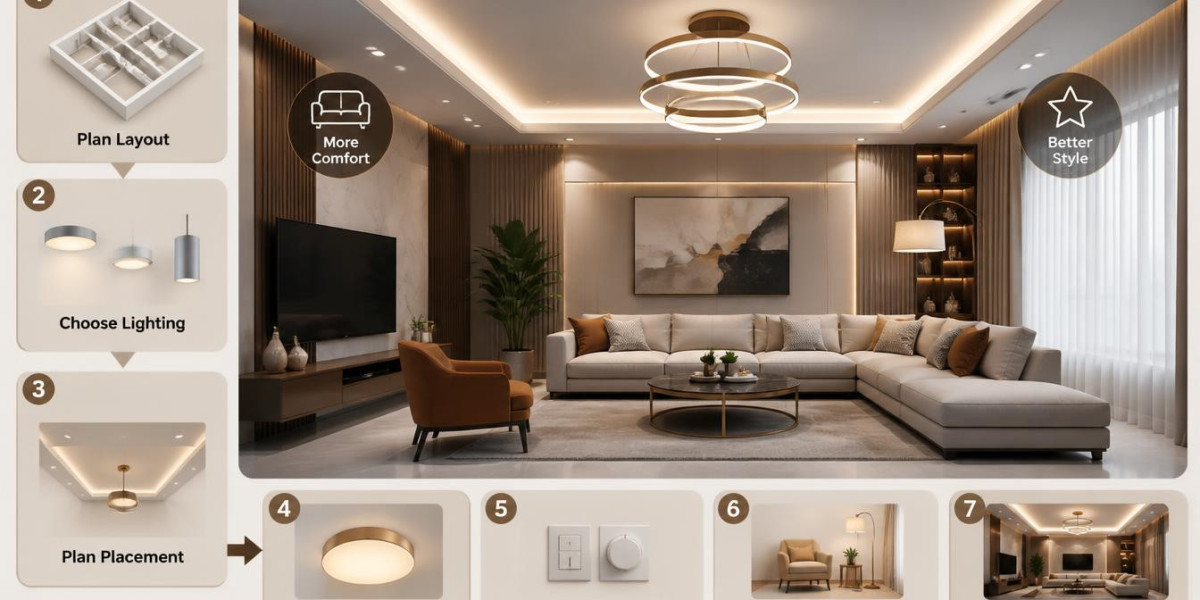

Wrong lighting makes even an excellent living room dull. On the contrary, good living room ceiling lights make the room stand out. The point is that lighting is not only about brightness.
There are many things that may affect the way people perceive the light in the evening, some of which are its color and light distribution.
How Do Living Room Ceiling Lights Elevate Comfort?
Lighting improves people's ability to see. Correct placement of ceiling fixtures will provide you with uniform lighting throughout your living room.
The lighting of the evening is important. Overly bright exterior lighting at night can interfere with the body’s natural melatonin production. The best plan is to pick a dimmable light.
A dimmable fixture offers more control. It lets homeowners reduce brightness as evening activities shift from reading and conversation toward relaxation. An LED ceiling fixture can also be controlled and dimmed when both the fixture and the control are compatible.
Big Room, Big Light: How Does Square Footage Define Your Setup?
The room size of an area plays a significant role in how much light is needed. In general, larger spaces would require more light as you are illuminating a bigger area.
The U.S. Department of Energy gives a living-space rule of thumb of approximately 5–20 lumens per square foot.
The table below applies that range to common U.S. living-room dimensions.
Living Room Area | At 10 Footcandles | At 20 Footcandles |
100 sq. ft. | 1000 lumens | 2000 lumens |
150 sq. ft. | 1500 lumens | 3000 lumens |
200 sq. ft. | 2000 lumens | 4000 lumens |
(Calculated from the DOE's 10–20 lumens-per-square-foot living-space guideline. Actual requirements vary with finishes, ceiling height, fixture distribution, daylight, and activities).
This range is broad for a reason. A room used mainly for conversation may need less illumination than one combining reading, games, entertaining, and detailed activities.
Which Light Characteristics Improve Everyday Comfort?
Color temperature changes the visual character of a room. DOE guidance identifies roughly 2700K–3000K as a suitable warm range for many residential applications.
Using warm light in seating areas can create a tranquil environment. Different color temperatures of light may create different ambience. However, the best choice of light depends on the finishes, activities, and mood of the room.
Quality of light is also significant. The Department of Energy mentions specific LED product measurements: lumens, wattage, efficacy, color temperature, and color rendering capability.
Concerning living room lighting, the distribution must also be considered. When there is enough luminous output, but the light is very focused, the lighting will have both brighter and darker spots.
Ambient illumination provides uniform illumination that makes one feel comfortable, since the difference between the bright and dark spots is reduced.
What Are The Effects Of Ceiling Lights In Room Design?
The right ceiling lighting design can change the shape, scale, texture, and contrast of modern interior design. Flush mounts should be used with shorter ceilings. These lights take up little space visually but provide enough light to every corner of modern interiors.
Bigger spaces can accommodate bolder forms of ceiling fixtures. A sculptural object view and a multi-layered pendant installation create an incredible effect.
The light has to match the proportions of the room. This is where CIRC Lighting provides solutions that can fit seamlessly into the design.
What To Consider Before Making A Fixture Choice?
Consider the room measurements at first. After that, consider the ceiling height, the furniture arrangement, natural light, the activity, and the main lighting function: general or layered.
Checklist to follow before finalizing the design:
Find out an approximate amount of necessary lumens based on the size of the room.
Select a warm color temperature for homes to achieve a calming atmosphere.
Make sure both the fixture and the control system have dimming capabilities.
Consider light distribution as well instead of judging brightness only according to the wattage.
Consider CRI when accurate color appearance is important for furniture, artwork, and decor.
These factors transform the decorative procurement into the functioning lighting decision.
Conclusion
Comfort goes hand-in-hand with style. The ideal living room ceiling lights are those that will deliver adequate lighting and allow for versatile evening use. Thus, selection based on lumens, color temperature, light distribution, and control mechanisms is more purposeful than selecting based only on aesthetics.