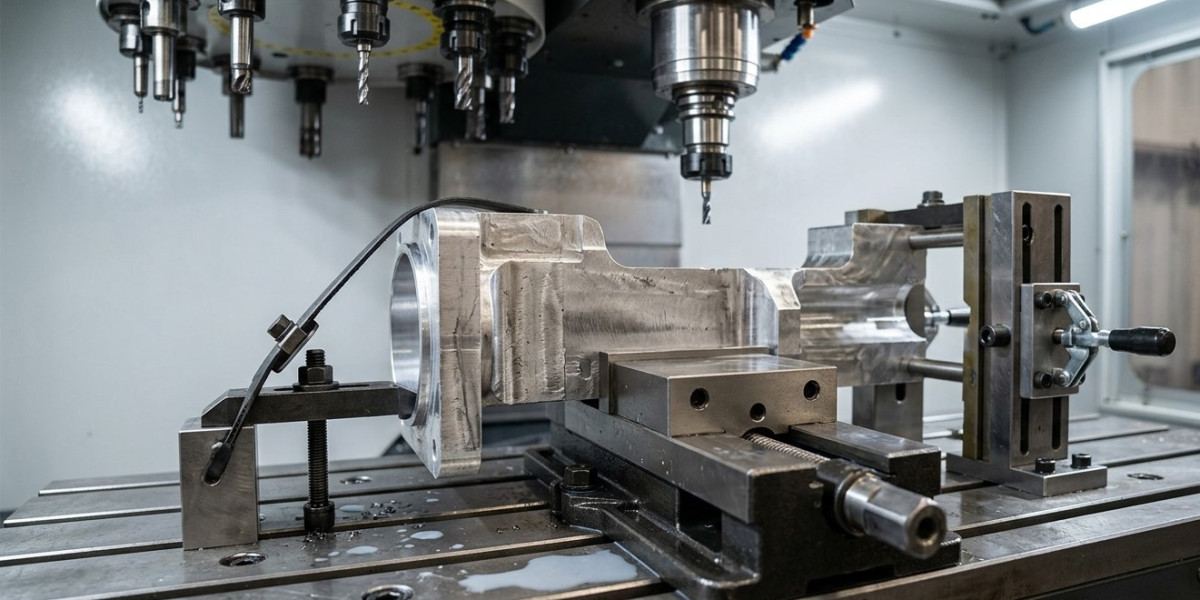

Precision machining depends on more than advanced CNC machines and high-quality cutting tools. A workpiece must also be held securely, positioned accurately, and supported consistently throughout the machining process. This is the role of a CNC workholding system. The right workholding solution helps reduce movement, vibration, setup errors, and dimensional variation while improving machining accuracy and productivity.
For engineering workshops, manufacturing companies, and CNC machining operations, choosing suitable workholding equipment is an important part of building a reliable production process. Khokhawala Trading LLC, an experienced Industrial Tools Supplier in Dubai, provides industrial tooling and machining solutions, including chucks, vises, milling accessories, cutting tools, and precision measuring tools for demanding industrial applications.
What Is a CNC Workholding System?
A CNC workholding system is a collection of devices used to secure and position a workpiece during machining. It prevents unwanted movement while cutting forces are applied and helps maintain a consistent relationship between the workpiece and cutting tool.
Common CNC workholding solutions include:
- CNC machine vises
- Three-jaw and four-jaw chucks
- Collet chucks
- Hydraulic chucks
- Pneumatic workholding
- Clamping systems
- Modular fixtures
- Vacuum fixtures
- Magnetic workholding
- Custom fixtures
- Soft jaws and specialized jaws
The appropriate system depends on the CNC machine, workpiece shape, material, production volume, machining operation, and required accuracy.
Why CNC Workholding Is Important
During machining, cutting tools generate forces that can cause a poorly secured workpiece to move or vibrate. Even a small amount of movement can result in dimensional errors, poor surface finish, tool damage, or component rejection.
A properly designed workholding system provides several important benefits.
Improved Machining Accuracy
Secure workholding keeps the workpiece in a controlled position. This helps the cutting tool follow the programmed toolpath accurately and supports consistent dimensional results.
Reduced Vibration
Vibration can affect surface finish, tool life, and machining stability. Proper clamping and adequate support can reduce unwanted movement during cutting.
Faster Setup
Efficient workholding systems can reduce the time required to load, align, and secure workpieces. This is particularly valuable in production environments where machines are frequently changed between jobs.
Improved Repeatability
Repeatable positioning is essential when manufacturing multiple components with the same specifications. Suitable fixtures and locating systems help maintain consistency between parts.
Common Types of CNC Workholding Systems
Different workholding systems are designed for different machining applications.
1. CNC Machine Vises
CNC vises are widely used on vertical and horizontal machining centers. They hold rectangular, square, and irregularly shaped components securely during milling and drilling.
Precision vises may incorporate hardened jaws, replaceable jaws, quick-change systems, or specialized clamping mechanisms.
They are suitable for:
- Milling
- Drilling
- Tapping
- Pocketing
- Profiling
- Contouring
2. Three-Jaw Chucks
Three-jaw chucks are commonly used on CNC lathes for holding round or hexagonal workpieces. The jaws move together, allowing the workpiece to be centered automatically.
They are particularly useful for repetitive turning operations where fast and consistent loading is required.
3. Four-Jaw Chucks
Four-jaw chucks provide greater flexibility because individual jaws can be adjusted independently. This makes them useful for irregularly shaped workpieces and applications where precise alignment is required.
They can also be used when the workpiece needs to be positioned away from the spindle centerline.
4. Collet Chucks
Collet systems provide accurate gripping for smaller cylindrical components. They are often used where repeatability, concentricity, and quick loading are important.
Collets are available in different sizes and designs to accommodate various workpiece diameters.
5. Hydraulic and Pneumatic Workholding
Hydraulic and pneumatic systems use fluid or compressed air to generate clamping force. These systems are particularly useful in high-volume production environments.
They can provide:
- Fast clamping
- Consistent clamping force
- Reduced manual setup
- Automation compatibility
- Improved production efficiency
6. Modular Fixtures
Modular workholding systems use interchangeable components that can be configured for different workpieces. This can reduce the need to manufacture a completely new fixture for every component design.
They are particularly useful for workshops producing multiple component types or smaller production batches.
7. Vacuum Workholding
Vacuum fixtures hold components by creating a pressure differential between the workpiece and fixture surface.
They are commonly used for thin, flat, or delicate components where conventional mechanical clamping may cause deformation or obstruct the machining area.
Selecting the Right CNC Workholding System
Choosing workholding equipment should begin with a clear understanding of the machining operation and workpiece requirements.
Consider the Workpiece Shape
The geometry of the component is one of the first factors to consider.
Round components may be better suited to chucks or collets, while rectangular components are commonly held in CNC vises. Irregular parts may require specialized or custom fixtures.
Consider Workpiece Material
Different materials can respond differently to clamping pressure.
Soft materials may require carefully controlled force to prevent deformation. Harder materials may allow stronger clamping but can still require appropriate jaw and contact surfaces.
Determine Required Clamping Force
The workholding system must generate enough force to resist machining forces without damaging the component.
Too little clamping force can allow movement, while excessive force may deform thin or delicate workpieces.
The required force depends on factors such as cutting conditions, material, contact area, workpiece geometry, and machining direction.
Evaluate Accessibility
Workholding should secure the component without unnecessarily blocking the cutting tool.
Before choosing a fixture, consider where the cutting tool needs to approach the workpiece and whether the jaws or clamps will interfere with machining.
Good workholding provides adequate access while maintaining sufficient support.
The Importance of Rigidity
Rigidity is one of the most important characteristics of a precision CNC workholding setup.
A rigid system minimizes movement when cutting forces are applied. This is especially important during heavy milling, high-speed machining, deep cuts, and operations involving hard materials.
Excessive fixture movement can cause:
- Chatter
- Poor surface finish
- Dimensional inaccuracies
- Tool wear
- Insert damage
- Reduced productivity
The fixture, machine table, workpiece, jaws, and tool holder should work together as a stable system.
Workholding and CNC Tool Holders
Workholding and tool holding are separate parts of the machining setup, but both influence overall accuracy.
A secure workpiece cannot compensate for excessive tool movement, runout, or poor tool holding.
High-quality CNC tool holders help maintain cutting tool stability and position. When combined with appropriate workholding, they create a more rigid machining environment.
For example, a precision vise holding the component securely should be paired with suitable CNC machining tools and a rigid tool holder to achieve consistent machining results.
Soft Jaws and Custom Workholding
Soft jaws are frequently used when standard hardened jaws do not provide the required gripping arrangement.
They can be machined to match the shape of a specific component, providing greater contact and improved positioning.
Custom workholding may be appropriate for:
- Complex components
- Thin-wall parts
- High-volume production
- Multi-operation machining
- Components requiring repeatable positioning
However, custom fixtures should be designed carefully to provide sufficient support while maintaining tool accessibility.
Workholding for Different CNC Operations
Different machining operations place different demands on the workholding system.
Milling
Milling generates cutting forces that can act in multiple directions. A rigid vise or fixture with sufficient clamping force is essential.
Turning
Turning commonly uses chucks, collets, or specialized fixtures. Concentricity and workpiece projection are particularly important.
Drilling
Drilling generates axial forces and torque. The workholding system must prevent rotation and movement.
Threading
Threading operations require stable workholding because inconsistent movement can affect thread geometry and dimensional accuracy.
Heavy Machining
Heavy material removal generates higher cutting forces. Robust fixtures and secure clamping become especially important.
Common CNC Workholding Problems
Even a good workholding system can perform poorly if it is incorrectly used.
Workpiece Movement
Movement may occur because of insufficient clamping force, incorrect jaw positioning, contamination, or inadequate contact.
Workpiece Deformation
Thin components can deform if excessive clamping pressure is applied. Operators should consider the workpiece's shape, material, and wall thickness.
Poor Repeatability
Inconsistent loading or incorrect locating surfaces can cause variations between components.
Chatter
Chatter may result from insufficient rigidity, excessive workpiece projection, poor clamping, or unsuitable cutting conditions.
Fixture Interference
A fixture may unintentionally block tool access. Workholding should always be evaluated against the complete machining sequence.
Best Practices for CNC Workholding
Workshops can improve workholding performance by following several practical guidelines:
- Clean all contact and locating surfaces before clamping.
- Use the correct fixture for the workpiece geometry.
- Apply sufficient but controlled clamping force.
- Minimize unsupported workpiece projection.
- Keep workholding components properly maintained.
- Check jaw and fixture condition regularly.
- Verify workpiece alignment before machining.
- Avoid unnecessary fixture interference.
- Use appropriate cutting conditions for the setup.
- Verify finished dimensions with suitable measuring equipment.
These practices help create more consistent machining processes.
Role of Precision Measurement
Workholding accuracy should not be assumed simply because a component appears properly clamped.
Precision measuring tools can be used to verify workpiece position, dimensions, alignment, and finished features.
Depending on the application, workshops may use:
- Vernier calipers
- Micrometers
- Dial indicators
- Height gauges
- Bore gauges
- Depth gauges
- Thread gauges
Measurement and inspection help identify errors early and support consistent production quality.
Benefits of a Proper CNC Workholding Strategy
A well-designed workholding system can contribute to:
- Better dimensional accuracy
- Improved repeatability
- Reduced vibration
- Faster setups
- Improved operator efficiency
- Better surface finish
- Longer tool life
- Lower risk of workpiece movement
- Improved production consistency
- Reduced machining downtime
For high-volume manufacturing, efficient workholding can also support automation and reduce manual intervention.
Conclusion
CNC workholding systems are an essential part of precision machining. The right vise, chuck, collet, fixture, clamping system, or specialized workholding solution can improve stability, accuracy, repeatability, and production efficiency.
When selecting a system, manufacturers should consider workpiece geometry, material, clamping force, machining operation, accessibility, rigidity, production volume, and required accuracy. Workholding should also be evaluated together with CNC tool holders, cutting tools, machine capabilities, and measurement equipment.
For businesses seeking dependable machining solutions, Khokhawala Trading LLC provides a wide range of industrial tools and machining accessories, including chucks, vises, cutting tools, and precision measuring tools. As an experienced Industrial Tools Supplier in Dubai, Khokhawala Trading LLC supports engineering workshops, CNC machining companies, manufacturers, and industrial businesses with tooling solutions designed for demanding applications.
A properly selected and maintained CNC workholding system is more than a clamping device—it is an important part of achieving stable, accurate, and repeatable machining performance.