
English spelling can sometimes be confusing, especially when two words look almost identical. One common example is “pacient or patient.” If you have ever wondered which spelling is correct, you are not alone. These words differ by just one letter, but only one is considered the standard English spelling.
In this guide, we will explain whether “pacient” or “patient” is correct, what patient means, how to use it in sentences, and why this spelling mistake occurs.
Pacient or Patient: Which Spelling Is Correct?
When choosing between pacient or patient, the correct English spelling is patient.
“Pacient” is an incorrect spelling in standard English. Although it may look reasonable because of similar words in other languages, it is not the accepted spelling in English.
For example:
Correct: She is very patient with her children.
Incorrect: She is very pacient with her children.
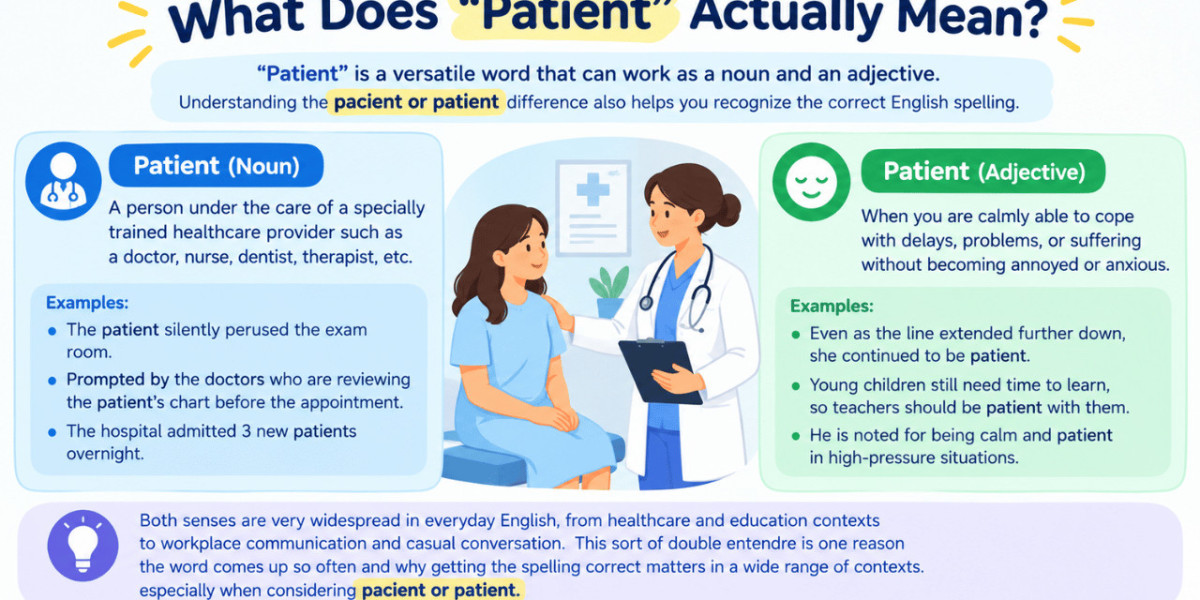
The word patient can function as both a noun and an adjective, depending on the context.
What Does Patient Mean?
The word patient has two main meanings in English.
As an adjective, patient describes someone who can remain calm and tolerate delays, difficulties, or annoying situations without becoming upset.
For example:
He was patient while waiting for his turn.
As a noun, patient refers to a person receiving medical care or treatment from a doctor, nurse, dentist, or other healthcare professional.
For example:
The doctor examined the patient carefully.
These two meanings are spelled the same but are understood from the context.
Why Do People Write “Pacient” Instead of “Patient”?
The confusion surrounding pacient or patient often comes from pronunciation and spelling patterns. When people hear the word “patient,” they may mistakenly associate its pronunciation with a spelling containing “ci.”
Another reason is that similar-looking words can influence how people spell it. In addition, people who are learning English may naturally write the word according to how they think it sounds.
However, remembering the spelling P-A-T-I-E-N-T can help prevent the mistake.
Patient as an Adjective
When used as an adjective, patient describes someone who remains calm and understanding, especially when dealing with a difficult or slow situation.
Here are some examples:
My teacher is very patient with beginners.
You need to be patient while learning a new skill.
She was patient despite the long delay.
Good parents are often patient with their children.
He remained patient during the difficult process.
In these sentences, patient describes a person's behavior or attitude.
Patient as a Noun
As a noun, patient usually refers to someone receiving medical attention.
Examples include:
The patient visited the clinic for a checkup.
The nurse spoke with the patient.
The doctor asked the patient about their symptoms.
Every patient deserves respectful care.
The hospital admitted a new patient.
Here, patient refers to a person receiving healthcare rather than someone who is calm or tolerant.
Patient vs. Patience
Another common source of confusion is the difference between patient and patience.
Patient can describe a person who remains calm or can refer to someone receiving medical treatment.
Patience is the noun that describes the ability to remain calm while waiting or dealing with difficulties.
For example:
She is patient with her students.
She has a lot of patience with her students.
A simple way to remember the difference is:
Patient = a person or a quality describing someone
Patience = the ability to remain calm and tolerate difficulties
Easy Examples of “Patient”
Here are a few everyday examples to help you understand the correct usage:
Please be patient; your order will arrive soon.
The patient is waiting to see the doctor.
You must be patient when teaching young children.
The doctor spoke kindly to the patient.
Learning a language requires patience and a patient attitude.
These examples show how the same word can have different meanings depending on the sentence.
How to Remember the Correct Spelling
If you often confuse pacient or patient, try remembering the word as three parts:
PAT + I + ENT = PATIENT
You can also connect it with the word patience. Both words begin with “patien-”, which can make their spelling easier to remember.
Whenever you are unsure, remember that “pacient” is not the standard English spelling. “Patient” is correct.
Common Mistakes With Patient
One of the most common mistakes is replacing the “t” with a “c”, creating “pacient.” This is especially common when someone relies heavily on pronunciation rather than memorizing the spelling.
Incorrect:
He is a very pacient person.
Correct:
He is a very patient person.
Incorrect:
The pacient is waiting outside.
Correct:
The patient is waiting outside.
Paying attention to the spelling can make your writing clearer and more professional.
Patient in Everyday English
The word patient is frequently used in everyday conversations, educational writing, workplace communication, and healthcare-related contexts.
You might use it when describing someone's personality:
She is patient and understanding.
You might also use it when talking about healthcare:
The patient has an appointment at 10 a.m.
Because the word has two common meanings, context helps readers understand what you mean.
Final Thoughts
When it comes to pacient or patient, the correct English spelling is patient. The spelling “pacient” is a common mistake, but it is not considered standard English.
Remember that patient can describe someone who remains calm and tolerant, or it can refer to a person receiving medical care. Learning these meanings and practicing the correct spelling can help you avoid this common error in everyday writing.
The easiest rule to remember is simple: Use “patient,” not “pacient.”