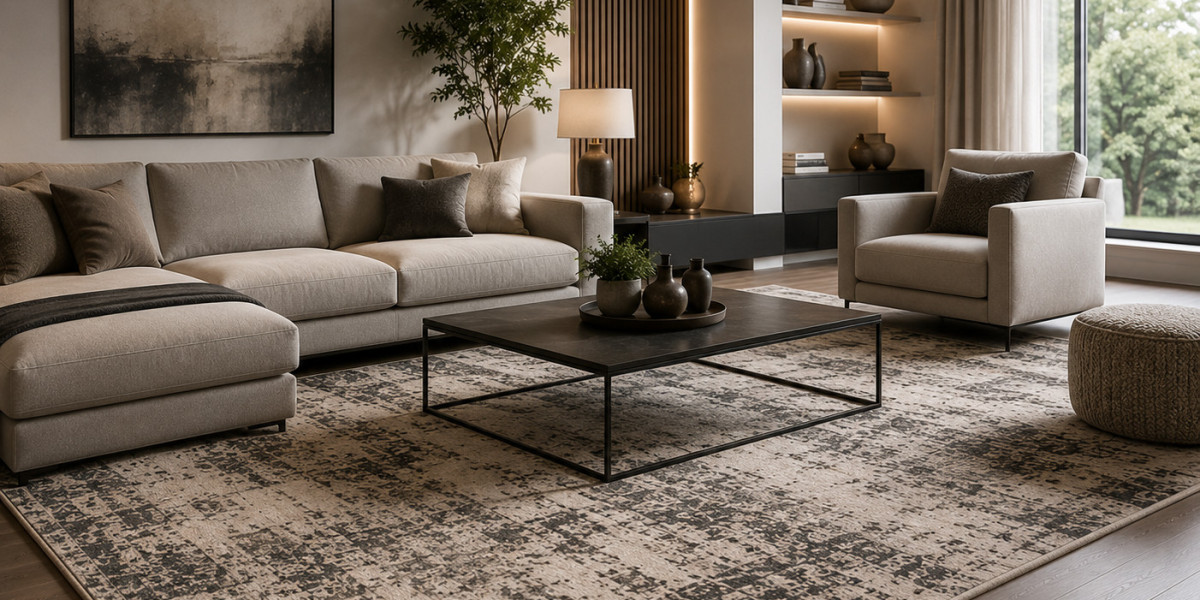

Habits are formed much less through willpower than people imagine; habits are formed around triggers — small and consistent environmental signs that inform the brain what actions are expected next. People take off their shoes when coming into the house because they see the mat. The coffee is always made in three specific actions because of the constant layout of the kitchen. Design impacts people's behavior in a much more significant way than people realize, and contemporary living room rugs provide an example of a trigger camouflaged in plain sight.
Stepping on the soft carpet after a long working day, something changes automatically; shoulders become relaxed, steps become slower. It is not accidental or imaginary. The distinctive alteration of the surface becomes a trigger that indicates the end of the old phase and the beginning of the new one; the trigger that is used by people at their front door to indicate the transition from outside life to inside. A living room rug is a larger-scale version of such a transition.
How a Rug Becomes a Behavioral Cue
It may sound fairly simplistic once it has been explained. Habitual behavior requires consistency, in that the same stimulus repeated will, eventually, lead to the same action being taken subconsciously. A rug which is always present, always soft, and which always designates the same area as one to relax in, becomes a part of those stimuli, much like a particular chair or mug does.
That is one reason why an unfurnished living room floor made of hard material can feel somewhat off even when no other aspects of the room have been altered. That lack of textural stimulus leaves the room with no particular cue for the mind to focus on, and thus makes the room feel more like a passage than a place.
What Makes a Rug Read as Genuinely Modern
The term “modern” can be applied liberally to furniture descriptions, but there are some distinguishing characteristics that set apart rugs that have the modern look from those that lack character:
Geometric designs in place of busy traditional designs
Pile height that is even and compact as opposed to thick or shabby-looking
Color schemes that are subdued and monochromatic – such as greys, whites, and black – to go with minimalist furniture and not work against it
Quality craftsmanship without being visually complicated, in which case hand-tufting beats industrial weaving
It goes without saying that such a rug will blend well into a design that is based on clean lines without having to adjust the furniture in the space around it.
Wool vs. Cotton: Choosing the Material Behind the Cue
For a rug to serve as a dependable daily prompt, it has to withstand everyday use – thus, the choice of material is even more critical than one may think.
The wool carpet is the more durable choice. It does not crush under repeated pressure of feet, maintains its color for years instead of months, and retains its texture intact, which is necessary for a rug intended to produce an identical relaxing effect every day. The downside is its cost and somewhat heavier texture.
A cotton carpet sacrifices some of its durability for the sake of versatility and convenience. Being lighter, less expensive, and easier to wash, this type of carpet is a reasonable choice for families that need to change their interior style regularly or encounter too much dirt and grime on a daily basis.
When Practicality Has to Win
Only if a cue is really there can it function as one – and when a rug is pulled out, cleaned after each spill, as cleaning it is not easy, then it ceases to work as a cue altogether. Washable rugs and washable carpet rugs help overcome more than just a nuisance; a rug that can easily be cleaned and put back on the floor becomes a regular part of the routine rather than a delicate object.
The Same Cue Logic Shows Up in Other Rooms
Once you've become aware of how a rug influences your living room behavior, it is quite simple to recognize the same occurrence elsewhere in the house, but this time signaling another activity.
The entryway rug is possibly the clearest instance of all — it is the tangible reminder of the shoes-off ritual, the boundary that ensures that the inside always stays clean without having to rely on someone to enforce it verbally. Families who have a reliable entryway rug installed in their home will have this ritual work far better than those who just remind themselves about it.
The kitchen rug is yet another cue for a completely different routine — namely the standing-cooking space, generally situated by the sink or stove, marking the area where meal preparation takes place.
In the case of the rug in the dining area, the meaning is somewhat different – the rug demarcates the area where people will sit and eat, separated from the larger open-plan area, encouraging them to remain seated throughout the meal instead of sitting elsewhere.
Similarly, the rug near the reading chair or even beside the bed is meant for the same purpose, but on a smaller scale, providing some texture indicating "here is where I am going to stop" or "here is where my day starts."
Making These Cues Feel Cohesive, Not Random
None of these areas have to match in their appearance in order to be used together successfully. Instead, what is important is that there is an overall sense of cohesion in terms of tone and materials that tie the entryway rug, the living room rug, and the kitchen rug together in terms of one cohesive home.
Keeping the Cue Working Long-Term
An old rug or one that is visibly deteriorated no longer serves as a welcoming indicator but becomes clutter instead. The rug should be vacuumed regularly to maintain its uniform texture on the floor, and should be turned every few months to avoid wear from walking paths on it; regular deep-cleaning is necessary, particularly for a wool rug.
Final Thought
In addition to occupying floor space, a rug also teaches manners in subtle increments that go unnoticed by most people. Contemporary living room rugs indicate the point where the pace of life slows down, like how an entryway rug shows the point at which the outside world leaves behind the inside, while a kitchen rug indicates the start of the task of preparing the food. Selecting the right rug is more than picking something stylish; it is establishing a signal that tells everyone what will follow.