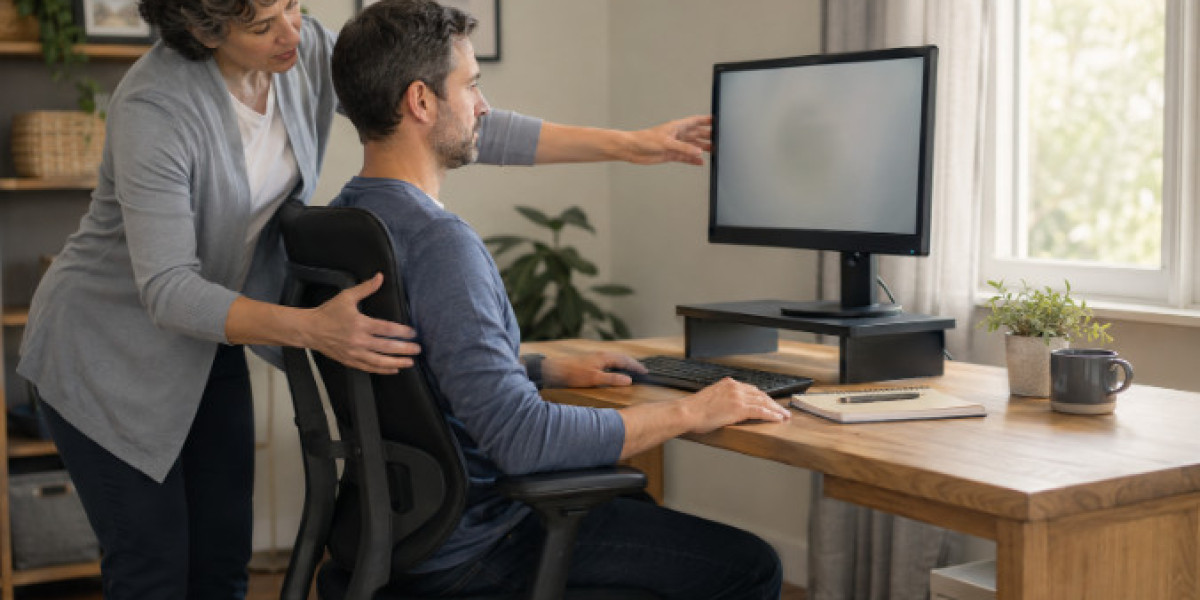

You have seen the poster. The figure on the left slouched over a laptop with a red cross, the figure on the right upright at ninety degrees with a green tick. Perhaps your employer ran an assessment, raised your monitor, and bought you a better chair.
And your back still hurts at four in the afternoon.
The subject of posture and ergonomics is one where the popular advice and the research evidence have drifted a long way apart. Some of what you have been told is supported. A fair amount of it is not, and one part of it may be actively unhelpful.
This article covers what the evidence actually shows about posture and back pain, what genuinely loads your spine at a desk, what the workplace trials found, and how to tell the difference between an uncomfortable desk and a spinal problem that a chair cannot fix.
The Uncomfortable Finding About “Good Posture”
Start with the claim underneath every ergonomics poster: that sitting or standing incorrectly causes back pain.
An umbrella review published in the Journal of Biomechanics in 2020 pooled the systematic reviews on spinal posture, physical exposure and low back pain. Its conclusion was that there is no consensus regarding causality. Associations have been documented in places, but they do not establish that posture causes back pain. On occupational sitting specifically, no association was found.
A widely cited 2019 viewpoint in the Journal of Orthopaedic and Sports Physical Therapy made the same case from a clinical angle. Its authors noted that despite the absence of strong evidence, a large posture industry has grown up around products and interventions claiming to correct posture and prevent pain, and that many health professionals give advice in line with that belief.
Even “text neck” does not hold up as cleanly as assumed. A cross-sectional study of 582 adults published in Spine found that text neck was not associated with neck pain prevalence, frequency, or maximum intensity.
None of this means your discomfort is imaginary. It means the specific shape your spine holds is a weaker explanation for it than most people assume, and that spending money on achieving a particular alignment may not deliver what you expect.
There is also a cost to the message itself. Telling people their spine is being damaged by how they sit encourages fear of ordinary movement, and fear of movement is associated with worse outcomes in back pain, not better ones.
What Actually Loads Your Spine at a Desk
If posture shape is not the main driver, what is?
The received wisdom is that sitting loads the lumbar spine more than standing. The picture is less settled than that. A systematic review and meta-analysis comparing in vivo intradiscal pressure between sitting and standing found that sitting produced higher pressure in normal discs overall, but that studies published after 1990 did not support that conclusion, and that in degenerated discs there was no difference between the two positions.
The more consistent theme in the research is not which position you adopt but how long you hold any position without changing it. Sustained static loading, whether seated or standing, is what tends to produce discomfort. Standing is not a free alternative either. Research has identified standing-induced low back pain as a real phenomenon, and transient pain developing during standing has been shown to predict later clinical low back pain in people who were previously symptom-free.
Which reframes the question. The useful variable is variation, not alignment.
What the Workplace Trials Actually Found
This is where the evidence gets specific, and where a lot of corporate spending looks less well founded.
A 2018 Cochrane review examined ergonomic interventions for preventing work-related musculoskeletal disorders of the upper limb and neck in office workers. Workstation adjustment and sit-stand desks did not have an effect on upper limb pain compared with no intervention. An arm support combined with an alternative mouse showed moderate-quality evidence of reduced neck or shoulder disorder incidence, which is one of the more positive findings in the review. Supplementary breaks showed very low-quality evidence of reduced neck and upper limb discomfort among data entry workers.
A separate 2018 Cochrane review looked at reducing workplace sitting. Sit-stand desks reduced sitting time by roughly 100 minutes per workday in the short term and around 57 minutes per day at three to twelve months, rated low-quality evidence. Reassuringly, standing more did not appear to produce harmful effects. But note what that review measured: sitting time, not pain.
Put plainly, sit-stand desks reliably change how much you sit. The evidence that they reduce back pain is considerably weaker than the marketing implies.
The intervention with the most consistent signal across both reviews is the least expensive one: taking breaks.
What Is Actually Worth Doing
Given all that, a reasonable approach at a desk looks different from the poster.
Change position regularly rather than holding the right one. Moving every twenty to thirty minutes has better support than any specific alignment. Stand for a call, walk to get water, shift how you sit.
Set the desk up for comfort, not correctness. Screen roughly at eye level, forearms supported, feet reachable to the floor. This reduces sustained static effort in the neck and shoulders, which is a real benefit. Frame it as comfort rather than as protecting your spine from damage.
Consider arm support and mouse position for neck and shoulder symptoms. This had the strongest evidence of the physical interventions reviewed.
Treat general physical activity as the main intervention. Overall conditioning and exercise have far better evidence for back pain than any equipment purchase. A structured spine rehabilitation program does more than a chair will.
Do not catastrophise your slouch. Sitting in a relaxed position for a while is not damaging your discs.
When Desk Pain Is Not a Desk Problem
Here is the part that matters most clinically, and it is the reason to read the rest with some care.
Ergonomic advice addresses non-specific, diffuse, muscular discomfort. It does not address nerve compression. If your symptoms include any of the following, adjusting your chair is not the right response:
Pain travelling down one arm or leg in a defined pattern, particularly with numbness, tingling, or weakness. That pattern suggests a compressed nerve root, and it is what sciatica or cervical radiculopathy looks like.
Clumsy hands, difficulty with buttons or coins, unsteady walking, or changed handwriting. These can indicate spinal cord compression and need medical assessment rather than a workstation review.
Pain that wakes you at night, unexplained weight loss, fever, or a history of cancer. These need investigation.
Any new or progressing weakness. This changes the urgency entirely.
A well-adjusted desk cannot decompress a nerve root. If you have spent months adjusting your setup while radiating symptoms have persisted or worsened, the setup was never the problem. Our guide on when conservative care fails covers how specialists judge that point.
Where This Leaves You
Ergonomics is worth doing for comfort. It reduces the sustained static effort of a long working day, and a workstation that fits you is better than one that does not. That is a genuine benefit and a reasonable thing to ask your employer for.
What the evidence does not support is the idea that a particular posture protects your spine, that slouching is damaging it, or that the right chair will resolve a structural problem. If your discomfort is diffuse and muscular, movement and general fitness will do more than equipment. If your symptoms follow a nerve, no amount of adjustment will change what is compressing it.
Get a Clear Answer on What Your Scans Show
If you have radiating arm or leg pain that has outlasted every adjustment to your working setup, the useful next step is finding out what is actually causing it.
Send your recent MRI and standing X-Rays to Spine Connection. Independent spine specialists in Germany and Thailand review your case and tell you whether your symptoms come from nerve compression, whether surgery is indicated, and which approach suits your anatomy, including motion-preserving options such as artificial disc replacement where appropriate. If they believe continued non-surgical care is right for you, they will tell you that too.
Every package price is confirmed in writing before you travel, paid directly to the hospital, with no waiting list. A dedicated patient guide stays with you from the first scan review through surgery and recovery at home.
Send your scans to our expert team today for a thorough online evaluation.
Frequently Asked Questions
Does bad posture cause back pain?
The evidence does not support a strong causal link. A 2020 umbrella review of systematic reviews found no consensus on causality between spinal postures and low back pain, and found no association for occupational sitting specifically. People with upright and slouched postures both experience back pain, and no single posture has been shown to protect against it.
Will a standing desk help my back pain?
It will reduce how long you sit, which Cochrane evidence supports at low certainty. Whether it reduces back pain is much less clear, and one Cochrane review found sit-stand desks had no effect on upper limb pain compared with no intervention. Standing for long unbroken periods can produce its own back discomfort, so alternating matters more than switching permanently to standing.
How often should I get up from my desk?
Changing position every twenty to thirty minutes is a reasonable target, and breaks showed a more consistent signal in the workplace trials than equipment did. The exact interval matters less than the fact that you are varying your position across the day rather than holding one for hours.
Is text neck real?
The idea is widespread but the evidence is weak. A study of 582 adults published in Spine found no association between text neck and the prevalence, frequency, or intensity of neck pain. Sustained static positions of any kind can cause discomfort, but the specific neck angle used with a phone has not been shown to cause lasting harm.
My desk is set up properly and I still have pain. What now?
Look at the character of the pain rather than the setup. Diffuse, muscular discomfort usually responds better to movement and general conditioning than to further adjustment. Pain that radiates into an arm or leg in a defined pattern, with numbness or weakness, points toward nerve involvement and warrants a clinical assessment rather than more ergonomic tinkering.
Scientific References
Swain CTV, Pan F, Owen PJ, Schmidt H, Belavy DL. No consensus on causality of spine postures or physical exposure and low back pain: a systematic review of systematic reviews. J Biomech. 2020;102:109312.
Slater D, Korakakis V, O’Sullivan P, Nolan D, O’Sullivan K. “Sit up straight”: time to re-evaluate. J Orthop Sports Phys Ther. 2019;49(8):562-564.
Correia IMT, Ferreira AS, Fernandez J, Reis FJJ, Nogueira LAC, Meziat-Filho N. Association between text neck and neck pain in adults. Spine (Phila Pa 1976). 2021;46(9):571-578.
Hoe VCW, Urquhart DM, Kelsall HL, Zamri EN, Sim MR. Ergonomic interventions for preventing work-related musculoskeletal disorders of the upper limb and neck among office workers. Cochrane Database Syst Rev. 2018;10:CD008570.
Shrestha N, Kukkonen-Harjula KT, Verbeek JH, Ijaz S, Hermans V, Bhaumik S. Workplace interventions for reducing sitting at work. Cochrane Database Syst Rev. 2018;12:CD010912.
Nelson-Wong E, Callaghan JP. Transient low back pain development during standing predicts future clinical low back pain in previously asymptomatic individuals. Spine (Phila Pa 1976). 2014;39(6):E379-E383.
Gallagher KM, Callaghan JP. Early static standing is associated with prolonged standing induced low back pain. Hum Mov Sci. 2015;44:111-121.
Li JQ, Kwong WH, Chan YL, Kawabata M. Comparison of in vivo intradiscal pressure between sitting and standing in human lumbar spine: a systematic review and meta-analysis. Life (Basel). 2022;12(3):457.
Chambers AJ, Robertson MM, Baker NA. The effect of sit-stand desks on office worker behavioral and health outcomes: a scoping review. Appl Ergon. 2019;78:37-53.
Qaseem A, Wilt TJ, McLean RM, Forciea MA; Clinical Guidelines Committee of the American College of Physicians. Noninvasive treatments for acute, subacute, and chronic low back pain: a clinical practice guideline from the American College of Physicians. Ann Intern Med. 2017;166(7):514-530.
Fehlings MG, Tetreault LA, Riew KD, et al. A clinical practice guideline for the management of patients with degenerative cervical myelopathy: recommendations for patients with mild, moderate, and severe disease and nonmyelopathic patients with evidence of cord compression. Global Spine J. 2017;7(3 Suppl):70S-83S.