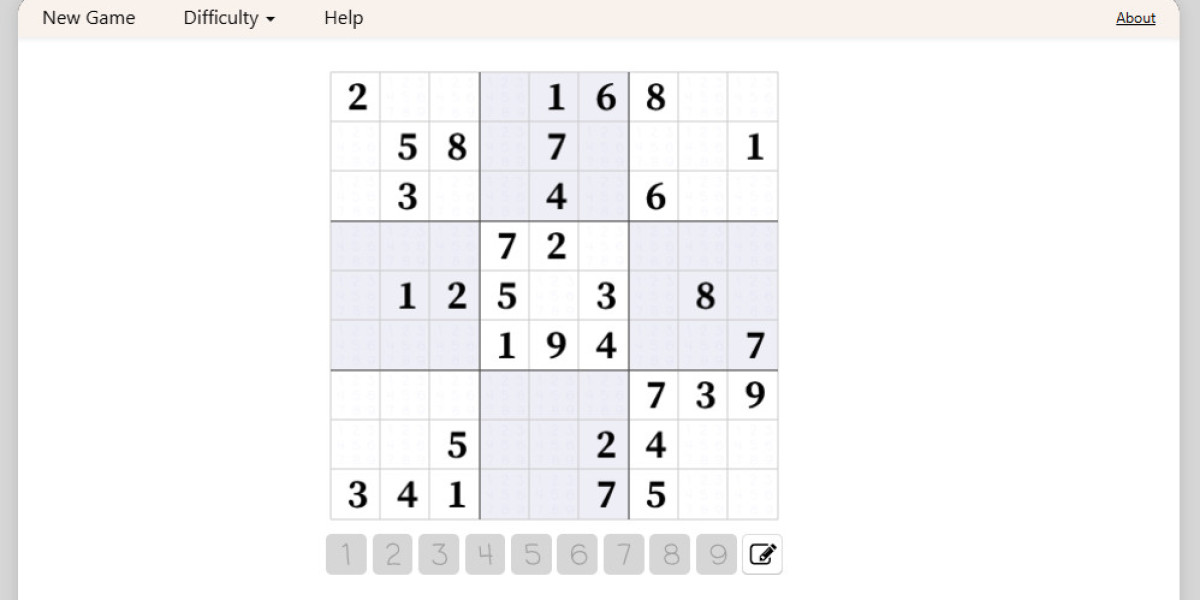

Sudoku is a popular number puzzle that combines simple rules with challenging logical thinking. The game does not require advanced mathematics, fast reflexes, or special knowledge. Instead, Sudoku depends on careful observation, concentration, deduction, and patience. This makes Sudoku suitable for beginners, experienced puzzle fans, students, and adults who want an engaging mental activity.
The classic Sudoku board contains 81 cells arranged in a 9x9 grid. The grid is divided into nine smaller 3x3 boxes. Some numbers are already placed on the board, while the remaining cells must be completed by following a set of logical rules. A correct solution requires every number from 1 to 9 to appear exactly once in each row, column, and 3x3 box.
What Is Sudoku and How Does It Work?
Sudoku is a logic-based puzzle that challenges players to complete a grid without repeating numbers in specific areas. Although numbers are used, the game is not based on arithmetic. Addition, subtraction, multiplication, and division are not necessary to solve a standard puzzle.
Understanding the Sudoku Grid
A standard Sudoku puzzle contains nine rows and nine columns. These rows and columns create 81 individual cells. The full board is also separated into nine 3x3 boxes.
Each row must contain numbers 1 through 9 without repetition. The same rule applies to every column and every 3x3 box. Pre-filled numbers provide clues that guide the solving process.
For example, if a row already contains eight different numbers, the missing number can be identified immediately. More difficult situations require players to compare possibilities across rows, columns, and boxes.
The Main Rules of Sudoku
The rules of Sudoku are straightforward. Every row must contain each number from 1 to 9 exactly once. Every column must also contain each number from 1 to 9 exactly once. Finally, every 3x3 box must contain each number from 1 to 9 exactly once.
A number cannot be placed in a cell if that number already appears in the same row, column, or box. These restrictions create a logical system where one placement can reveal several additional possibilities.
Why Sudoku Remains Popular
Sudoku has remained popular because the basic concept is easy to understand while the difficulty can increase significantly. A beginner can learn the rules within minutes, but advanced puzzles can require extended concentration and sophisticated solving techniques.
Sudoku Provides a Mental Challenge
Solving Sudoku encourages logical reasoning and systematic thinking. Players need to examine available information, eliminate impossible choices, and identify the most useful next move.
The puzzle also rewards patience. Random guessing can easily create contradictions later in the grid. Careful deduction provides a more reliable path toward a complete solution.
Sudoku Can Support Focus and Concentration
Sudoku requires attention to small details. A single number can influence several cells because each placement changes the available possibilities in one row, one column, and one box.
Regular puzzle sessions can therefore provide an enjoyable way to practice sustained attention. The experience is especially appealing for people who prefer quiet activities that provide a clear mental challenge.
How to Solve Sudoku More Effectively
A strong Sudoku strategy begins with simple observations before moving toward more advanced techniques. Beginners should avoid guessing and focus on information that can be proven logically.
Start With Easy Numbers
Look for rows, columns, or boxes that already contain many numbers. These areas usually provide fewer possible choices and can reveal missing values quickly.
A useful method is to scan the entire board for cells where only one number can legally fit. These cells are often called naked singles because one candidate remains after all restrictions are considered.
Use Candidate Numbers
When a cell cannot be solved immediately, possible numbers can be noted mentally or with small marks. Candidate numbers help organize information and prevent unnecessary guessing.
Suppose a cell is located in a row containing 1, 3, 5, 7, and 9. The column and box may eliminate several additional numbers. If only two candidates remain, later discoveries can eliminate one of them.
Search for Hidden Singles
Sometimes a cell can accept several numbers, but one particular number has only one possible location within a row, column, or box. This situation is known as a hidden single.
Finding hidden singles is an important step because it allows progress even when no cell appears to have only one candidate.
Advanced Sudoku Techniques
More difficult puzzles require deeper pattern recognition. Several techniques can help experienced players solve challenging boards without relying on random guesses.
Naked Pairs and Triples
A naked pair occurs when two cells in the same unit contain exactly the same two candidates. Those candidates must occupy those two cells, so they can be removed from other cells in that row, column, or box.
The same principle can apply to triples. Recognizing these patterns can reduce the number of possibilities and reveal new placements.
Box and Line Interaction
A useful advanced technique involves comparing a 3x3 box with a row or column. If a particular candidate within a box can only appear in one row, that candidate can often be removed from other cells in that row outside the box.
This technique connects different parts of the grid and can create important breakthroughs.
Choosing the Right Sudoku Difficulty
Sudoku puzzles are commonly available in several difficulty levels. Easy puzzles contain many clues and often rely on straightforward elimination. Medium puzzles introduce more candidate management and pattern recognition.
Hard and expert puzzles may require advanced strategies and significantly more concentration. Beginners should start with easier puzzles and gradually increase difficulty as solving confidence improves.
Why Difficulty Matters
Choosing an appropriate difficulty level keeps Sudoku enjoyable. A puzzle that is too easy may become repetitive, while an extremely difficult puzzle can feel frustrating.
Gradual progression allows players to learn new techniques naturally. Each completed puzzle also provides useful experience for recognizing familiar patterns in future games.
Sudoku as a Daily Puzzle Activity
Sudoku can fit easily into a daily routine because one puzzle can be completed in a relatively short session. A player can use a newspaper, puzzle book, mobile application, or online platform.
The most important part is consistency. Regular solving creates opportunities to practice scanning, elimination, candidate management, and logical deduction.
Final Thoughts on Sudoku
Sudoku is much more than a simple number game. It is a structured logic puzzle that combines concentration, deduction, patience, and pattern recognition. The rules are simple enough for beginners, while advanced techniques provide an ongoing challenge for experienced players.
Whether used as a short daily activity or a serious puzzle challenge, Sudoku offers an engaging way to exercise logical thinking. With regular practice and a systematic approach, players can become faster, more accurate, and more confident at solving increasingly difficult grids.