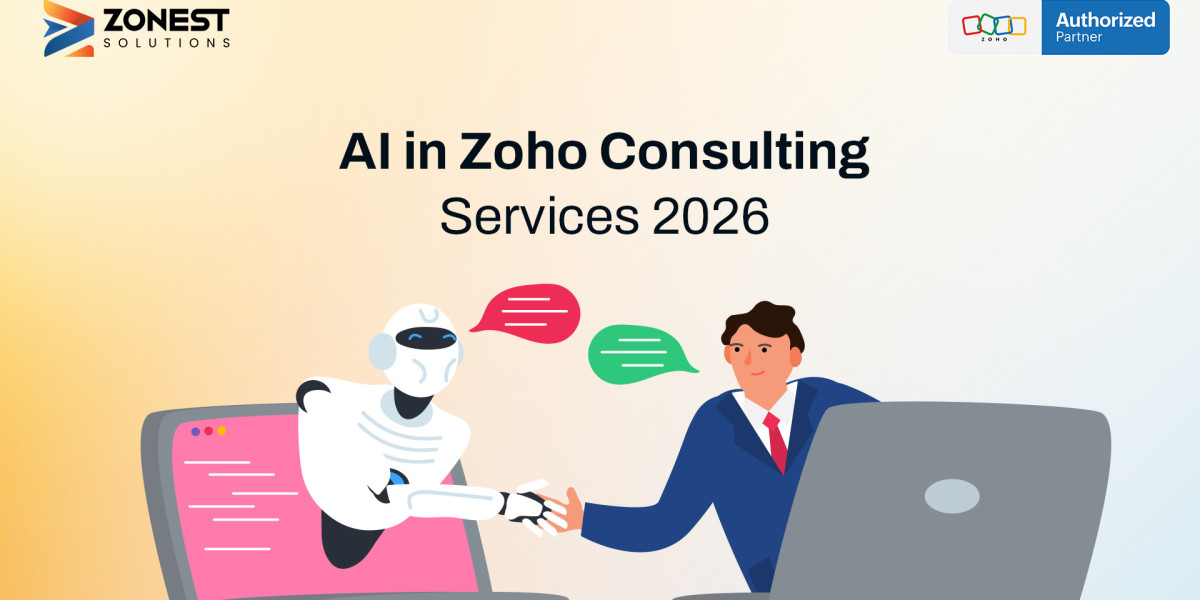

Artificial Intelligence is rapidly changing the way businesses manage sales, customer relationships, marketing, support, and everyday operations. Businesses are no longer looking for software that simply stores information. They want intelligent systems that can automate repetitive tasks, identify opportunities, provide useful insights, and support better decision-making.
This transformation is also changing the role of Zoho Consulting. Traditional consulting focused mainly on implementing Zoho applications, configuring modules, creating workflows, integrating systems, and training users. Today, businesses expect Zoho consultants to go beyond implementation and help them use AI to create smarter and more efficient business processes.
The Growing Importance of AI in Zoho
Zoho has integrated AI capabilities through Zia, its AI-powered assistant. Zia can help businesses analyze data, provide insights, automate certain activities, identify patterns, and support users across different Zoho applications.
For businesses using Zoho CRM and other Zoho solutions, AI can help reduce manual work and improve the way teams interact with their business data.
Instead of depending entirely on employees to analyze large amounts of information, businesses can use AI-powered capabilities to identify important patterns and provide recommendations that support faster decision-making.
AI-Powered Sales Predictions
Sales forecasting is an important part of business planning. Sales teams need to understand which opportunities have a higher possibility of conversion and where they should focus their efforts.
AI can analyze historical sales data and identify patterns that can help businesses understand potential outcomes. Sales managers can use these insights to prioritize opportunities and make better decisions about their sales pipeline.
This can reduce the amount of manual analysis required from sales teams and allow them to focus more on high-value opportunities.
Reducing Manual CRM Data Entry
Manual data entry is one of the common challenges faced by sales and customer service teams. Employees often spend a significant amount of time updating CRM records, entering information, and maintaining customer data.
AI can assist with automating parts of these activities and reducing repetitive administrative work.
When employees spend less time on manual CRM updates, they can focus more on customer communication, sales activities, and other important responsibilities.
However, data quality remains extremely important. AI-generated insights are only as useful as the information available in the system. Businesses therefore need clean, accurate, and well-organized CRM data.
Smarter Business Automation
Traditional workflow automation generally works according to predefined rules. When a specific condition is met, the system performs a particular action.
AI can make automation more intelligent by helping businesses identify patterns and opportunities for improvement.
For example, businesses can analyze processes such as lead management, follow-ups, approvals, customer support, and sales activities to identify repetitive tasks and potential bottlenecks.
With the right configuration, AI and automation can help businesses create faster and more efficient workflows.
AI-Based Lead Scoring
Lead management is another area where AI can provide significant value.
Sales teams often receive many leads, but not every lead has the same potential. Manually reviewing every lead can consume considerable time.
AI-powered lead scoring can analyze available customer information and behavior to help businesses identify leads that may have a higher probability of conversion.
Sales representatives can then prioritize their efforts and focus on prospects that are more likely to become customers.
This can improve sales productivity and create a more organized lead management process.
Conversational Insights and Business Data
Another important benefit of AI is easier access to business information.
Instead of manually searching through multiple reports and records, users can interact with AI to obtain relevant information and insights.
For example, a sales manager may want to understand which opportunities require attention, which deals are progressing slowly, or what activities are pending.
AI-powered insights can make this information easier to access and help managers make faster business decisions.
Traditional Zoho Consulting vs AI-Driven Consulting
The role of a Zoho consultant is evolving.
Traditional Zoho consulting generally focuses on:
Zoho application implementation
Module configuration
Data migration
Application integration
Workflow creation
User training
AI-driven Zoho Consulting expands this approach by focusing on:
AI-powered automation
Predictive insights
Data quality
AI configuration
Intelligent lead management
Business process optimization
Measuring business outcomes
AI adoption and employee training
The goal is no longer simply to implement the software. The goal is to help businesses achieve measurable value from their Zoho ecosystem.
What Businesses Should Expect from a Modern Zoho Consultant
Businesses adopting AI-powered Zoho solutions should look for consultants who understand both technology and business processes.
1. Better Data Preparation
Clean and accurate data is essential for effective AI implementation. A consultant should identify duplicate, incomplete, or inconsistent information and help improve data quality before implementing AI capabilities.
2. Customized AI Configuration
Every business operates differently. A solution that works for one company may not be suitable for another.
A Zoho consultant should understand the organization's processes and configure AI capabilities according to its specific requirements.
3. Intelligent Automation
Businesses should identify repetitive activities that can be automated. This can include lead management, follow-ups, approvals, customer support processes, and other routine activities.
4. Measuring Business Results
AI implementation should have measurable objectives. Businesses can track improvements in productivity, time savings, sales efficiency, automation, and other relevant performance indicators.
5. Employee Training
Employees need to understand how AI tools work and how to use AI-generated insights effectively.
A consultant should provide appropriate training so teams can confidently adopt AI-powered Zoho features in their daily workflows.
How AI Can Solve Common Business Challenges
Many businesses face similar operational challenges.
Sales teams may spend too much time entering CRM information manually. AI and automation can help reduce this workload.
Sales managers may struggle with forecasting because important information is spread across multiple records. AI-powered insights can provide additional visibility into sales opportunities.
Businesses may also experience missed follow-ups or delayed processes. Automated workflows and intelligent reminders can help teams manage these activities more effectively.
Customer support teams can also benefit from AI by accessing relevant information faster and reducing repetitive work.
These improvements can become increasingly valuable as a business grows.
Why Businesses Need AI-Focused Zoho Consulting
Simply enabling AI features does not guarantee business success.
Successful AI adoption requires clean data, appropriate configuration, optimized processes, employee training, and continuous measurement.
This is why the role of an experienced Zoho Consulting partner is becoming more important. Consultants need to understand the actual business problem before recommending an AI solution.
Rather than implementing every available AI feature, businesses should focus on the capabilities that directly address their operational challenges.
This approach can make AI adoption more practical, focused, and valuable.
The Future of Zoho Consulting
The future of Zoho Consulting is moving toward intelligent automation and AI-driven business transformation.
Businesses will increasingly expect consultants to help them use AI not only for automation but also for decision-making, customer engagement, sales optimization, data analysis, and operational efficiency.
Zoho consultants who understand AI capabilities, business processes, data management, and automation will be better positioned to help organizations achieve long-term value from their technology investments.
Conclusion
AI is changing what businesses expect from Zoho Consulting. Companies are moving beyond basic software implementation and looking for smarter automation, predictive insights, better data management, and measurable business outcomes.
Zoho's AI capabilities, including Zia, can help businesses automate repetitive activities, improve sales predictions, analyze information, prioritize leads, and make faster decisions.
However, successful AI adoption depends on more than technology. Businesses also need reliable data, customized configuration, optimized processes, and effective employee training.
For organizations looking to get more value from Zoho, an AI-focused consulting approach can help connect technology with real business goals.
Read the complete guide: https://www.zonestsolutions.com/blog/how-ai-is-changing-zoho-consulting