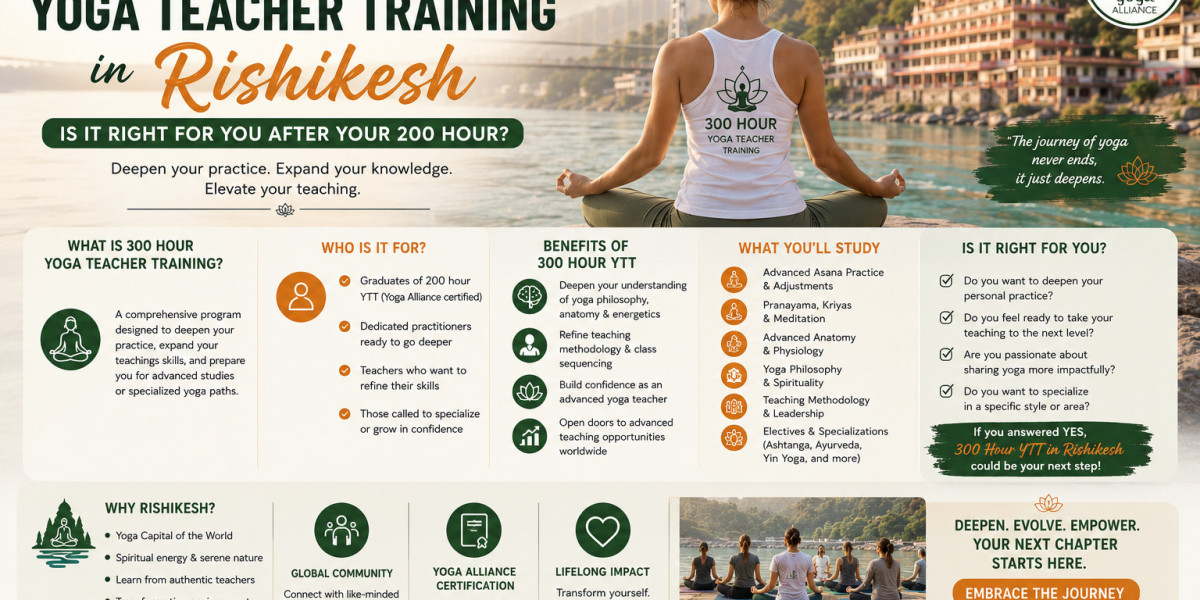

Completing your 200-hour TTC is a significant achievement — but for many graduates, it marks the beginning of a deeper inquiry rather than the end of one. The yoga teacher training in Rishikesh at the 300-hour level is designed precisely for those who have tasted what yoga really is and want to go further than the foundational certification allows. The question is not whether the 300-hour training is valuable — it undeniably is. The question is whether you are ready for it right now, and what you will gain from pursuing it immediately versus allowing your teaching experience to deepen first.
Taking an honest look at where your practice and teaching actually are right now — rather than where you hope they are — is the most useful starting point for this decision.
What Is a 300-Hour TTC?
A 300-hour yoga teacher training is the advanced certification that, when combined with a completed 200-hour program, results in the RYT 500 — the highest standard of yoga teacher registration recognized by Yoga Alliance globally. It is not a repetition of the 200-hour content repackaged at a higher price point. It is a genuine and substantial deepening — a program that assumes foundational knowledge is already in place and builds significantly beyond it into territory that the foundational training could only briefly introduce.
Graduates of strong 300-hour programs consistently describe the experience as the point at which yoga stopped being something they practiced and became something they genuinely understood — from the inside, at every level simultaneously.
What Does the 300-Hour Curriculum Cover?
The advanced curriculum moves into territory that a 200-hour program can only gesture toward, and it does so across every dimension of yogic education:
Advanced asana — More complex postures, deeper and more nuanced alignment study, and the therapeutic applications of yoga for specific physical conditions and populations that require a more informed and carefully calibrated teaching approach
Advanced pranayama — Subtle breathwork practices that work directly with the energetic body in ways the foundational curriculum does not have space to explore, including classical Hatha practices that carry significant transformative power when taught correctly
Yoga philosophy at depth — Deeper immersion in classical texts including the Upanishads, the Hatha Yoga Pradipika, and a far more nuanced engagement with the Bhagavad Gita's teachings on action, duty, surrender, and liberation than the 200-hour level allows
Advanced anatomy — A deeper look at how the body actually moves under load, how the fascial network influences flexibility and pain, and how to translate that understanding into teaching that genuinely serves students with widely varying physical backgrounds and histories
Teaching practicum —Extended hours of observed teaching with honest, specific feedback from senior teachers who are invested enough in your growth to tell you what you actually need to hear rather than what is simply comfortable
Specialization areas — Many 300-hour programs offer the opportunity to go deeper in specific areas such as yoga therapy, Yin yoga, restorative practice, trauma-informed teaching, or the energetic and subtle body dimensions of the practice
Each of these areas builds on what the 200-hour program established, taking it from functional knowledge into genuine mastery — the kind that shows up clearly in how you teach, how you hold space, and how your students experience their own practice under your guidance.
Is It Right for You Right Now?
This is the most honest question to sit with before enrolling, and the answer depends entirely on where you genuinely are rather than where you want to be. The 300-hour TTC is worth pursuing now if any of the following genuinely resonate with your current experience:
You completed your 200-hour training and found yourself wanting significantly more depth rather than feeling finished or ready to simply teach what you already know
You are teaching regularly and beginning to notice specific gaps in your knowledge that limit your effectiveness with real students in actual classroom situations
You feel genuinely drawn to supporting students who arrive with particular physical challenges or health conditions that require a more sophisticated and carefully considered teaching approach
The philosophical and energetic dimensions of yoga have become more compelling and alive to you than the physical aspects — a natural evolution that the 300-hour curriculum is specifically designed to honor and develop
You want the RYT 500 credential to meaningfully expand your professional opportunities, your teaching scope, and the range of students and settings you are qualified to work with
On the other hand, if you completed your 200-hour training recently and are still in the early stages of integrating what you learned into your actual teaching, waiting six months to a year before pursuing the 300-hour level will almost always produce a richer, more practically grounded, and more genuinely valuable advanced training experience. The teaching hours you accumulate between the two programs become the raw material the 300-hour curriculum works with — and the more of that material you bring, the deeper the advanced training goes.
What Changes Between the 200 and 300-Hour Levels
Beyond the curriculum differences, something shifts in the nature of the learning itself at the 300-hour level. The 200-hour program teaches you what yoga is and gives you the tools to share it. Where the 200-hour gave you the tools, the 300-hour asks you to look honestly at how you are using them — and then builds your ability to use them with far greater skill, awareness, and intentionality.
Students at this level are no longer beginners finding their footing. They are developing teachers with real questions born from real experience, and the best 300-hour programs are specifically designed to meet that level of readiness with content and challenge that matches it.
The conversations between students and teachers at this level also carry a different quality. Because everyone in the room has teaching experience and a developed personal practice, the philosophical discussions go deeper, the practical sessions are more nuanced, and the community that forms around shared advanced inquiry creates a learning environment that is qualitatively different from the foundational training in almost every dimension.
Why Rishikesh for Advanced Training?
Advanced training benefits enormously from a powerful environment, and Rishikesh provides that in a way that very few places in the world can match. The depth of teacher knowledge concentrated in this city, the spiritual atmosphere that permeates daily life here, and the community of serious practitioners who consistently gather on these banks create conditions where advanced learning accelerates naturally and the content lands with a depth and permanence that a neutral classroom environment cannot replicate.
At the 300-hour level, the subtle and philosophical dimensions of yoga become increasingly central — and Rishikesh is precisely the environment where those dimensions feel most immediate, most alive, and most accessible. The tradition is not just taught here. It is lived, practiced, and breathed by the community around you every single day.
Nirvana Yoga School offers a comprehensive, Yoga Alliance-certified 300-hour TTC in Rishikesh led by teachers who bring genuine depth of knowledge, years of real teaching experience, and a sincere investment in every advanced student's growth — exactly what serious practitioners at this stage of their journey deserve.