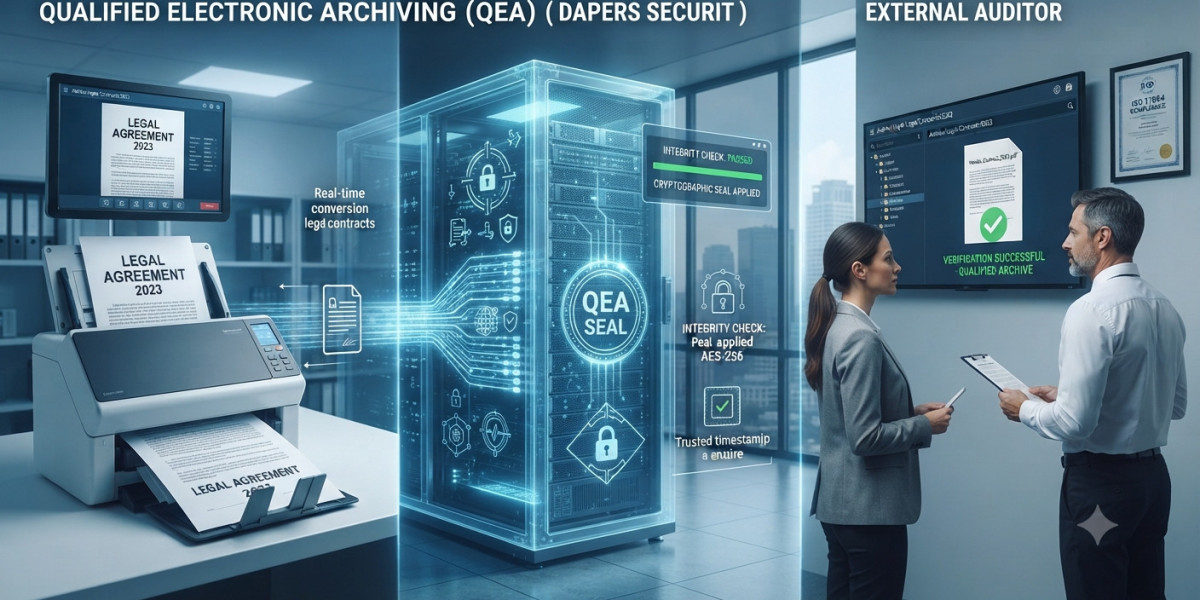

Legal records can remain relevant long after the systems that created them have been replaced. Contracts, signed agreements, regulatory submissions, case files, employee records, and transaction evidence may need to stay accessible for years while retaining their original context and integrity. Qualified Electronic Archiving helps organizations preserve these records in a controlled environment designed to support long-term trust, accessibility, and evidential value.
Simply saving a document in cloud storage is rarely enough. Legal records must be protected against unauthorized alteration, accidental deletion, format obsolescence, incomplete audit trails, and the loss of information required to verify where a record came from.
Why Ordinary Document Storage May Not Protect Legal Records
Standard document storage focuses primarily on keeping files available. Legal archiving has a broader responsibility.
A legal record may need to demonstrate:
Who created or submitted the document
When the document was signed or received
Whether the content has changed
Which version is considered authoritative
Who accessed, transferred, or exported the record
How long the record must be retained
Whether the document can still be opened and understood
A file stored in a shared folder may remain readable, but that does not automatically make it reliable evidence. The folder may not preserve a complete chain of custody. Administrators may be able to overwrite files. Metadata can be changed during migration. Access permissions may be too broad, and there may be no dependable record of earlier actions.
These weaknesses become especially important during litigation, audits, regulatory reviews, internal investigations, or contractual disputes.
What Qualified Electronic Archiving Protects
Qualified Electronic Archiving is intended to preserve more than the visible document. It protects the information needed to understand, verify, manage, and retrieve that document over time.
A properly controlled archive may preserve:
The original electronic file
Associated metadata
Electronic signatures and seals
Time-related evidence
Retention and disposal rules
Access and activity logs
Document classifications
Relationships between connected records
Evidence of preservation actions
This wider preservation approach is essential because a document rarely exists in isolation. A signed agreement, for example, may depend on signature information, timestamps, identity evidence, attachments, approval records, and correspondence that explains the transaction.
If these elements are separated or lost, the legal meaning of the record may become harder to establish.
Preserving Record Integrity Over Time
Integrity means being able to demonstrate that a record has not been altered improperly.
Businesses can support record integrity through controls such as cryptographic verification, controlled ingestion, tamper-evident storage, access restrictions, and documented preservation events. These measures create a clearer history of what happened to the record after it entered the archive.
The process often begins when a document is transferred into the archival environment. At this stage, the system can verify the file, capture its metadata, assign retention requirements, and record the ingestion event.
Future actions should also be traceable. When someone views, exports, migrates, or updates the classification of a record, the archive should create an auditable entry.
This does not mean that every archived document becomes legally valid by default. Legal value depends on factors such as the record type, jurisdiction, business process, signing method, and applicable regulations. However, strong preservation controls can help an organization demonstrate that it managed the record responsibly.
Maintaining the Validity of Electronic Signatures
Electronic signatures can create a major long-term preservation challenge.
A signature may be valid when it is created, but the supporting certificate can later expire or be revoked. Cryptographic standards can also become outdated. If the organization stores only the signed PDF without preserving the supporting validation information, it may become difficult to verify the signature years later.
A preservation strategy should therefore consider more than the signature image shown on the document. It may need to retain:
Signature certificates
Certificate validation data
Relevant timestamps
Revocation information
The original signed file
Evidence of later preservation actions
Digital signature preservation helps maintain the information required to assess whether a signature was valid at the time it was applied.
Docbyte supports organizations that need to preserve signed records, associated validation evidence, and long-term access to important digital documents. The goal is not simply to retain the file but to preserve the trust framework surrounding it.
Creating a Defensible Chain of Custody
A chain of custody documents how a record moved from its original source into the archive and what happened after that point.
This is particularly important for records that may be used during legal proceedings, compliance reviews, or investigations. An organization may need to explain how the file was collected, whether it was altered, who had access, and how it was protected.
A defensible chain of custody generally requires:
Controlled collection
Records should enter the archive through approved and documented processes.Verification during ingestion
The system should confirm that the file was received correctly and record relevant technical information.Restricted access
Only authorized users should be able to view, manage, or export sensitive records.Complete activity logging
Important user and system actions should be recorded.Documented migrations
If records move to a new platform or format, the organization should preserve evidence of the migration.Controlled export procedures
Exported records should include the information required to understand and verify them.
Without these controls, a business may possess the correct document but struggle to prove how reliably it was managed.
Keeping Records Accessible Beyond the Original System
Legal records often outlive the software used to create them.
An enterprise application may be retired because it is expensive, unsupported, insecure, or no longer compatible with the organization’s technology environment. However, deleting the application without preserving its records can create serious operational and legal risks.
Businesses may still need access to:
Historical contracts
Customer communications
Financial transactions
Employee files
Approval histories
Compliance reports
Supporting attachments
Audit evidence
Qualified Electronic Archiving can help separate long-term records from the legacy application. The organization can retire the original system while keeping required information searchable and accessible through a controlled archive.
Docbyte combines archiving and application retirement capabilities to help organizations preserve important records without keeping outdated business systems running indefinitely.
Applying Retention and Disposal Rules
Keeping every record forever is not an effective legal strategy.
Excessive retention can increase storage costs, privacy exposure, discovery obligations, and security risk. At the same time, premature deletion can violate legal, contractual, regulatory, or operational requirements.
A controlled archive should support retention rules based on factors such as:
Record category
Business purpose
Contractual commitments
Applicable regulation
Jurisdiction
Legal holds
Investigation requirements
Data protection obligations
Retention periods should be approved by the appropriate legal, compliance, information governance, and business stakeholders.
When a retention period ends, the organization should not immediately delete the record without further checks. It should first determine whether the document is subject to a legal hold, unresolved dispute, active investigation, or another requirement that justifies continued preservation.
Disposal should also be documented. A deletion log can help show which records were removed, when the action occurred, and which policy authorized it.
Controlling Access to Sensitive Legal Information
Legal archives frequently contain confidential, personal, commercially sensitive, or privileged information.
Access should follow the principle of least privilege. Users should receive only the permissions required for their responsibilities.
Important access controls may include:
Role-based permissions
Multi-factor authentication
Segregation between business units or clients
Restrictions on downloads and exports
Approval workflows for sensitive actions
Regular access reviews
Alerts for unusual activity
Detailed audit logging
Encryption can protect records during transfer and storage, but encryption alone is not sufficient. Businesses must also manage user identities, administrator privileges, recovery procedures, backups, and security incidents.
An archive is only as trustworthy as the governance surrounding it.
Planning for Format Obsolescence
A legal record is not useful if nobody can open it.
Some proprietary formats depend on software that may no longer be supported in the future. Others rely on plugins, databases, fonts, or external components that are difficult to reproduce.
Long-term preservation planning may involve converting records into stable archival formats while retaining the original file where appropriate. Organizations should document any transformation and verify that the converted version accurately represents the original content.
This process should preserve important characteristics such as:
Text content
Page layout
Images
Attachments
Metadata
Signatures
Relationships between records
Format migration should be controlled and auditable. Otherwise, an organization may accidentally change or remove information during conversion.
What Businesses Should Evaluate Before Choosing a Solution
Before implementing an archival platform or service, businesses should examine both technical capabilities and governance requirements.
Key questions include:
Can the solution preserve original files and supporting metadata?
Does it maintain detailed audit trails?
Can it support electronic signatures and validation evidence?
Are retention rules configurable by record type?
Can legal holds prevent scheduled deletion?
How are records exported during audits or disputes?
Can the archive support data from retired applications?
How are migrations documented?
What security and access controls are available?
Can the organization demonstrate how records were preserved?
Businesses should also define ownership. Legal teams may determine evidential requirements, compliance teams may interpret regulatory obligations, IT may manage integration and security, and records managers may govern retention and classification.
A successful archive requires cooperation across all these functions.
Building a Reliable Legal Record Strategy
Qualified Electronic Archiving gives businesses a structured way to protect records that must remain trustworthy, accessible, and understandable over long periods. It addresses risks that ordinary storage systems often overlook, including incomplete audit trails, signature validation problems, legacy system dependence, weak retention controls, and format obsolescence.
The strongest approach begins with clear record classification, defined retention rules, controlled ingestion, restricted access, and documented preservation processes. Technology supports these controls, but governance determines how effectively they work.
Docbyte helps organizations preserve critical digital records, retire outdated applications, and maintain access to information needed for legal, regulatory, and operational purposes. Businesses reviewing their current archiving environment should begin by identifying which records carry the greatest legal value and whether the existing systems can protect that value for the required period.