
As the global digital economy accelerates, the infrastructure powering our connected world—the data center—is facing a thermal crisis. With the explosion of AI, cloud computing, and high-performance computing (HPC), the heat generated by modern server racks has reached unprecedented levels. This shift has placed the Data Center Cooling Market at the forefront of technological innovation and capital investment.
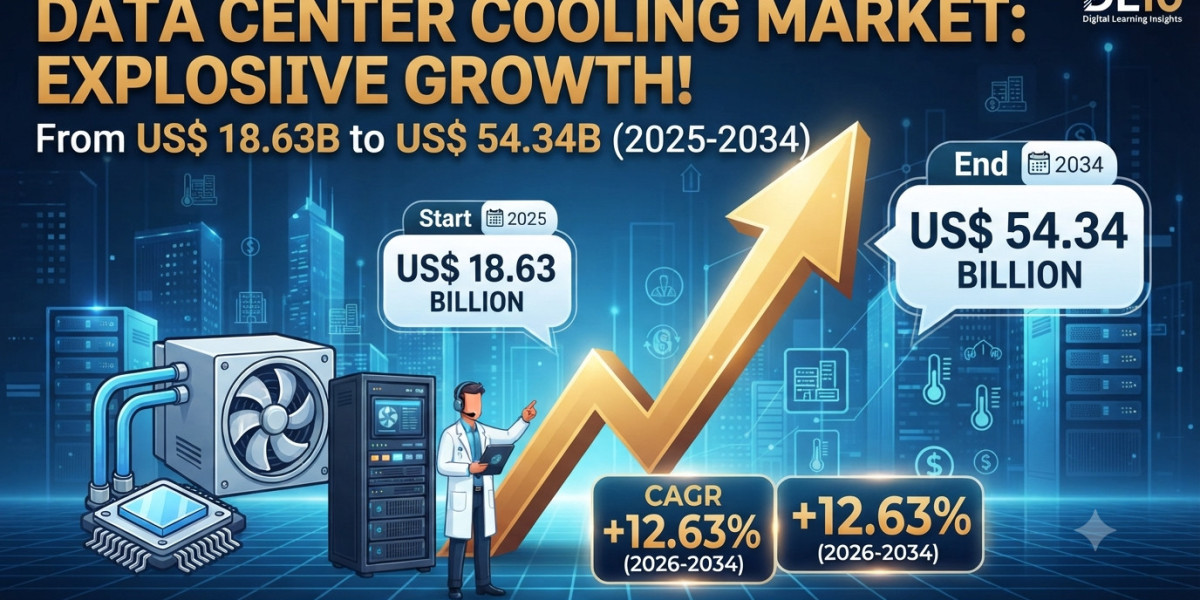
According to Renub Research, the Data Center Cooling Market is poised for significant expansion. The market is projected to reach US$ 54.34 billion by 2034, growing from US$ 18.63 billion in 2025, representing a robust CAGR of 12.63% between 2026 and 2034.
Download Free Sample Report:https://www.renub.com/request-sample-page.php?gturl=data-center-cooling-market-p.php
Data Center Cooling Industry Overview
The cooling industry is no longer just about keeping hardware from overheating; it is a fundamental pillar of operational reliability and environmental stewardship. As hyperscale and enterprise data centers consolidate to handle massive data volumes, heat density has become the primary constraint on scalability.
The Technological Evolution
The industry is undergoing a paradigm shift from traditional, energy-intensive air cooling to more sophisticated, efficient methodologies.
Next-Gen Cooling: Liquid cooling and immersion cooling technologies are rapidly gaining market share. These methods offer superior thermal conductivity compared to air, making them ideal for the extreme power densities required by AI workloads.
AI and Automation: The integration of Artificial Intelligence (AI) and the Internet of Things (IoT) is revolutionizing how cooling systems function. Predictive maintenance and real-time, automated adjustments allow facilities to optimize thermal management dynamically, significantly reducing wasted energy.
Geographic Dynamics: While North America and Europe lead in current adoption due to mature hyperscale infrastructures and strict energy regulations, the Asia-Pacific region is emerging as the fastest-growing market. Rapid digitization and state-backed cloud initiatives in countries like India, China, and Japan are driving this shift.
Primary Growth Drivers
1. The Scaling of Digital Infrastructure
The proliferation of 5G, IoT devices, and big data analytics requires a massive increase in processing power. Higher server density—often required to support GPU-intensive AI training—creates intense heat. The need to maintain stable operating conditions for these sensitive assets makes advanced cooling an absolute necessity.
2. The Sustainability Imperative
Cooling systems can account for up to 40% of a data center’s total energy consumption. With electricity costs rising and global pressure to meet carbon-neutral goals, data center operators are under immense pressure to optimize. Energy-efficient strategies—such as hot/cold aisle containment and free cooling—are being adopted to lower PUE (Power Usage Effectiveness) and comply with stringent environmental regulations.
3. Technological Innovations
R&D in the sector is focused on modularity and efficiency. Modern cooling systems are becoming more compact, allowing for easier retrofitting in legacy data centers. Innovations such as in-row cooling and hybrid solutions provide the flexibility required to scale cooling capacity alongside growing IT loads.
Market Challenges
Despite the growth, the industry faces distinct hurdles:
Capital Expenditure: High-efficiency cooling solutions, particularly liquid and immersion systems, carry a significant upfront price tag. This can prove difficult for small and medium-sized operators to justify, despite long-term energy savings.
Operational Complexity: Designing systems that balance high-density cooling requirements with energy cost management requires expert engineering. Incorrect configurations can lead to thermal hotspots, equipment failure, and costly downtime.
Regional Market Insights
United States: The U.S. remains a global leader, driven by the massive expansion of hyperscale facilities. A strong focus on integrating AI-enabled cooling and modular solutions keeps the U.S. at the cutting edge of market efficiency.
United Kingdom: The UK market is characterized by a strong emphasis on sustainability. Operators are increasingly utilizing liquid cooling and aisle containment to meet strict green mandates while supporting extensive digital transformation.
Japan: Japan is prioritizing energy conservation. The market is witnessing a high uptake of IoT-enabled predictive maintenance, which is essential for ensuring operational continuity in the face of local climate challenges and high power costs.
United Arab Emirates: With high ambient temperatures, the UAE represents a unique market where advanced thermal management is a critical survival factor for IT infrastructure. The region is seeing strong adoption of robust, high-performance cooling systems as part of government-led smart city initiatives.
Recent Strategic Developments (Renub Research Insight)
The industry is seeing intense collaboration between major power players and specialized cooling firms:
Strategic AI Investments: In 2025, firms like Brookfield Asset Management have pivoted toward AI infrastructure, investing heavily in liquid cooling and "in-the-box" GPU systems.
Collaborative Innovation: Partnerships, such as the one between Vertiv Group Corp. and Tecogen Inc., highlight the trend toward integrating natural gas-powered chiller technology to solve power constraints.
AI-Ready Infrastructure: Major vendors like Schneider Electric are launching reference designs for liquid-cooled AI clusters (supporting up to 132 kW per rack) and high-density UPS systems, specifically built to optimize space and energy in the era of AI.
Frequently Asked Questions (FAQs)
Q1: What is the projected market size for data center cooling by 2034 according to Renub Research? A1: According to Renub Research, the market is expected to reach US$ 54.34 billion by 2034.
Q2: What is the expected CAGR for this market from 2026 to 2034? A2: The market is expected to grow at a CAGR of 12.63% during the forecast period of 2026–2034.
Q3: What role does AI play in the data center cooling market? A3: AI is driving the need for higher rack densities, necessitating liquid cooling, while simultaneously providing the tools (IoT/AI monitoring) to optimize cooling performance and predictive maintenance.
Q4: Which region is identified as the fastest-growing market? A4: Asia-Pacific is currently identified as the fastest-growing region, fueled by rapid digitization, government support for cloud adoption, and expanding data traffic.
Q5: Why is energy efficiency a critical factor in this market? A5: Because cooling can represent up to 40% of total data center energy usage; improving efficiency directly reduces operational costs and helps companies meet carbon reduction goals.
Q6: What are the main types of cooling technologies gaining traction? A6: Liquid cooling, immersion cooling, hot/cold aisle containment, and hybrid/modular cooling systems are gaining significant traction due to their high thermal efficiency.
Q7: What is a primary barrier to entry for smaller data center operators? A7: The high initial investment cost for advanced, AI-enabled, and liquid-based cooling technologies remains the primary barrier for smaller or enterprise-level operators.