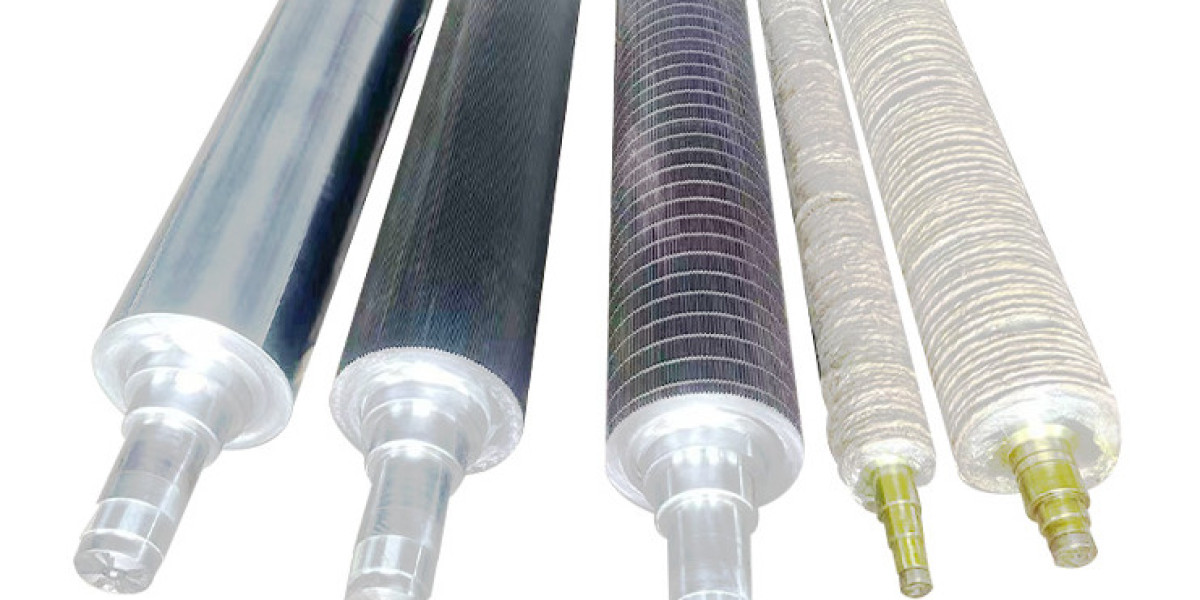

Corrugated packaging relies heavily on precision machinery, and the Corrugating Roller is one of the most important components in the production line. It is responsible for forming the fluted structure that gives corrugated board its strength, cushioning ability, and stack resistance.
In a single facer unit, the Corrugating Roller works as a matched pair—upper and lower rollers rotate in opposite directions. Under controlled heat and pressure conditions, typically between 160°C and 200°C steam temperature, the medium paper is shaped into flutes such as A, B, C, E, or F profiles. These flute types vary in height from around 0.6 mm to 5.0 mm, depending on packaging requirements.
The roller surface is usually made of forged alloy steel such as 48CrMo or 50CrMo, which provides high mechanical strength. After heat treatment and quenching, surface hardness can reach above HRC58–60. To improve wear resistance, coatings such as hard chrome (0.06–0.08 mm thickness) or tungsten carbide (up to 1300 HV hardness) are commonly applied.
During operation, paper passes through the corrugating nip where pressure and temperature soften the fibers. The roller tooth profile determines flute accuracy and directly impacts cardboard compressive strength. Precision requirements are strict, with runout tolerance often controlled within ≤0.02 mm.
The Corrugating Roller is not only a forming tool but also a key factor in production efficiency. High-speed corrugation lines can reach 150–300 m/min, requiring stable thermal distribution and precise alignment.
Ultimately, the quality of corrugated packaging depends heavily on the accuracy, durability, and surface engineering of the Corrugating Roller system.