
Point of Care Diagnostics Market Analysis
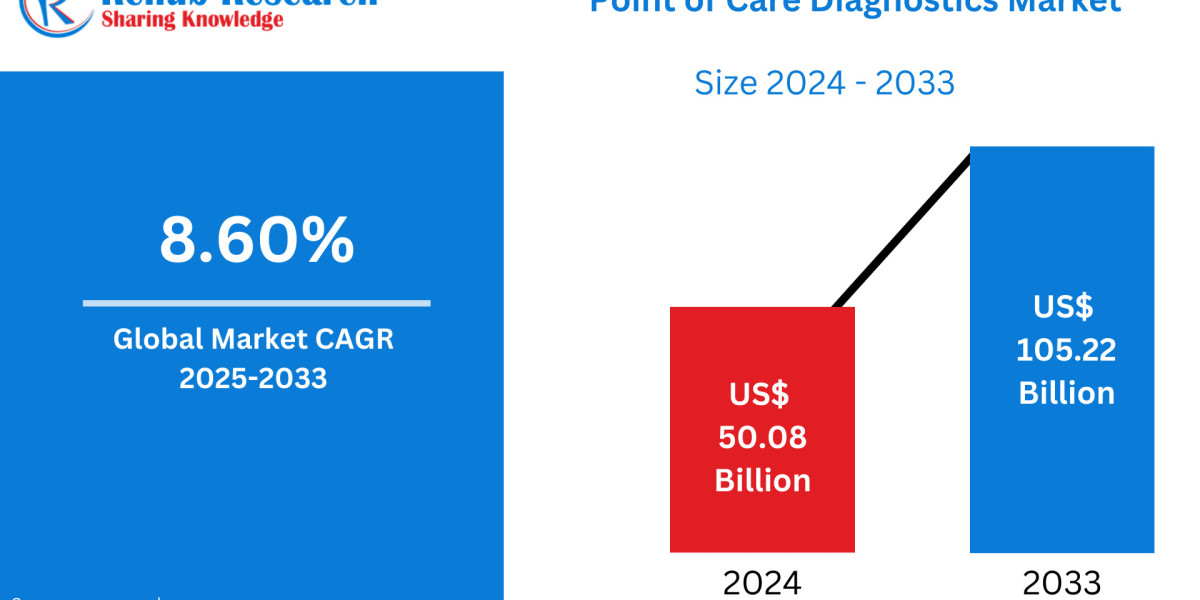
According to Renub Research Global Point of Care (POC) Diagnostics Market is poised for remarkable expansion, projected to reach US$ 105.22 billion by 2033 from US$ 50.08 billion in 2024, registering a robust CAGR of 8.60% between 2025 and 2033. Growth is driven by rising demand for rapid diagnostic solutions, increasing prevalence of infectious and chronic diseases, evolving patient-centered healthcare models, and continued technological innovation backed by device miniaturization and automation. As healthcare systems increasingly prioritize efficiency, accessibility, and timely intervention, point-of-care diagnostics are emerging as a critical pillar of global healthcare delivery.
Download Free Sample Report:https://www.renub.com/request-sample-page.php?gturl=point-of-care-diagnostics-market-key-players-analysis-p.php
Point of Care Diagnostics Market Overview
Point-of-care diagnostics refers to medical testing conducted at or near the site of patient care, eliminating the dependency on centralized laboratories. These tests deliver immediate results, enabling swift clinical decision-making, improved patient management, and enhanced workflow efficiency across healthcare settings. POC testing spans multiple domains, including glucose monitoring, infectious disease testing, cardiac markers, hematology, urinalysis, and molecular diagnostics.
The rising need for rapid testing in emergency care, remote healthcare environments, pandemics, and underserved regions has accelerated adoption. The COVID-19 pandemic notably amplified global awareness of decentralized diagnostics, strengthening infrastructure and investment momentum. Moreover, advancements in sensor technology, microfluidics, AI integration, and connectivity have significantly improved the accuracy, affordability, and usability of POC devices, widening their clinical acceptance and commercial reach. As personalized medicine evolves, point-of-care technologies will continue to play a transformative role in bringing diagnostics closer to patients, improving outcomes, and reducing systemic healthcare burdens.
Download Free Sample Report:https://www.renub.com/request-sample-page.php?gturl=point-of-care-diagnostics-market-key-players-analysis-p.php
Key Market Growth Drivers
Increasing Demand for Rapid and Convenient Diagnostics
Healthcare providers and patients increasingly value fast and convenient diagnostic solutions that reduce turnaround time and expedite treatment decisions. POC diagnostics offer real-time insights, enabling earlier interventions and reducing hospital stays, costs, and complications. Their role is especially vital in emergency departments, intensive care units, ambulances, rural clinics, and home healthcare settings.
Rising Prevalence of Infectious and Chronic Diseases
The global burden of infectious diseases such as influenza, COVID-19, HIV, respiratory infections, and sexually transmitted diseases continues to drive demand for accurate rapid testing. Additionally, chronic disorders like diabetes, cardiovascular disease, and kidney disease require frequent monitoring, making POC devices indispensable for continuous patient management.
Technological Advancements and Device Miniaturization
Ongoing innovation in microfluidics, biosensors, molecular amplification, digital connectivity, and wearable diagnostics has redefined the scope of POC testing. Devices today are increasingly portable, cost-effective, and capable of delivering laboratory-grade accuracy. Integration with cloud platforms and healthcare IT systems enhances data sharing, remote monitoring, and clinical decision support.
Market Challenges
Despite strong market potential, the POC diagnostics industry faces barriers such as reimbursement limitations, regulatory complexities, data security concerns, and the need for skilled personnel in certain testing categories. Variability in test accuracy across platforms and cost considerations, especially for advanced molecular POC systems, may limit adoption in resource-constrained environments. Nonetheless, industry players continue to address these issues through innovation, strategic partnerships, cost optimization, and expanded regulatory approvals.
Leading Companies Shaping the Market
The market is highly competitive and innovation-driven, with key players including Sysmex, Abbott Laboratories, Becton Dickinson (BD), Danaher Corporation, Quidel Diagnostics, Roche, Thermo Fisher Scientific, Bio-Rad, QIAGEN, bioMérieux, Siemens Healthineers, EKF Diagnostics, Nova Biomedical, Sekisui Diagnostics, Trinity Biotech, Chembio Diagnostics Systems, PTS Diagnostics, Alere, ACON Laboratories, and Nipro Diagnostics, among others. These companies leverage strong R&D capabilities, global distribution networks, and robust product portfolios to maintain leadership in various product categories.
Top 5 Companies in the Point of Care Diagnostics Market by 2033
Leading industry participants such as Sysmex, Abbott Laboratories, BD, Danaher Corporation, and Quidel Diagnostics are expected to dominate the competitive landscape. Their strengths include technological expertise, diversified portfolios, strong brand recognition, and extensive market penetration across both developed and emerging regions. Continuous innovation, new product launches, expansion into molecular POC platforms, and collaborative initiatives remain crucial to sustaining their leadership positions.
Product Launches Enhancing Market Dynamics
Recent product launches, including Roche’s LightCycler PRO system and Thermo Fisher’s automated nucleic acid purification platforms, highlight ongoing advancements in molecular diagnostics and laboratory automation. These innovations enhance testing precision, efficiency, and diagnostic reach—further reinforcing industry progression.
SWOT Insights Highlight Competitive Positioning
Companies such as Bio-Rad Laboratories and QIAGEN continue to strengthen their market competitiveness through robust diagnostic R&D capabilities, scalable manufacturing, regulatory expertise, and integrated sample-to-result platforms. Their strategic investments in molecular innovation and decentralized diagnostics position them strongly in the rapidly evolving POC landscape.
Sustainability Focus Strengthens Market Leadership
Sustainability is becoming increasingly central to corporate strategies in the diagnostic industry. Companies like EKF Diagnostics and Nova Biomedical are prioritizing eco-friendly manufacturing, waste reduction, renewable energy adoption, and socially responsible initiatives to align with global sustainability goals while improving healthcare access.
Recent Strategic Developments
Strategic collaborations—such as bioMérieux partnering with Altesa BioSciences and Siemens Healthineers’ research partnership in Singapore—underscore industry emphasis on clinical innovation and disease-focused diagnostics. These initiatives foster new testing capabilities, improve patient outcomes, and open new market opportunities.
Market Segmentation Overview
The Point of Care Diagnostics Market is segmented by historical performance, forecast outlook, technology platforms, and company-level market share assessments. Analytical insights extend across:
· Historical Trends and Forecast Analysis
· Market Share Insights
· Technology and Product Assessments
· Company Profiles and SWOT Analyses
· Revenue and Strategy Evaluations
Conclusion: Strong Outlook for the Point of Care Diagnostics Market
The Point of Care Diagnostics Market is set for sustained and transformative growth through 2033. As healthcare systems worldwide focus on decentralization, early detection, personalized treatment, and enhanced patient experience, POC diagnostics will remain indispensable. Continuous innovation, sustainability initiatives, expanding clinical applications, and strategic collaborations are expected to reinforce market expansion. With rising global demand and supportive technological ecosystems, the industry is well-positioned to redefine diagnostic accessibility, efficiency, and patient care worldwide.